The History of Nike Air Max
Few sneaker lines have shaped modern sneaker culture the way Nike Air Max has. What started as a bold experiment in visible cushioning became a multi-decade design language that blends performance, innovation, and street-level relevance. Air Max isn’t just a series of shoes—it’s a timeline of how technology, culture, and design evolve together.
To understand Air Max properly, you have to look beyond hype and silhouettes. This is a story about risk, engineering breakthroughs, and how a running shoe ended up becoming one of the most important lifestyle sneakers ever made.
Let’s break it down from the beginning.
Air Max is one of Nike’s most recognizable innovations — but it’s only one chapter in a much larger story. From early performance breakthroughs to modern lifestyle icons, the brand’s catalog runs deep. Explore the full picture inside the Nike Sneakers hub and see how Air Max fits into Nike’s broader evolution.
Before Air Max: The Invisible Air Era
Nike didn’t invent Air Max overnight. The groundwork was laid years earlier.
In the late 1970s, Nike introduced Air cushioning—a sealed unit filled with pressurized gas designed to absorb impact while retaining shape. The first major use appeared in the Nike Tailwind (1978), a running shoe that hid the Air unit inside the midsole.
At the time, Air was invisible. Consumers had to trust Nike’s word that something innovative was happening underfoot.
And that was the problem.
Nike had cutting-edge tech, but no visual proof.
Tinker Hatfield Enters the Picture
The turning point came when Tinker Hatfield, an architect by training, joined Nike’s design team.
Hatfield approached sneakers differently. He thought in structures, systems, and exposed elements. While traveling in Paris, he visited the Centre Pompidou, a building famous for exposing its internal pipes and structure on the exterior.
That idea sparked a question that changed sneaker history:
What if the Air unit wasn’t hidden?
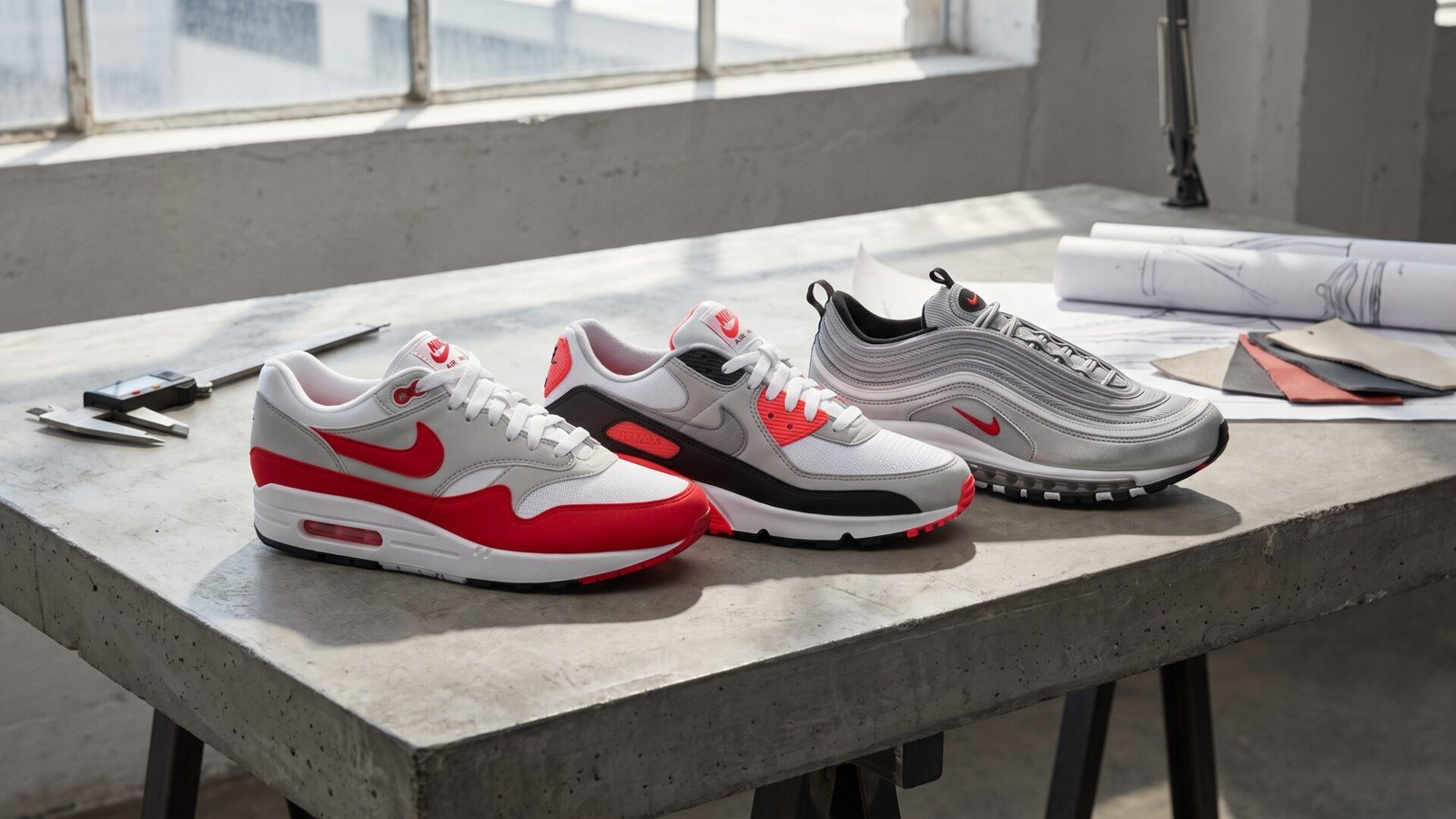
Nike Air Max 1 (1987): The Risk That Changed Everything
When the Nike Air Max 1 debuted in 1987, it was controversial—even within Nike.
Key features:
- First visible Air unit in the heel
- Mesh and suede upper for lightweight performance
- Bold color blocking, especially the iconic red and white colorway
Some executives worried that exposing the Air unit would:
- Make the shoe look unfinished
- Compromise durability
- Confuse consumers
Instead, it did the opposite.
People finally saw the technology. Air Max became tangible, understandable, and exciting.
From Running Shoe to Cultural Object
Originally designed for running, the Air Max 1 quickly moved beyond the track.
Why?
- It was comfortable for everyday wear
- The visible Air unit became a conversation starter
- The design felt futuristic without being aggressive
By the late ’80s and early ’90s, Air Max models were appearing on the streets, not just in races.
This was the beginning of Air Max as a lifestyle icon.
Nike Air Max 90: Sharper, Louder, More Confident
Released in 1990 (originally called the Air Max III), the Air Max 90 refined the formula.
What changed:
- Larger, more emphasized Air window
- Aggressive angles and overlays
- Bolder color accents
The AM90 felt faster and more assertive. It wasn’t just about cushioning anymore—it was about presence.
Over time, the Air Max 90 became:
- A staple in European street culture
- A go-to casual sneaker worldwide
- One of Nike’s most reissued silhouettes
Its balance of comfort and style made it timeless.
Nike Air Max 95: Function Turns Into Art
Then came the shoe that truly broke expectations.
The Nike Air Max 95, designed by Sergio Lozano, took inspiration from:
- Human anatomy (spine, muscles, ribs)
- Trail running aesthetics
Key innovations:
- Visible Air units in both heel and forefoot
- Gradient paneling
- Chunkier, more aggressive stance
This was Air Max as statement footwear.
The AM95 resonated deeply in cities like London and Tokyo, becoming a symbol of underground style, long before sneaker culture was mainstream.
Air Max 97: The Future Goes Full Chrome
If the Air Max 95 was bold, the Air Max 97 was futuristic.
Notable features:
- Full-length visible Air unit
- Reflective piping
- Sleek, wave-like upper design
The silver “Silver Bullet” colorway looked like nothing else on the market at the time. It felt fast, modern, and slightly alien.
Though initially polarizing, the Air Max 97 aged exceptionally well and is now considered one of the most iconic Air Max designs ever.
Air Max in the Late ’90s: Experimentation Era
As the 1990s progressed, Nike leaned into experimentation.
Models like:
- Air Max Plus (TN)
- Air Max 98
- Air Tuned Max
Pushed boundaries in:
- Cushioning systems
- Aggressive aesthetics
- Regional identity
In places like Australia and parts of Europe, Air Max became deeply tied to local youth culture.
This era proved Air Max could adapt to different audiences without losing its core identity.
The 2000s: Lifestyle Takes Over
In the early 2000s, performance running began shifting toward lighter foams and minimalist designs. Air Max, meanwhile, found new life as a lifestyle sneaker.
Nike leaned into:
- Retro releases
- New colorways
- Fashion collaborations
Models like the Air Max 1 and Air Max 90 became everyday staples, worn casually rather than athletically.
Air Max wasn’t about chasing the fastest times anymore—it was about comfort and identity.
Nike Air Max 360 and the Push for Maximum Air
In 2006, Nike introduced the Air Max 360, featuring:
- A full-length Air sole with no traditional foam midsole
- Maximum visibility of cushioning
- A futuristic aesthetic
This marked another technical milestone, showing that Nike was still willing to experiment with Air technology at scale.
While not universally loved for casual wear, the 360 reinforced Air Max as a platform for innovation.
Air Max and Collaborations
As sneaker culture matured, Air Max became a canvas for collaboration.
Over the years, Nike partnered with:
- Designers
- Boutiques
- Artists
- Fashion labels
These collaborations helped reposition Air Max as:
- Collectible
- Fashion-forward
- Culturally relevant
Limited runs and storytelling elevated certain models beyond mass-market status.
Air Max Day and Community Culture
Nike officially recognized Air Max’s cultural impact by launching Air Max Day on March 26th—the anniversary of the Air Max 1.
Air Max Day celebrates:
- Innovation
- Heritage
- Sneaker community
Each year, it reinforces the idea that Air Max isn’t just a product line—it’s a movement.
Modern Air Max: Balancing Heritage and Innovation
Today’s Air Max lineup blends old and new:
- Retro reissues stay close to original designs
- New models experiment with recycled materials and updated cushioning
- Lifestyle-first silhouettes dominate everyday wear
While some purists prefer the classics, the line’s ability to evolve keeps it relevant.
Why Air Max Still Matters
Air Max endures because it sits at a rare intersection:
- Technological storytelling
- Recognizable design
- Cultural flexibility
It works for:
- Long-time collectors
- Casual wearers
- Fashion-focused consumers
Few sneaker lines can say that after nearly four decades.
Air Max as a Design Philosophy
More than anything, Air Max represents a mindset:
- Show the technology
- Take visual risks
- Trust the audience
That philosophy influenced not just Nike, but the entire sneaker industry.
Visible cushioning is now normal. In 1987, it was radical.
The Legacy Moving Forward
As sneaker culture continues to evolve, Air Max remains a reference point.
Every new cushioning system, every bold silhouette, traces some lineage back to that first cutout in the Air Max 1 midsole.
Air Max didn’t just change how sneakers feel—it changed how they look, how they’re marketed, and how they’re remembered.