Designer Sneaker Vault: Gucci, Dior, Balenciaga
Welcome to the Designer Sneaker Vault—your ultimate resource for everything luxury footwear.
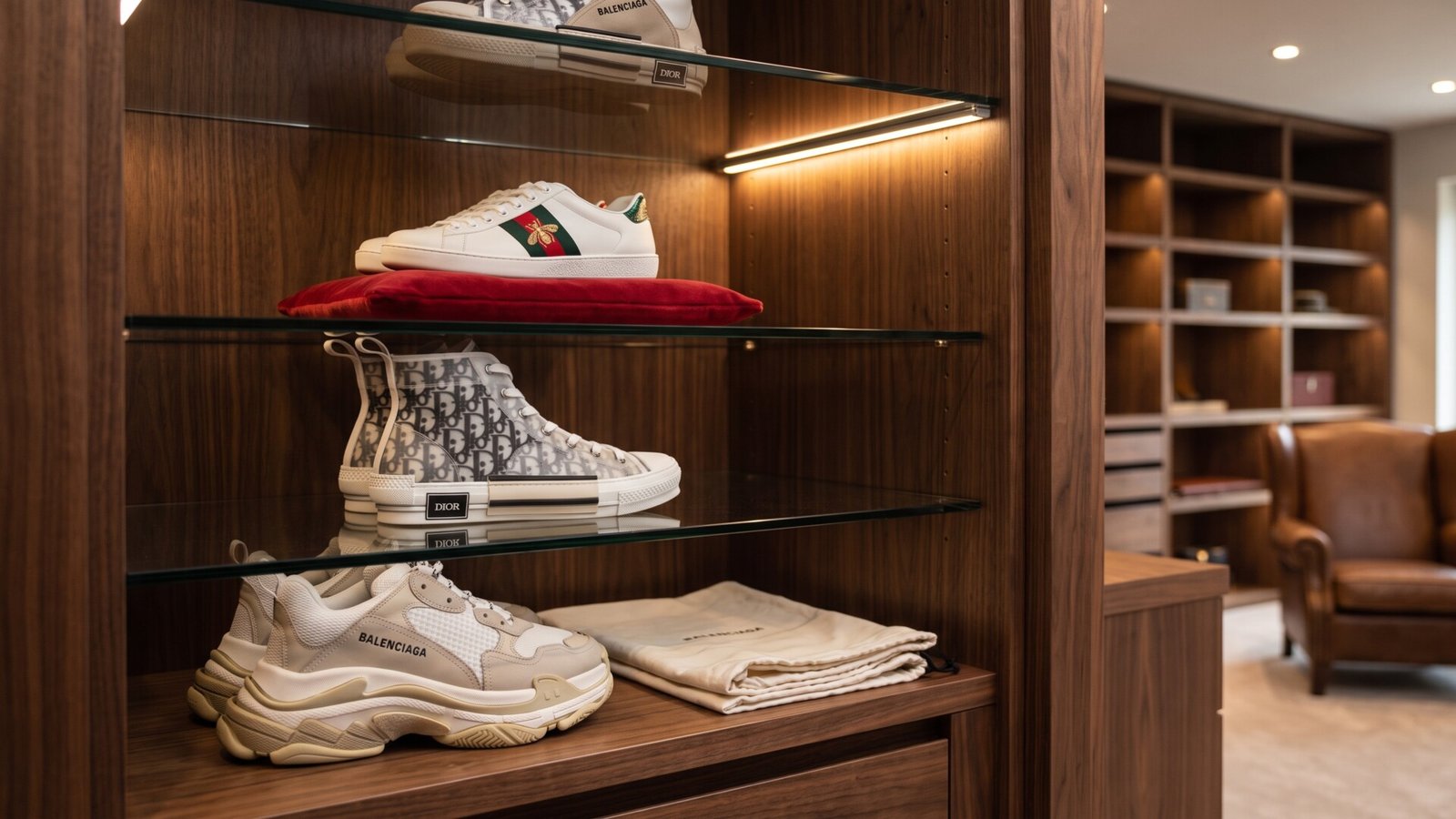
Here at Street Sneakers Vault, we’ve spent years breaking down the culture, the history, and the style moves that matter. But today we’re doing something different. Today we’re building a hub. A central command. A place where you can find everything you need to know about the three biggest names in luxury sneakers: Gucci, Dior, and Balenciaga.
Why these three? Because they represent the holy trinity of designer footwear. Each approaches sneakers differently, yet together they’ve defined what luxury means in the 21st century.
Gucci brings heritage and maximalist storytelling—sneakers that feel like wearable art, loaded with embroidery, patches, and references to a century of fashion history.
Dior represents refined elegance—sneakers that could walk a runway or a red carpet, crafted with the kind of precision that comes from decades of haute couture.
Balenciaga is the disruptor—the brand that made “ugly” beautiful, that pushed proportions to cartoonish extremes, that proved luxury could be street and street could be luxury.
This pillar page is your gateway. Click through to our deep dives on each brand, explore the guides, and level up your luxury game. Let’s get into it.
Why Designer Sneakers Matter
Before we dive into specific brands, let’s talk about why this category exists at all.
There was a time—not that long ago—when luxury and sneakers occupied separate universes. Luxury meant handcrafted leather shoes, polished to a shine, worn with suits and formal wear. Sneakers meant canvas and rubber, worn with jeans, associated with skate parks and basketball courts. The two never mixed.
That time is dead.
The shift started in the 1980s with Run-DMC’s “My Adidas” and Michael Jordan’s partnership with Nike. Sneakers became cultural artifacts, not just athletic equipment. By the 2000s, streetwear brands were collaborating with luxury houses. By the 2010s, the lines had completely disappeared.
Today, designer sneakers are the fastest-growing segment of the luxury market. They’re worn by CEOs and skate kids, celebrities and regular folks. They’re investments, status symbols, and expressions of personal style all rolled into one.
At Street Sneakers Vault, we believe understanding designer sneakers means understanding how culture works in 2026. And that starts with the big three.
Gucci – The Storyteller
The House That Built Modern Luxury
Let’s start with Gucci, because you can’t talk about luxury without talking about the double G.
Founded in Florence in 1921 by Guccio Gucci, the house began as a maker of leather goods and luggage. By the 1950s, Gucci had become synonymous with Italian craftsmanship and Hollywood glamour. Audrey Hepburn, Grace Kelly, Jacqueline Kennedy—they all carried Gucci.
The brand’s codes were established early: the green-red-green Web stripe (inspired by equestrian saddle girths), the horsebit hardware, the GG logo. These elements would appear on bags, loafers, and eventually sneakers.
But Gucci’s sneaker story really begins in 1977 with the Tennis sneaker. Combining canvas and leather, featuring that signature Web stripe prominently on the side, the Tennis was clean, minimalist, and unmistakably Gucci. It sat atop a rubber sole that discreetly concealed embossed double-G logos—early evidence of the logo mania that would define later decades.
In 1984, a new Tennis sneaker debuted for both men and women, timed with Gucci’s first clothing line dedicated to the sport. Tennis was moving from country clubs to mainstream culture, and Gucci was paying attention.
The Alessandro Michele Revolution
When Alessandro Michele took over as creative director in 2015, everything changed. Michele’s Gucci was maximalist, eclectic, romantic, and weird in the best way. He layered patterns, mixed eras, and turned the brand into a cultural phenomenon.
In 2016, he introduced the Ace sneaker. Based on that 1977 Tennis silhouette, the Ace featured white leather, the green-red-green Web stripe, and contrasting heel tabs—one red, one green. Clean, simple, instantly recognizable.
But Michele didn’t stop there. He understood the Ace could be a canvas for the kind of storytelling that defined his Gucci. Soon, the Aces started showing up with embroidered patches: bees, snakes, tigers, flowers, dragons. Each motif referenced some part of Gucci’s archive or Michele’s personal mythology. The bee, for example, had first appeared in Gucci ready-to-wear in the 1970s.
Suddenly, the Ace wasn’t just a sneaker. It was a collectible. A statement piece. A way to participate in Michele’s vision without going full head-to-toe patterned suit.
Gucci Collaborations and Special Editions
Michele treated the Ace like a blank canvas and invited artists, characters, and cultural icons to paint on it.
Unskilled Worker (2017) – Helen Downie’s whimsical portraits printed directly on Ace leather. Limited, exclusive, instantly sold out.
Disney – Mickey Mouse, Donald Duck, and the nephews in various poses, tapping into nostalgia and whimsy.
Doraemon (2020) – The beloved Japanese anime character, a massive hit in Asia and beyond.
FIFA – World Cup-themed embroidery for soccer fans.
MLB – New York Yankees and Los Angeles Dodgers logos for baseball collectors.
Beyond collaborations, Gucci released glitter Aces, embroidered Aces, GG canvas versions, platform Aces, and endless seasonal colorways. Each kept the silhouette fresh while maintaining the core design.
The Ace in 2026
Michele departed Gucci in 2022. After an interim period, Sabato De Sarno took over as creative director. His vision is different—more streamlined, more minimal, more focused on tailoring.
But the Ace endures. In 2024, Gucci introduced the Ace 2.0 Low, featuring recycled calfskin, biodegradable EVA midsole, and laser-etched GG motif. At $795, it’s the best-selling men’s sneaker in Gucci’s lineup, with 103% price retention on secondary markets after six months.
Why does the Ace endure? According to market analysis, it leads sales “not because it’s flashy—but because it solves real problems: durability without weight, polish without stiffness, and versatility across contexts (office, dinner, weekend)”.
Gucci Fit and Sizing
The Ace generally runs large. Most sources recommend sizing down by at least half a size. The Ace 2.0 has a narrower forefoot, so it’s true-to-size for medium-width feet but may be snug for wide feet.
Gucci Authentication Guide
When authenticating Gucci sneakers, check:
- Web stripe – Green-red-green should be perfectly inset, colors consistent, no glue visible
- Heel tabs – One red, one green—a signature detail
- Embossing – Script logo on heel should be crisp and clear
- Insole – GG logo properly aligned, no smudging
- Stitching – 12-14 stitches per inch on visible seams
- Leather grain – Natural variation, not uniform embossing
- Box and packaging – Quality materials, correct labeling
Dior – The Elegant Innovator
A Legacy of Refinement
Dior’s story begins in 1946, when Christian Dior founded his house in Paris with backing from textile magnate Marcel Boussac. The timing was perfect—post-war Paris was ready for glamour, and Dior delivered.
His 1947 “New Look” collection revolutionized women’s fashion with its cinched waists, full skirts, and luxurious fabrics. Dior became synonymous with elegance, sophistication, and French craftsmanship. The house’s codes—cannage (the cane-pattern stitching inspired by Napoleon III chairs), the lily of the valley, the CD logo—were established early and endure today.
But Dior’s sneaker story is much more recent. For decades, the house focused on dress shoes, boots, and sandals for its couture clientele. Sneakers were beneath Dior—until the market shifted.
The B23 and B30 Eras
Under creative director Kim Jones (menswear) and Maria Grazia Chiuri (womenswear), Dior embraced sneakers in a serious way.
The B23 was a watershed moment. Released in 2020, it featured the house’s signature Dior Oblique canvas—the monogram pattern created by Marc Bohan in 1967. The silhouette was a high-top sneaker with a translucent sole, available in both low and high versions. It was sporty but unmistakably Dior, blending streetwear energy with maison craftsmanship.
The B30 followed, a runner-inspired silhouette with technical mesh and leather panels, often featuring the CD logo on the side. Sleeker than the B23, it appealed to the “gorpcore” crowd while maintaining Dior’s elegance.
The Dior x Jordan Brand Collaboration
In 2020, Dior announced something that shocked the fashion world: a collaboration with Jordan Brand.
The Dior x Air Jordan 1 was the ultimate symbol of luxury meeting streetwear. The most famous sneaker silhouette of all time, reinterpreted by one of the most prestigious fashion houses in the world.
The shoe featured premium Italian leather, Dior’s Oblique monogram on the swoosh, “Air Dior” branding on the tongue, and the Wings logo stamped with “Dior” instead of the usual “Air Jordan”. Only 8,500 pairs were produced, priced at $2,000 retail. Resale prices quickly climbed to $10,000+.
This collaboration proved that the boundaries between luxury and streetwear were completely erased. Jordan Brand—the epitome of basketball culture—was now partnering with Dior—the epitome of Parisian elegance. Nothing would ever be the same.
B33 and B35 – The 2026 Landscape
In 2024, Dior introduced the B33 sneaker, an evolution of the runner silhouette with even more technical elements. The B33 features layered mesh and leather construction, reflective details, and the CD logo in various placements. It’s lighter than the B30 and more versatile for daily wear.
The B35, released in 2025, takes the runner concept further with chunkier proportions and more aggressive sole units. It’s Dior’s answer to the chunky trainer trend, executed with the house’s signature refinement.
Both models maintain the Dior Oblique canvas option, ensuring brand recognition while pushing the design forward.
Dior Pricing and Market Position
Dior sneakers typically range from $850 to $1,500 depending on materials and complexity. The B23 starts around $950, while limited collaborations can exceed $2,000.
The secondary market for Dior sneakers is strong but not as volatile as Balenciaga’s. Standard colorways often depreciate slightly, while limited collaborations and Oblique canvas versions hold value well.
Dior Authentication Guide
When authenticating Dior sneakers, check:
- Oblique canvas – The monogram pattern should be perfectly aligned, colors consistent
- CD logo – Clean, crisp, properly positioned
- Stitching – Flawless, even, no loose threads
- Materials – Premium leather and mesh, no plasticky feel
- Insole – Proper branding, often with “Dior” embossed
- Box and packaging – High-quality, includes dust bag and authenticity card
- Size tag – Correct font, format matches release era
Balenciaga – The Disruptor
From Couture to Street
Balenciaga’s story begins in 1919, when Cristóbal Balenciaga founded his house in Spain. The designer quickly established himself as a master of form, developing revolutionary silhouettes—the cocoon coat, the sack dress, the balloon minidress—that ignored the waist in an era when the hourglass dominated fashion.
Christian Dior called him “the master of us all.” Coco Chanel said he was “the only true couturier among us.” His influence was immense.
When Cristóbal retired in 1968, he chose to close his house rather than dilute his legacy. Balenciaga lay dormant until 1986, when it was revived under new ownership. The house was acquired by Kering in 2001, joining Gucci, YSL, and other luxury brands.
The Demna Gvasalia Era (2015–2025)
The arrival of Demna Gvasalia as creative director in 2015 changed everything. Demna brought a background co-founding the subversive collective Vetements, and his approach was fundamentally different from anything luxury fashion had seen.
Demna described his method as “destruct to create”—deconstructing familiar objects and reassembling them into something new. He was fascinated by the mundane, the ordinary, the things people actually wore. Sportswear, utility wear, and athletic footwear became his primary references.
Speed Trainer (2016–2017) – The first shot across the bow. A sock-like knit upper mounted on a memory foam sole, priced at $795. It looked like nothing else in luxury—minimalist, technical, almost alien. It sold out everywhere.
Triple S (2017) – The game-changer. A stacked sole unit constructed from three different athletic shoe treads—running, basketball, track and field. The upper assembled from 68 individual pieces, distressed to look worn and lived-in. At $795, it was expensive, aggressive, and undeniably influential. It launched the “dad shoe” trend and proved luxury could be ugly and beautiful simultaneously.
Track (2018) – Trail running aesthetics with complex upper construction, released in ultra-limited quantities.
X-Pander and Defender – Spring-loaded suspension elements, bulbous tire-tread soles—pushing proportions to extremes.
3XL Runner – Distressed finishes, mesh paneling, reflective details, priced around $1,500.
Monday and Hampton (2025) – Demna’s farewell. Monday looked back to 1990s running shoes with full-grain leather and visible stitching ($995). Hampton offered true minimalism with clean lines and flexible leather ($890).
The Pierpaolo Piccioli Era (2026–Present)
In late 2025, Demna departed Balenciaga for Gucci, leaving behind a legacy that would be difficult to match. His successor, Pierpaolo Piccioli, formerly of Valentino, faced the task of evolving Balenciaga’s sneaker language without abandoning its foundation.
Triple S.2 (2026) – The first major release under Piccioli. Retains the stacked, splayed outsole but streamlines the overall silhouette. Enhanced mesh panels add breathability. New colorways drop regularly. Pre-orders began February 2026, with full retail in March.
Manolo Blahnik Collaboration (2026) – A surprising partnership focusing on evening wear, not sneakers—signaling Piccioli’s interest in couture heritage while maintaining luxury credibility.
Balenciaga Pricing and Market
Balenciaga sneakers range from $500 (Speed basics) to $1,500+ (limited editions). The Triple S.2 retails around $1,100. Secondary market values vary—some colorways appreciate, others settle below retail.
The 3XL Runner, for example, trades between $1,190 and $2,843 on secondary markets, with current average around $1,516.
Balenciaga Authentication Guide
When authenticating Balenciaga sneakers, check:
- Size label font – Number “4” thickness, character shapes
- Inner tag – Font styles for letters like “G,” “R,” and numbers
- Insole logo – Material texture, paint quality, font style
- Tongue profile – Sharp, defined corners on authentic models
- Heel logo – Font style and frame shape
- Midsole stitching – Authentic has specific stitching patterns
- Weight – Authentic pairs feel substantial, not light
- Box and packaging – Quality materials, correct labeling
Comparing the Big Three
Design Philosophy
Gucci tells stories. Every embroidered patch, every collaboration, every limited edition adds to a narrative that spans nearly a century. Wearing Gucci means participating in that story.
Dior embodies elegance. Even the most technical runners maintain a refinement that screams Parisian luxury. Wearing Dior means appreciating craftsmanship.
Balenciaga disrupts expectations. The shoes challenge what luxury should look like. Wearing Balenciaga means making a statement.
Price Ranges
| Brand | Entry Level | Core Range | Limited Editions |
|---|---|---|---|
| Gucci | $500–$700 | $700–$1,000 | $1,000–$2,500+ |
| Dior | $850–$950 | $950–$1,200 | $1,500–$10,000+ |
| Balenciaga | $500–$700 | $700–$1,200 | $1,200–$3,000+ |
Investment Potential
- Gucci Ace – 103% price retention after six months for Ace 2.0
- Dior x Jordan 1 – 500%+ appreciation
- Balenciaga Triple S – Strong but varies by colorway
Versatility
- Gucci Ace – Works with almost everything, from jeans to tailored trousers
- Dior B23 – Statement piece, requires intentional styling
- Balenciaga Triple S – Bold, anchors streetwear looks
How to Start Your Designer Collection
Entry Points
If you’re new to designer sneakers, start with versatility:
Gucci Ace – Clean white leather, minimal embroidery, around $700–$800. Works with everything, holds value, instantly recognizable.
Balenciaga Speed Trainer – Sock-like comfort, minimal branding, around $500–$600. Lightweight, easy to wear, less intimidating than chunky models.
Dior B23 (low) – Oblique canvas, clean silhouette, around $950. Statement piece that’s still wearable.
Building Your Rotation
Once you have a foundation, add variety:
- One clean white leather pair (Gucci Ace, Common Projects)
- One technical runner (Balenciaga 3XL, Dior B30)
- One statement collaboration (Dior x Jordan, Gucci x Disney)
- One experimental silhouette (Triple S, B35)
Budget Strategy
- Set monthly or quarterly limits
- Watch seasonal sales (January, July)
- Check pre-owned platforms regularly
- Use price tracking tools
- Consider past-season colorways
Maintenance Essentials
- Store in dust bags, away from sunlight
- Use shoe trees to maintain shape
- Clean regularly with appropriate products
- Rotate pairs to extend life
- Condition leather every 6–8 weeks
The Future of Designer Sneakers
Sustainability
All three brands are investing heavily in sustainable materials and production. Gucci’s Ace 2.0 features recycled calfskin and biodegradable midsoles. Balenciaga has incorporated recycled materials across multiple lines. Dior’s commitment to ethical sourcing continues to evolve.
Digital Integration
NFTs, digital sneakers, metaverse activations—luxury brands are exploring every corner of digital culture. Expect more releases with digital twins, AR try-ons, and blockchain authentication.
The Next Generation
With Demna at Gucci and Piccioli at Balenciaga, the creative landscape has shifted. New voices bring new perspectives. The next five years will bring innovations we can’t yet imagine.
Enduring Value
Despite all the change, one thing remains constant: the appeal of well-made, beautifully designed sneakers. Gucci, Dior, and Balenciaga have spent decades—in some cases, a century—perfecting their craft. That’s not going anywhere.
Your Designer Journey Starts Here
Look, the world of designer sneakers can feel intimidating. The prices are high. The terminology is confusing. The fear of buying fakes is real.
But here’s the thing: every collector started somewhere. Every person with a wall of grails once bought their first pair and wondered if they were making a mistake.
The key is knowledge. Understanding what you’re buying, why it costs what it costs, and how to tell real from fake. That’s what Street Sneakers Vault is here for.
Use this pillar page as your home base. Bookmark it. Come back when you need a refresher. Click through to the deep dives and guides. And remember: collecting is a journey, not a destination.
Whether you’re saving for your first pair of Aces or adding your tenth Triple S to the rotation, you’re part of something bigger—a community of people who appreciate craftsmanship, design, and the stories shoes can tell.
Welcome to the Designer Sneaker Vault. Now go explore.