Streetwear Sneakers: Essential Pairs for Every Wardrobe
Today we’re talking about something fundamental—the essential sneakers that belong in every streetwear rotation.
Look, we all love the crazy limited releases. The collaborations that require camping out for days. The designer pairs that cost a month’s rent. But here’s the thing: those aren’t the shoes you wear every day. They’re not the foundation of your wardrobe. They’re the sprinkles on top.
Every great streetwear collection needs a core. A group of sneakers that work with almost everything, that you can grab without thinking, that hold up to daily wear and still look fresh. These are the essentials—the pairs that never go out of style, that transcend trends, that form the backbone of personal style.
At Street Sneakers Vault, we believe building a wardrobe is about strategy, not just accumulation. This guide breaks down the essential sneakers every streetwear rotation needs, why they matter, and how to wear them.
Let’s get into it.
The Philosophy of Essentialism
Before we start naming shoes, let’s talk about why this approach matters.
Quality Over Quantity
The rise of “slow fashion” and mindful consumption has changed how people think about their wardrobes. Instead of chasing every drop, more collectors are focusing on quality over quantity, investing in pieces that will last for years.
A well-curated collection of essential sneakers serves multiple purposes. They’re your daily drivers. They work with any outfit. They’re comfortable enough for all-day wear. And because they’re classics, they never look dated.
The Cost-Per-Wear Calculation
Here’s a simple way to think about value: cost per wear. A $200 pair of sneakers worn 200 times costs you $1 per wear. A $100 pair worn ten times costs $10 per wear. The more you wear a shoe, the better value it becomes.
Essential sneakers are the ones you’ll wear most often. That makes them the best value in your collection, regardless of their price tag.
The Building Blocks
Think of your sneaker collection like a toolbox. You need certain basics—a hammer, screwdrivers, a wrench—before you add specialized tools. The same applies here. Start with the essentials, then build out from there.
The Clean White Leather Sneaker
Every streetwear wardrobe needs a pristine white leather sneaker. It’s non-negotiable.
Why It’s Essential
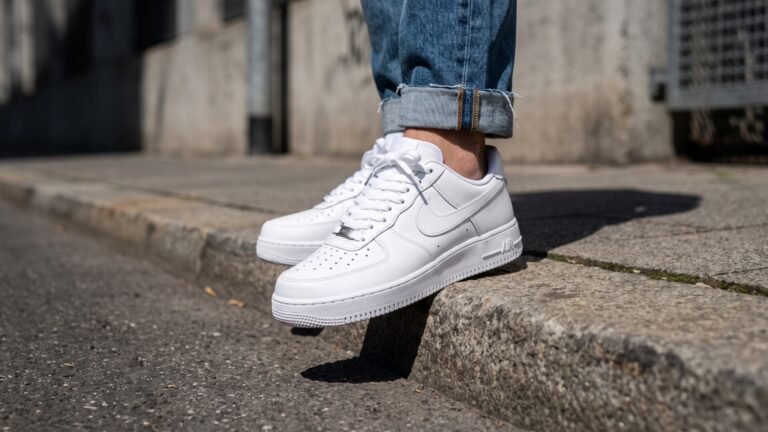
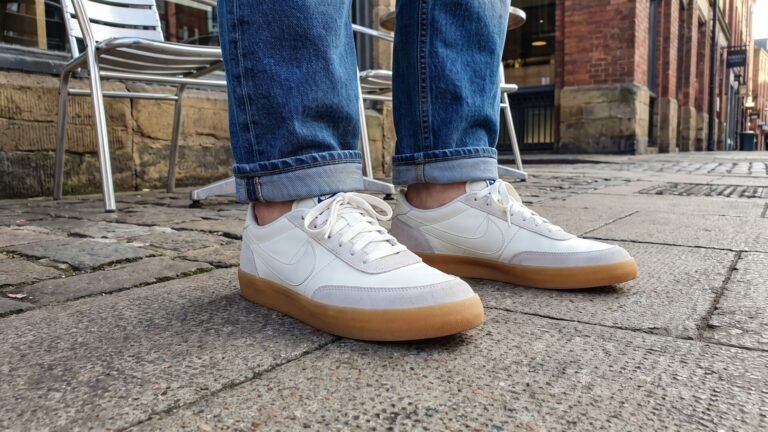
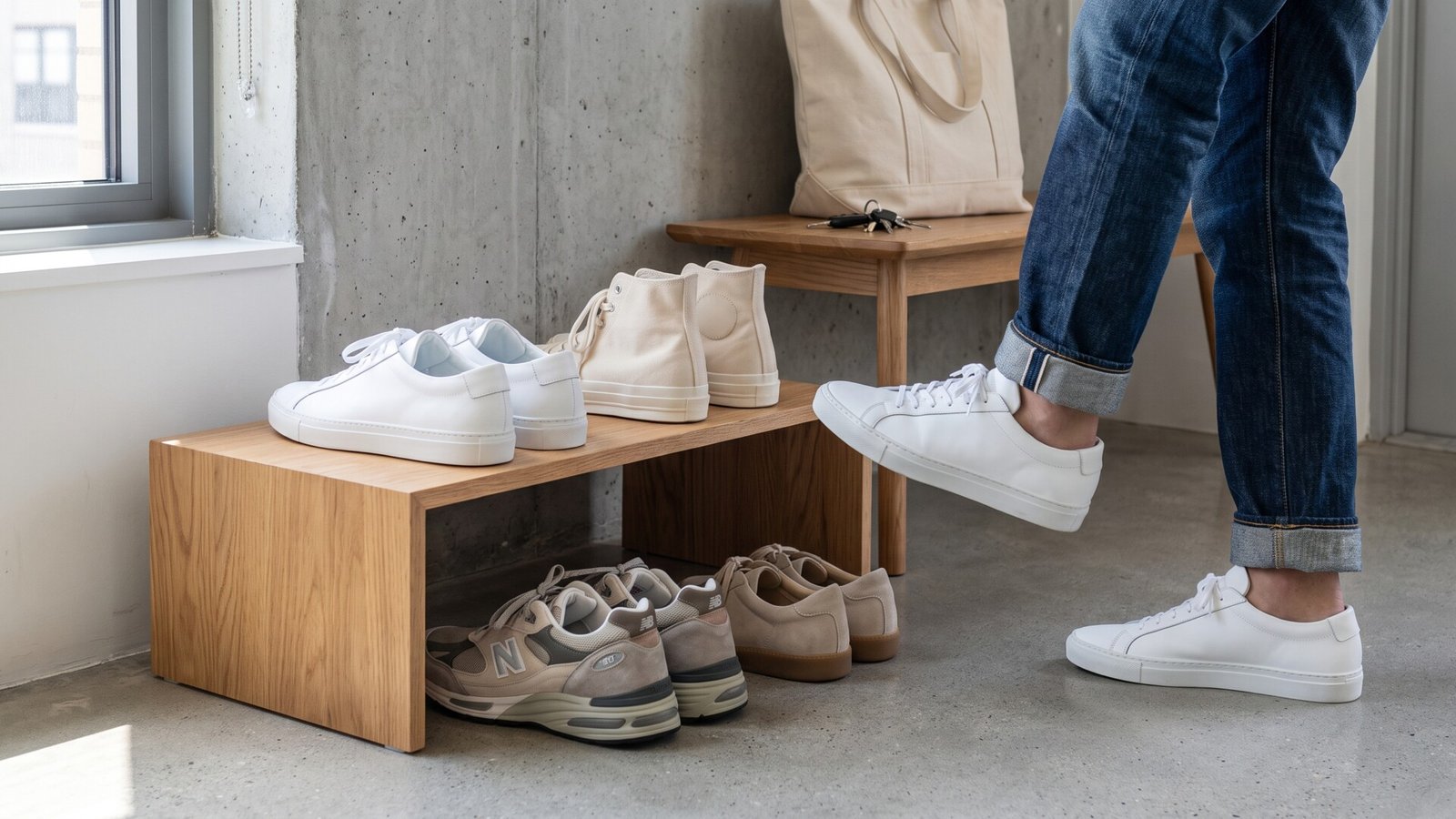
White sneakers are the ultimate blank canvas. They work with jeans, joggers, shorts, tailored trousers, even suits. They brighten any outfit and add a touch of clean sophistication to streetwear looks.
According to stylists, white sneakers should be the foundation of any sneaker collection. They’re the pair you reach for when nothing else seems right.
The Gold Standard: Common Projects Achilles Low
If budget allows, the Common Projects Achilles Low is the king of this category. Italian leather, minimalist design, that iconic gold number stamp. Retailing around $400, they’re not cheap—but they’re built to last for years.
The leather develops a beautiful patina over time, and the simple design means they never look dated. Cost-per-wear, they’re actually excellent value.
The Affordable Alternatives
Not everyone can drop $400 on sneakers. Fortunately, the market is full of excellent alternatives:
Greats Royale – Made in Italy, same minimalist aesthetic, around $179. Often on sale for under $150. The closest you’ll get to Common Projects without the price tag.
Koio Capri – Another Italian-made option, around $248. Catch them on sale and you’re golden.
Adidas Stan Smith – The OG tennis shoe, now a streetwear staple. Clean, simple, around $80-100. The perforated three-stripes are subtle but recognizable.
Veja V-10 – Sustainable, understated elegance. Organic cotton and chrome-free leather, around $170. The “V” logo adds just enough detail.
Nike Court Vision – Retro basketball vibes, clean leather, around $75-90. A budget option that doesn’t look cheap.
How to Wear
White leather sneakers work with literally everything. Jeans and a white t-shirt. Black joggers and an oversized hoodie. Tailored trousers and a button-down. Shorts in summer. They’re the ultimate versatile piece.
Maintenance Note
White sneakers require care. Clean them regularly with appropriate products. Use shoe trees to maintain shape. And accept that they’ll get scuffed—that’s part of the charm. Check our Cleaning White Sneakers: Step-by-Step Guide for an in depth dive.
The Classic Black Sneaker
If white is the day shoe, black is the night shoe. Every rotation needs both.
Why It’s Essential
Black sneakers serve a different purpose than white. They’re edgier, more urban, more versatile for darker outfits. They hide dirt better, making them ideal for travel or rainy days. And they pair perfectly with black jeans—the streetwear uniform.
The Icon: Vans Old Skool
The Vans Old Skool in black with white sidestripe is arguably the most essential streetwear sneaker of all time. Released in 1977, it was the first Vans shoe to feature the now-iconic sidestripe.
The combination of suede and canvas, the vulcanized construction, that waffle outsole—it’s simple, durable, and unmistakable. At around $80, it’s accessible to everyone.
The Old Skool has transcended its skate origins to become a cultural icon. Punks wore them. Hip-hop heads wore them. Fashion editors wear them. They work because they don’t try too hard.
The Alternative: Converse Chuck Taylor All Star
The Chuck Taylor in black is another essential. Canvas upper, rubber toe cap, simple silhouette—it’s been around since 1917 and never goes out of style. Low-top or high-top, depending on your preference.
At $60-75, they’re even more affordable than Vans. And they carry over a century of cultural history.
The Elevated Option: Axel Arigato Clean 90
For something a step up, Axel Arigato’s Clean 90 in black offers premium materials and Scandinavian minimalism. Around $250, they’re the midpoint between Vans and designer options.
How to Wear
Black sneakers are for monochrome fits. Black jeans, black hoodie, black Old Skools—clean and timeless. They also work with darker denim, cargo pants, and anything with an edge.
The Retro Runner
The running shoe revival has been one of the biggest stories in streetwear over the past decade. Every rotation needs at least one retro runner.
Why It’s Essential
Retro runners offer comfort that lifestyle sneakers can’t match. They’re built for movement, with cushioning technology that actually works. And their dad-shoe aesthetic has become a cornerstone of modern streetwear.
The King: New Balance 990 Series
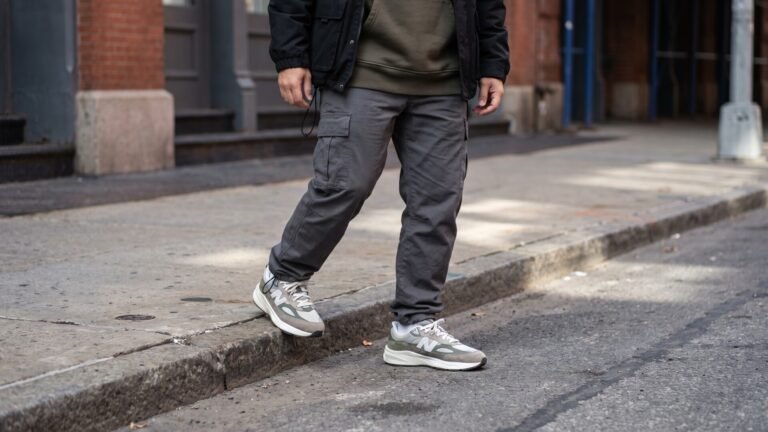
The New Balance 990 is the undisputed king of retro runners. First released in 1982 as the most expensive running shoe on the market ($100, which was crazy at the time), it set new standards for quality and performance.
The 990v6, released in 2023, continues the legacy with updated materials and ENCAP cushioning. Made in the USA (one of the few sneakers still manufactured domestically), it represents the pinnacle of New Balance craftsmanship.
At $200-220, they’re an investment—but one that pays off in comfort and durability.
The Icon: New Balance 574
If the 990 is the flagship, the 574 is the people’s champion. Launched in 1988, it combined rugged off-road aesthetics with on-road versatility. It’s been in continuous production ever since.
At around $100, the 574 offers incredible value. It’s comfortable, durable, and available in endless colorways. The grey “Classic” is the essential choice.
The Alternative: Asics Gel-Lyte III
The Gel-Lyte III, released in 1990, introduced the split-tongue design that made it famous. It’s been a staple of the running shoe revival, with countless collaborations over the years.
Around $120-150 for standard colorways, with collaborations ranging higher.
The Fashion Pick: Saucony Shadow 6000
Saucony’s Shadow 6000, released in 1991, has become a favorite among collectors for its chunky silhouette and premium materials. Collaborations with Bodega and other streetwear staples have cemented its status.
How to Wear
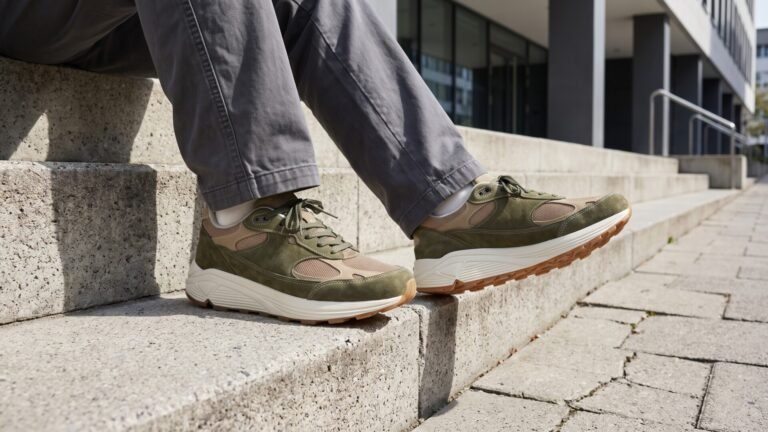
Retro runners work with wide-leg pants, cropped trousers that show off the shoe, and anything casual. They’re the anchor for gorpcore looks and add visual interest to simple outfits.
The Skate Shoe
Skate shoes have been streetwear staples since the beginning. Every rotation needs at least one pair with true skate heritage.
Why It’s Essential
Skate shoes bring authenticity to streetwear. They’re not fashion products pretending to be something else—they’re actual functional footwear designed for a specific purpose. That authenticity matters.
The Icon: Vans Old Skool
We mentioned the Old Skool earlier, but it deserves another mention here. It’s both a classic black sneaker AND a skate icon. That versatility is rare.
The Classic: Nike SB Dunk
The Nike SB Dunk has one of the craziest stories in sneaker history. Originally a 1985 basketball shoe, it was revived in 2002 for skateboarding with added Zoom Air and a padded tongue.
The SB Dunk has produced some of the most legendary collaborations ever—Supreme, Diamond Supply Co., Concepts, Travis Scott. But general release colorways are accessible and just as skateable.
Prices range from $120 retail to thousands for rare collaborations.
The Underrated: Adidas Busenitz
Designed with legendary skater Dennis Busenitz, the Busenitz Pro combines classic Adidas aesthetics with modern skate tech. The cupsole construction offers durability and board feel.
Around $90-100, it’s an affordable entry point to premium skate footwear.
The OG: Converse Chuck Taylor All Star
The Chuck Taylor has been skated since the 1960s. While not technically advanced by modern standards, its heritage is undeniable. The CONS line adds modern cushioning while keeping the classic look.
How to Wear
Skate shoes pair perfectly with baggy jeans, cargo pants, and the whole skate-adjacent aesthetic. They’re casual by nature, so don’t try to dress them up too much.
The Statement Sneaker
Every rotation needs at least one pair that makes people look. Something bold, colorful, or unexpected.
Why It’s Essential
Statement sneakers add personality to your collection. They’re for days when you want to stand out, when subtle won’t cut it, when your shoes should start conversations.
The Guidelines
When choosing a statement pair, consider:
- Versatility within boldness – Can you wear it with multiple outfits?
- Quality of materials – Statement doesn’t mean disposable
- Personal connection – Does it mean something to you?
The Options
New Balance 990 in a bold color – Grey is classic, but purple or teal? Statement.
Asics Gel-Lyte III collaborations – Artists like Kiko Kostadinov have created wild, collectible versions.
Adidas Samba with a twist – Wales Bonner collaborations in earthy tones or metallic finishes.
Nike Air Max 1 – The visible Air bubble and endless colorways make this a statement classic.
Anything from a favorite collaboration – If you love the story, wear it proudly.
How to Wear
Let the shoes be the focus. Keep the rest of your outfit simple—black, white, neutral tones. The statement should come from your feet, not your whole look.
The Modern Minimalist
Not all streetwear is loud. The minimalist movement has produced some of the most elegant sneakers in recent years.
Why It’s Essential
Minimalist sneakers offer sophistication without sacrificing comfort. They bridge the gap between streetwear and tailored clothing, making them incredibly versatile.
The Standard: Axel Arigato
Swedish brand Axel Arigato has built its reputation on minimalist designs with premium materials. The Clean 90 and Clean 90 Mesh are modern classics, priced around $250.
The Innovator: Hoka
Hoka’s maximalist cushioning meets minimalist aesthetics in shoes like the Transport. Designed for city commuters, they combine technical performance with clean design. Around $170.
The Sustainable Choice: Veja
Veja’s minimalist silhouettes use sustainable materials and ethical production. The Campo and V-10 are favorites among conscious consumers. $150-200.
How to Wear
Minimalist sneakers work with everything, but they shine with clean, simple outfits. Think monochrome, quality fabrics, intentional styling.
Building Your Rotation
Now that you know the categories, let’s talk about actually building your collection.
The Starter Rotation (Under $400)
- Clean white leather: Adidas Stan Smith ($80) or Veja V-10 ($170)
- Classic black: Vans Old Skool ($80)
- Retro runner: New Balance 574 ($100)
- Total: $260-350, four essential pairs
The Intermediate Rotation ($800-1,200)
- Premium white: Greats Royale ($150) or Koio Capri ($250)
- Classic black: Vans Old Skool ($80)
- Retro runner: New Balance 990v6 ($220)
- Skate shoe: Nike SB Dunk ($120)
- Statement: New Balance 574 in bold color ($100) or collaboration piece
- Total: $670-870, five pairs with upgraded quality
The Advanced Rotation ($2,000+)
- Luxury white: Common Projects Achilles Low ($400)
- Classic black: Vans Vault Old Skool ($120)
- Retro runner: New Balance 990v6 Made in USA ($220)
- Skate shoe: Limited SB Dunk collaboration ($300-500)
- Statement: Designer collaboration or rare release
- Minimalist: Axel Arigato Clean 90 ($250)
- Total: $1,500+, six premium pairs
The Real-World Example
Remember Sarah from our luxury collecting guide? She built a versatile rotation for under $800:
- Common Projects Achilles Lows (pre-owned) – $240
- Veja V-10s (sale) – $119
- ALD x New Balance 550 (cashback deal) – $185
- Camper Lab slides – $220
That’s four distinct categories for less than the retail price of one designer pair.
Maintenance and Longevity
Essential sneakers get worn most, so they need the most care.
Daily Care
- Wipe down after each wear
- Use shoe trees to maintain shape
- Rotate pairs—don’t wear the same shoes two days in a row
Cleaning Schedule
- Deep clean every 3-4 months
- Condition leather every 6-8 weeks
- Replace insoles when worn
Storage
- Keep in dust bags or original boxes
- Store away from direct sunlight
- Use silica gel packs in humid environments
When to Retire
Even essential sneakers have lifespans. When the sole is worn smooth, the upper has holes, or they’re no longer comfortable—it’s time. But with proper care, quality sneakers can last years.
The Bottom Line
Look, the sneaker world is overwhelming. Thousands of releases every year. Endless collaborations. Hype cycles that move faster than ever. It’s easy to get caught up in the chase, to feel like you’re missing out if you don’t have the latest drop.
But here’s the truth: the best collections aren’t the biggest. They’re the most thoughtful. The most personal. The most worn.
A rotation of essential sneakers—worn often, cared for properly, loved deeply—will always beat a wall of unworn hype pairs. Because sneakers are meant to be worn. They’re meant to move with you, to collect memories, to become part of your story.
Start with the essentials. Build from there. And remember: style isn’t about what you have. It’s about how you wear it.