Puma Sneakers: The Bold Cat That Keeps Reinventing Itself
We’re diving deep into a brand that’s been making noise for over seven decades—Puma.
Look, when you talk about sneaker culture, the conversation usually starts with the big names. But Puma has quietly built one of the most impressive catalogs in the game. We’re talking about a brand that dressed Pelé and Maradona, that put sneakers on the feet of New York breakdancers in the ’80s, that teamed up with Rihanna to create one of the most iconic women’s sneakers of the 2010s, and that’s now dominating the performance running space with cutting-edge nitrogen-infused foam.
The Puma story is wild. It starts with a brotherly feud that split a small German town in half. It involves Olympic protests that changed history. And it continues today with some of the most innovative footwear technology on the market.
At Street Sneakers Vault, we believe in giving credit where it’s due. And Puma is due a whole lot. So let’s break it down—the history, the icons, the technology, and where Puma stands in 2026.
The Dassler Brothers – A Feud That Changed the World
The Beginning in Herzogenaurach
To understand Puma, you have to understand the story of Rudolf Dassler and his brother Adolf. It’s one of the most legendary tales in athletic history—a sibling rivalry that split a town and created two of the biggest sportswear brands on the planet.
The story starts in 1919, when Rudolf and Adolf Dassler started a shoe factory in their parents’ home in Herzogenaurach, Germany. By 1924, they had moved into a proper facility and their products were gaining recognition. At the 1928 Summer Olympics in Amsterdam, the majority of German athletes wore “Gebrüder Dassler” spikes.
Then came 1936. Jesse Owens won four gold medals at the Berlin Olympics wearing Dassler spikes. Seven gold and five bronze medals followed for other athletes. Two world records and five Olympic records were broken in Dassler shoes. The brothers had arrived.
The Split
But World War II changed everything. The relationship between the brothers deteriorated, and by 1948, they had gone their separate ways. Rudolf moved into another building belonging to the family and, with 14 employees, founded his own company—the “Schuhfabrik Rudolf Dassler (RUDA)”.
The company was registered as a business in January 1948. Operations commenced on June 1, 1948. On October 1, 1948, the PUMA brand was born and registered at the German Patent and Trademark Office. By December, Rudolf announced the name “PUMA Schuhfabrik Rudolf Dassler.”
Meanwhile, Adolf—known as Adi—founded his own company: Adidas. The two brands would become global rivals, and Herzogenaurach became known as “the town of bent necks”—because residents would look down at your shoes before deciding whether to talk to you.
The Formstrip and Early Innovation (1950s-1960s)
The Atom and Super Atom
Puma’s first major success came in 1950 with the ATOM football boot. But it was the 1952 SUPER ATOM that really caused a stir. Rudolf Dassler collaborated with experts, including West Germany’s national coach Sepp Herberger, to develop the world’s first boot with screw-in studs. This marked the beginning of Puma’s legendary football heritage.
The Formstrip
In 1958, Puma patented its second brand logo: the FORMSTRIP. Originally created to stabilize the foot inside the shoe, it would become the Puma trademark found on almost all of the brand’s footwear. It was also used as a design element on apparel products. Thanks to emerging media, the FORMSTRIP became visible all over the world.
Olympic Glory
The 1960s were huge for Puma. At the 1960 Rome Olympics, West Germany’s Armin Hary won gold in the 100m wearing Puma. Ethiopian legend Abebe Bikila won his second gold medal at the 1964 Tokyo Olympics—this time in Puma shoes, after running barefoot in 1960. Belgium’s Gaston Roelants won gold in the 3,000m steeplechase, and England’s Mary Rand won long jump gold while breaking the world record.
The Icons Are Born (1966-1973)
The KING (1966)
At the 1966 World Cup in England, Portuguese striker and Ballon d’Or winner Eusébio was named top scorer while wearing Puma football boots. Honoring this accomplishment, Puma introduced the legendary PUMA KING football boot in 1966.
The KING featured a leather upper and nylon sole construction, making it lightweight and comfortable. It became a favorite among the best goal scorers and playmakers—Pelé, Cruyff, Maradona, Matthäus—and has since transcended the pitch into the lifestyle realm with revived styles from Jil Sander, Alexander McQueen, Rhude, and more.
The Suede (1968)
Introduced at the 1968 Mexico Olympics, the silhouette was initially named Crack. But it was a moment of protest that made it legendary.
On October 16, 1968, American sprinter Tommie Smith won gold in the 200m sprint. As the national anthem played during his medal ceremony, Smith and bronze medalist John Carlos raised their fists wearing black gloves—a silent gesture protesting discrimination against African-Americans and other minorities. Both men wore Puma suede shoes.
That image would become one of the most iconic in Olympic history. And the shoe would become one of the most iconic in sneaker history.
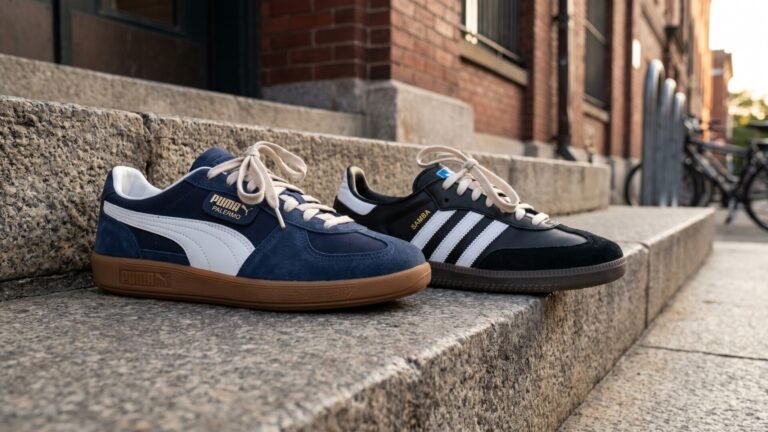
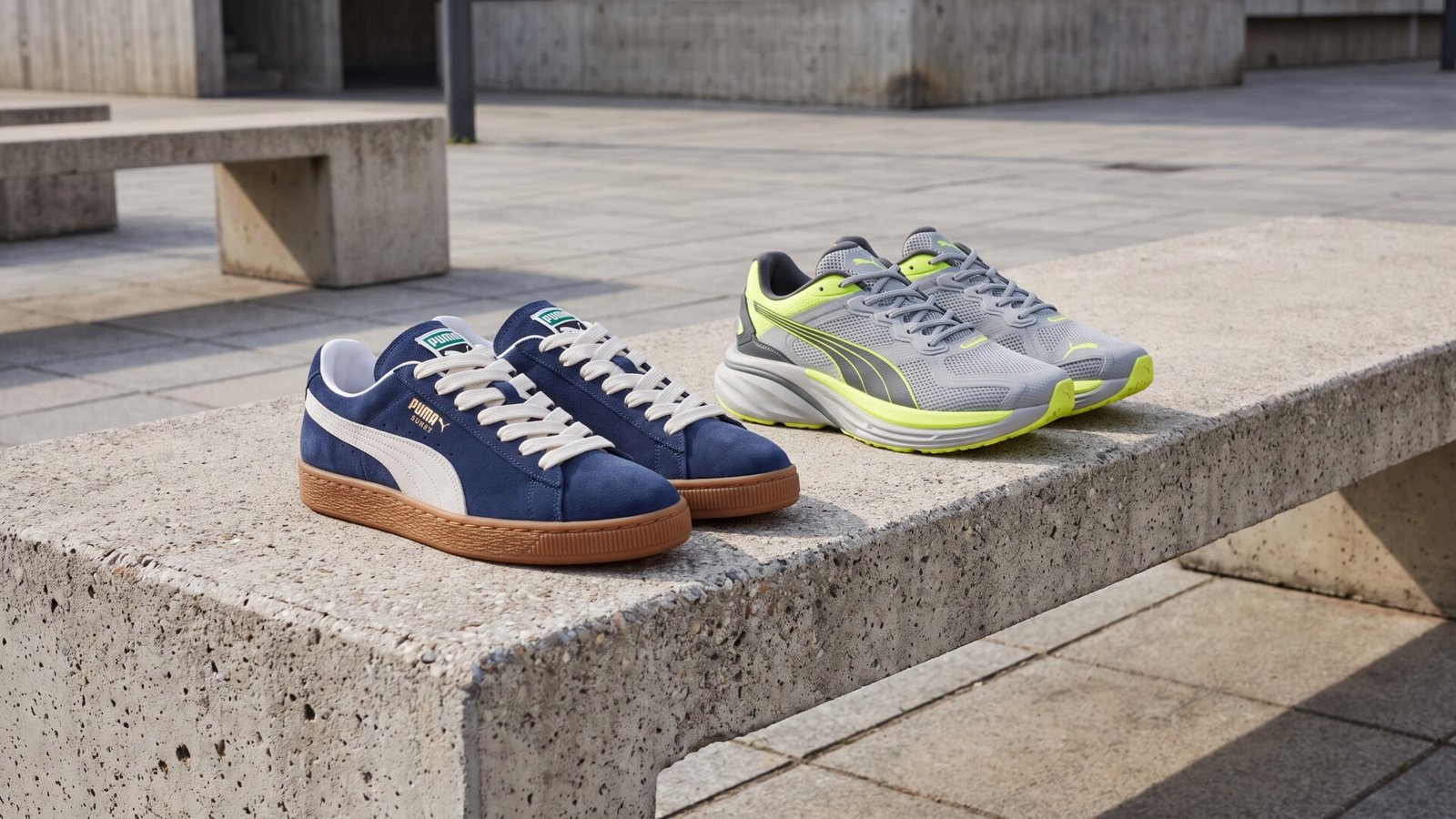
The PUMA SUEDE arrived updated in the ’80s with a wider fit and bigger sole, making its mark on the New York hip-hop and breakdance culture scenes. Decades later, the SUEDE remains a symbol of street culture—celebrated for its timeless style.
The T7 Tracksuit (1968)
Also in 1968, Puma entered the sports textile market with the iconic T7 training suit. It featured the FORMSTRIP implemented as a 7cm wide, conically tapered, color-contrasting stripe along the sleeves. The T7 would become a streetwear staple for generations.
The Clyde (1973)
When Puma started using suede, one of the basketball players who built an affinity for the material was Walt “Clyde” Frazier. The New York Knicks Hall of Famer famously featured it on his signature sneaker with Puma, which made him the first professional NBA player with his own shoe.
Boasting an easy-to-dye suede upper, Frazier was reported to wear a new pair every game. Known for his off-court signature style, he earned the nickname “Clyde” after the movie character from “Bonnie and Clyde”. When he asked for a custom-made pair of basketball shoes, Puma was immediately in the game—and the CLYDE was born.
With the likes of Banksy, Noah, Dapper Dan, and many more adding their signature touches to the silhouette, the CLYDE has cemented itself as an icon in the sneaker world.
The Tech Revolution (1980s-1990s)
The Running System (1985)
In 1985, Puma developed a new cushioning system: the Running System, now known as RS. It was a sole that combined four components with different physical and chemical characteristics into one unit to absorb shock and control motion.
Based on this system, Puma developed the first-ever computer shoe: the RS-Computer. It strapped a computer to a running shoe’s heel that analyzed data to compare runs, improve performance, and understand how to become faster, more efficient, and competitive. Long before smartwatches and fitness trackers, Puma was asking the question: “What if your running shoe could think?”
The Trinomic (1990)
Making more leaps in footwear cushioning technology, Puma introduced another advancement with the TRINOMIC. Inspired by the strength of honeycomb, the hexagonal system in the sole allowed it to compress and rebound to effectively withstand impact. This innovative tech was incorporated into a selection of the brand’s sportswear and lifestyle sneakers, with the likes of Ronnie Fieg and BAPE adding their styles to key silhouettes.
The CELL (1997)
Building upon the TRINOMIC system, the CELL also presented a visible honeycomb-inspired structure made from polyurethane cells that offered flexible cushioning that outperformed conventional foam soles of the time.
The Mostro (1999)
Futurism extended beyond technology in the ’90s. Enter the MOSTRO of 1999, which, with its futuristic design, represented the experimentation associated with the millennium. Fusing track spikes with surfing shoes, the result was a low-profile silhouette that took Y2K by storm. In 2025, the Mostro returned in a collaboration with A$AP Rocky featuring a removable “Caged Monster” cage.
The Speedcat Era (2000-Present)
The Speedcat (2000)
A year after entering performance motor racing, Puma continued its low-profile design aesthetic with the SPEEDCAT. Merging street style with driving inspirations, its racing roots unlocked a new category for the brand.
With a sleek suede upper and a variety of colorway offerings, it wasn’t long before it became Puma’s most sold sneaker ever. The Speedcat became a staple in motorsport culture and beyond.
In 2024, Puma introduced the Speedcat Plus, a premium take on the trendy silhouette. And in 2025, the brand released the Speedcat LS 3.0 in bold yellow and black colorways, proving that some designs never get old.
The California (1981 / 2018)
Heading to the west coast, the 1981 PUMA CALIFORNIA references the California Technique of shoe manufacturing that utilizes only two parts: a sole and upper, credited to women during the Civil War. The PUMA CALI that we know now was launched in 2018, and with design roots paying homage to its OG, it finds inspiration from tennis whites with a particular focus on women’s footwear, with Puma adding its signature upper on top of a brand-new platform sole.
The FENTY Era (2014-2018)
In 2014, Puma made a move that would change the brand’s trajectory: they signed Rihanna as creative director of women’s footwear.
The FENTY x Puma collaboration was massive. The Creeper—a platform version of the Suede—became an instant hit and earned the FN Shoe of the Year award in 2016. The collection expanded to slides, sneakers, and apparel, bringing a new energy to Puma that resonated with younger consumers.
While the partnership eventually ended, its impact is still felt. It proved that Puma could compete in the fashion space, and it opened doors for future collaborations.
The NITRO Revolution (2021-Present)
The Technology
In 2021, Puma re-entered the performance running market in a serious way with the introduction of NITRO technology. Nitrogen-infused foam offered a unique combination of softness and responsiveness—lightweight cushioning that didn’t sacrifice energy return.
But NITRO alone wasn’t enough. Puma had been experimenting with carbon fiber since 2006, when they integrated a carbon plate into the v1.06 football boot—long before carbon was discussed as a performance engine in running. As Matthias Hartmann, Head of Material Engineering Innovation Footwear, explains: “Carbon offers the best ratio of weight to stiffness. You can make something extremely rigid without making it heavy”.
For footballers, that meant more stability without extra bulk. For runners, it meant something else entirely.
Carbon + NITRO = The PWRPLATE
Carbon consists of thousands of filaments, thinner than a human hair, layered into textiles and embedded into a polymer matrix before being cured. The orientation of these fibers determines how forces are absorbed and returned.
“Traditional plastics become sluggish over time. They creep, they lose tension, and they don’t fully return to their original position,” Hartmann explains. Carbon does the opposite. “It stores energy and releases it again without changing”.
At Puma, there’s a word for that behavior: snappiness. “If you bend the plate and let go, it snaps right back. It feels like the shoe pushes you forward”. This instant feedback becomes a physical impulse that redirects energy. And NITRO foams amplify that effect.
“Carbon on its own does not make a fast running shoe. But carbon in combination with NITRO creates a new running experience”.
The Deviate NITRO Elite 4 (2026)
In January 2026, Puma unveiled the latest evolution of its hero running franchise: the Deviate NITRO™ Elite 4 and Deviate NITRO™ 4.
The Deviate NITRO™ Elite 4 is specially crafted for race day. It improves on its predecessor by returning even lighter and more efficient, thanks to enhanced NITROFOAM™ ELITE cushioning. The redesigned carbon fiber PWRPLATE is now stiffer and has been engineered to reduce stress in the metatarsal area, with gradual rib structuring to enhance stability.
Specifications :
- Price: €250
- Weight: 170g (UK8 men’s)
- Stack Height: 32mm (heel) / 40mm (forefoot)
- Drop: 8mm
The Deviate NITRO™ 4 is built for everyday runners serious about getting faster. It features an evolved NITROFOAM™ midsole with a new dual-layer, nitrogen-infused foam that delivers elevated rebound for a more energetic stride.
Specifications :
- Price: €180
- Weight: 250g (UK8 men’s)
- Stack Height: 30mm (heel) / 38mm (forefoot)
- Drop: 8mm
Both models launched with limited releases in January-February 2026, followed by global availability on February 26, 2026.
The Deviate NITRO Elite HYROX (February 2026)
On February 19, 2026, Puma released the first sneaker purpose-built for HYROX—one of the world’s fastest-growing fitness races. HYROX combines eight stations with eight kilometers of running, including SkiErg, sled push, sled pull, burpee broad jumps, rowing, farmer’s carry, lunges with a sandbag, and wall balls.
The Deviate NITRO Elite HYROX features four key technologies :
- High-traction PUMAGRIP outsole with a specially engineered lug pattern for multi-surface control
- Nitrogen-infused NITROFOAM Elite cushioning for maximum energy return
- A freshly curated carbon fiber PWRPLATE for propulsion and support
- Ultra-lightweight ULTRAWEAVE upper for breathability
The Fast-XP Concept Collection (September 2025)
In September 2025, Puma revealed its most daring collection yet: the Fast-XP concept shoes. Like racing car manufacturers using concept cars to test ideas before they hit the track, these shoes showcase the next generation of speed-driven innovation.
The collection includes five radical designs :
- FAST-XP SPT: Inspired by the Berserker spike worn by world record holder Karsten Warholm, purpose-built for 200m and 400m sprinters with a split, asymmetrical 3D PWRPLATE.
- FAST-XP LVT: Taking cues from Mondo Duplantis’ pole vault spike, reimagining vertical propulsion for the road with a dual-density midsole and hollow heel geometry.
- FAST-XP PLS: A wild design featuring cascade-shaped NITROFOAM geometry for long-distance speed.
- FAST-XP SPG: Evolving from the Fast RB Nitro Elite, mirroring the explosive rebound of a springboard.
- FAST-XP BLD: Inspired by the dynamics of carbon blades, engineered for aggressive propulsion.
While none of these shoes are for sale, the technology will likely trickle down to future releases.
The 2026 Collaborations
Daniëlle Cathari x Puma (February 2026)
On February 7, 2026, Puma released its first collaboration with Dutch designer Daniëlle Cathari, reimagining the Suede and Speedcat through natural textures and rich materials.
Rich, fuzzy suede envelops both silhouettes, bringing a tactile and visual richness to two Puma icons. Colorways are inspired by vibrant fungi—the Suede in a saturated red cap-mushroom hue, the Speedcat in a softer dusty moss tone.
Debossed shapes on the heel of each shoe resemble peering spider eyes, doubling as Cathari’s logo. Both styles come with interchangeable lacing options and classic gum soles underneath.
The 2026 Chinese New Year Collection
In January 2026, Puma released its “彪足马力” (Biao Zu Ma Li) Chinese New Year collection, celebrating the Year of the Horse.
The collection draws inspiration from legendary horses in Chinese history, creating five distinct “Five Steeds Welcoming Spring” interpretations :
- SPEEDCAT inspired by “Salu Zi” (a purple steed), featuring a quiet purple mist colorway
- BELLA UT inspired by “Jade Lion,” with a translucent pink palette
- PARK LIFESTYLE inspired by “Red Hare,” with golden brown base and golden texture
- CAVEN III inspired by “Yellow Biao,” with golden stripes and light luxury aesthetic
- RS LITE inspired by “Black Zhui,” with deep black representing the role of breaker
The Current Lineup
Lifestyle Icons
Suede: The 1968 original remains a streetwear staple. Clean, versatile, endlessly reimagined through collaborations.
Clyde: Walt Frazier’s signature shoe, now available in countless colorways and collaborations.
Speedcat: Puma’s best-selling sneaker ever, with its racing heritage and low-profile design.
Mostro: The Y2K futurist silhouette that keeps coming back in fresh collaborations.
Cali: The ’80s tennis-inspired platform that became a women’s favorite in 2018.
Performance Running
Deviate NITRO Elite series: Carbon-plated race day weapons with NITRO foam.
Deviate NITRO series: Everyday training with accessible pricing and premium tech.
Fast-R NITRO Elite: Puma’s most aggressive racing silhouette.
Basketball
Puma returned to basketball in 2018 and has been building momentum with signatures for LaMelo Ball (MB series), Scoot Henderson, and Tyrese Haliburton. The brand also collaborated with Salehe Bembury on Haliburton’s signature shoe.
Football
The KING remains Puma’s flagship football boot, worn by stars like Neymar and Antoine Griezmann.
Puma’s Financial Health (2025-2026)
Puma has been performing well despite a challenging economic environment. In the third quarter of 2025, the brand posted solid results, though facing currency challenges and market uncertainties.
Recent rumors of a potential takeover caused Puma’s share prices to leap. The brand remains focused on innovation, collaborations, and expanding its presence in key markets like China.
Why Puma Matters
Look, in a sneaker world dominated by a few massive players, Puma has carved out its own lane. It’s a brand with real history—seven decades of it. It’s a brand with real icons—the Suede, the Clyde, the Speedcat. And it’s a brand with real innovation—from the RS-Computer in 1985 to the NITRO foam and carbon plates of today.
What makes Puma special is its willingness to take risks. The Mostro in 1999. The FENTY collaboration in 2014. The Fast-XP concept shoes in 2025. Puma doesn’t just follow trends—it creates them.
At Street Sneakers Vault, we respect that. We respect the brand that dressed Tommie Smith at the 1968 Olympics. The brand that put Pelé and Maradona in boots. The brand that teamed up with Rihanna and A$AP Rocky and Daniëlle Cathari.
Puma has been pushing sports and culture forward since 1948. And in 2026, with the Deviate NITRO Elite 4 dropping and the Suede and Speedcat getting fresh collaborations, the cat shows no signs of slowing down.
Whether you’re a runner chasing PRs, a collector chasing grails, or just someone who appreciates quality sneakers, Puma has something for you.
And that’s why it belongs in the Vault.
Want more deep dives into iconic sneaker brands? Check out our brand archives for stories on Adidas, Onitsuka Tiger, Saucony, and more.
Care to dig even deeper? Check out the Puma Sneakers That Defined Street Culture over the decades.
Street Sneakers Vault – Keeping you fresh since day one.