How to Authenticate Designer Sneakers: The 2026 Guide
Today we’re talking about something that should matter to anyone spending real money on kicks—how to tell if your designer sneakers are the real deal.
Look, the counterfeit game has gotten scary good. We’re not talking about obvious fakes sold on street corners anymore. Today’s replicas are made in the same factories as the originals, sometimes by the same workers. The difference? Microscopic details that most people never notice.
The numbers are wild. The global counterfeit sneaker market is pushing over $5 billion annually. That’s billions of dollars worth of fake shoes flooding the market. And with high-end designer sneakers running $500 to $1,500+, the incentive for counterfeiters keeps growing.
At Street Sneakers Vault, we believe knowledge is power. This guide breaks down exactly how to authenticate designer sneakers—from visual checks to professional services—so you never get burned.
Let’s get into it.
Why Authentication Matters More Than Ever
Here’s the reality check: you can’t just trust a receipt anymore. Receipts can be forged or recycled from legitimate purchases. You can’t trust a high price—some scammers price their fakes at retail to seem legit. You can’t even trust that “authorized dealer” stamp on a random website.
Professional authenticators are seeing fakes that require X-ray analysis, infrared cameras, and UV light examination to detect. The SNKRDUNK Lab in Japan maintains a 99.97% authentication accuracy rate, and even they need advanced tech to catch some of these super-fakes.
Marcus Tran, Senior Authentication Specialist at LegitCheck Pro, puts it bluntly: “Today’s best fakes are made in the same factories as originals—sometimes by the same workers. The difference lies in microscopic details”.
That means you need a systematic approach. No shortcuts. No guessing.
Before You Buy – The Pre-Purchase Checklist
Half of authentication happens before you spend a dime. Run through this checklist before you click “buy” :
Research the seller. Check their reviews, how long they’ve been selling, and whether they have verified sales history. If a seller has zero reviews or all their reviews sound fake, walk away.
Compare photos to official images. Pull up the brand’s official product page. Match every angle. Logos, stitching, sole patterns, color gradients—everything should line up.
Ask questions. Legitimate sellers will answer promptly. Ask about condition, original packaging, receipts, and authenticity guarantees. Vague answers are red flags.
Request more photos. If the listing photos are low-res or missing key angles, ask for close-ups of the tongue label, heel tab, insole, size tag, and box.
Check return policies. Make sure there’s a solid return or refund process if the shoes don’t check out.
Use secure payment. PayPal Goods and Services, credit cards, and platform payment systems offer buyer protection. Friends and Family or direct bank transfers? Too risky.
Jared L., a sneaker collector from Chicago, learned this lesson the hard way. He was offered unreleased Travis Scott x Air Jordan 1 Lows for $700—way below market. Excited, he almost bought until he requested detailed photos. Zooming in, he noticed the red heel stitching wasn’t continuous and the box had a flat barcode instead of the scannable version. Cross-referencing with an authentication group confirmed fakes. He saved over $2,000.
The Visual Inspection – What to Look For
Once you have the shoes in hand, it’s time to put on your detective hat. Here’s what professional authenticators check.
Overall Shape and Symmetry
Authentic designer sneakers have perfect symmetry. Hold the shoe at eye level and look down the length. Are both sides even? Does the toe box match the official shape? Fakes often have slightly warped proportions because their molds aren’t as precise.
Stitching Quality
This is one of the easiest giveaways. Authentic sneakers feature tight, even stitches—typically 12-14 stitches per inch on visible seams. There should be no loose threads, no skipped stitches, no wandering lines.
Run your finger along the seams. If you feel bumps or gaps, that’s a problem.
Material Quality and Smell
Real leather has a distinctive rich, organic aroma. Fake leather often smells like chemicals or plastic. The material itself should feel supple, not stiff or plasticky. High-grade synthetics can feel good too, but they won’t have that chemical odor.
If you’re buying new, the shoes should smell like fresh leather and textiles, not glue factories.
Logo Placement and Clarity
Brand logos should be crisp, clear, and perfectly positioned. On fakes, logos often appear blurry, off-center, or slightly distorted. The fonts must match the brand’s official typography exactly.
For Gucci’s Ace sneakers, the green-red-green Web stripe should be flawlessly inset with no glue visible. For Balenciaga, the embossed size markings on the heel should be sharp and precise. For Louis Vuitton, the stamping depth and color vibrancy are consistent across authentic pairs.
Midsole and Outsole Alignment
On genuine sneakers, the midsole foam lines up perfectly with the outsole grooves. Fakes often show slight misalignment due to inferior molding. Rotate the shoe slowly under good light to detect inconsistencies.
Heel Counter and Embossing
Branded heels should feel firm and symmetrical. Logos are either laser-cut or precisely molded. On fakes, these often appear blurry, raised too high, or slightly distorted.
Insole Quality
Authentic insoles feature consistent padding, clean branding, and often a unique serial number linked to the production batch. The logo should be clearly printed, not smudged or faded. Some brands include specific text formatting—Off-White x Nike, for example, uses Helvetica for their “for use on the road” text.
Tongue Label and Size Tag
The fabric, font, and placement of the size tag vary by model and year. For Nike’s older models, a specific serif font is used that replicas often get wrong. The tag should sit flush with no loose threads or crooked edges.
Brand-Specific Authentication Points
Different brands have different tells. Here’s what to check for specific designers.
Balenciaga
The Balenciaga 3XL “Champagne” has several key authentication points :
- Size label font – The number “4” on fakes is generally thicker than authentic versions
- Inner tag – Characters like “G,” “R,” and numbers show different font styles
- Insole logo – Differences in material texture, paint quality, and font style
- Tongue profile – Authentic “3XL” has sharp, defined corners; fakes show softer, rounded edges
- Heel logo – Differences in font style and the surrounding frame shape
- Midsole stitching – Fakes often show more stitching lines
Some super-fakes even replicate internal plates and engravings, requiring X-ray analysis to detect.
Gucci
For Gucci Ace sneakers :
- Web stripe – Green-red-green stripe should be perfectly inset, colors consistent
- Heel tabs – One red, one green—a signature detail
- Embossing – Script logo on heel should be crisp and clear
- Insole – GG logo properly aligned, no smudging
Nike SB and Collaborations
For the Nike SB Dunk “Ben & Jerry’s Chunky Dunky,” authenticators check :
- Outsole spacing – Genuine pairs have wider spacing between treads; fakes pack them too tightly
- Tongue back embroidery – Characters sharply defined, ® symbol slightly above center
- Tongue front – “NIKE SB” lettering fully embroidered, no missing letters
- Factory code – Authentic pairs have “VH” code on inside label
- Insole back – Visible air cushion and clear size info
- Midsole hole – Small circular locator hole near heel on authentic pairs
For Travis Scott x Jordan 1 Lows, counterfeiters sometimes mix real and fake parts, so authenticators focus on craftsmanship details that factories can’t perfectly replicate.
New Balance Collaborations
The JUNYA WATANABE MAN x New Balance 1906L requires advanced inspection :
- Tongue text under microscope – Authentic pairs show fine dot printing patterns; fakes show solid block printing
- Interior tag UV reaction – Authentic pairs show clean, defined logo reactions
- Side panel “1906L” – Authentic features clean silver/grey coloring; fakes show only white with misaligned ink
- Outsole text – Counterfeits contain typographical errors in “durance” text
- Upper IR camera – Authentic shows varied white/black reactions; fakes show predominantly black
- Heel NB logo – Authentic has glossy finish with square borders; fakes lack gloss with wavy edges
- UV light on upper – Fakes often show dotted line patterns not present on authentic pairs
- Penny keeper – Authentic features grey embroidered text; fakes have white
The Box and Packaging
Never underestimate packaging as an authentication tool.
Box quality – Authentic boxes have crisp printing, correct weight, and no smudging. Misaligned barcodes or generic labels are immediate red flags.
Holographic stickers – Many luxury sneakers include specific holographic stickers with unique patterns that counterfeiters struggle to replicate.
Dust bags – Genuine dust bags are made from quality materials with proper branding. They should feel substantial, not cheap and thin.
Tissue paper – Even the tissue paper fold patterns can be consistent across authentic pairs.
Extra laces – Most designer sneakers come with additional laces. Check that they match the quality and color of the originals.
Authenticity cards – Some brands include cards with serial numbers. Counterfeiters often skip these or include obviously fake versions.
The Weight Test
Here’s something sneaky: authentic sneakers often weigh slightly more than fakes because of quality materials and solid construction.
If you have access to a digital scale and can find the official weight specs online, weigh your pair. A significant difference is suspicious.
That said, some super-fakes have gotten smart about this and add weights to match. So weight alone isn’t conclusive, but combined with other checks, it’s useful.
DIY Tools for Authentication
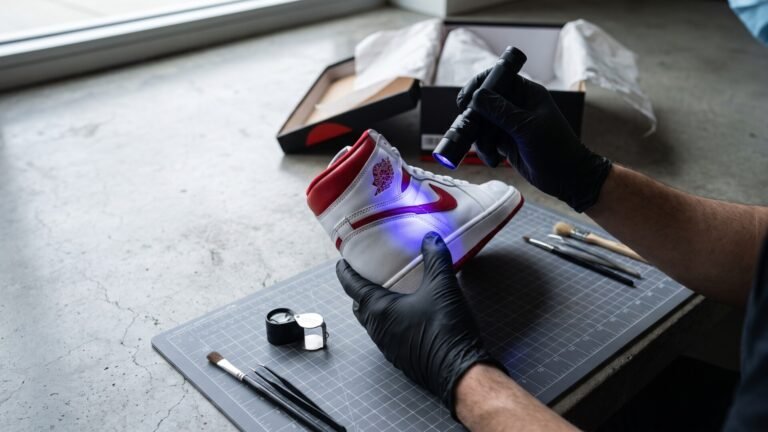
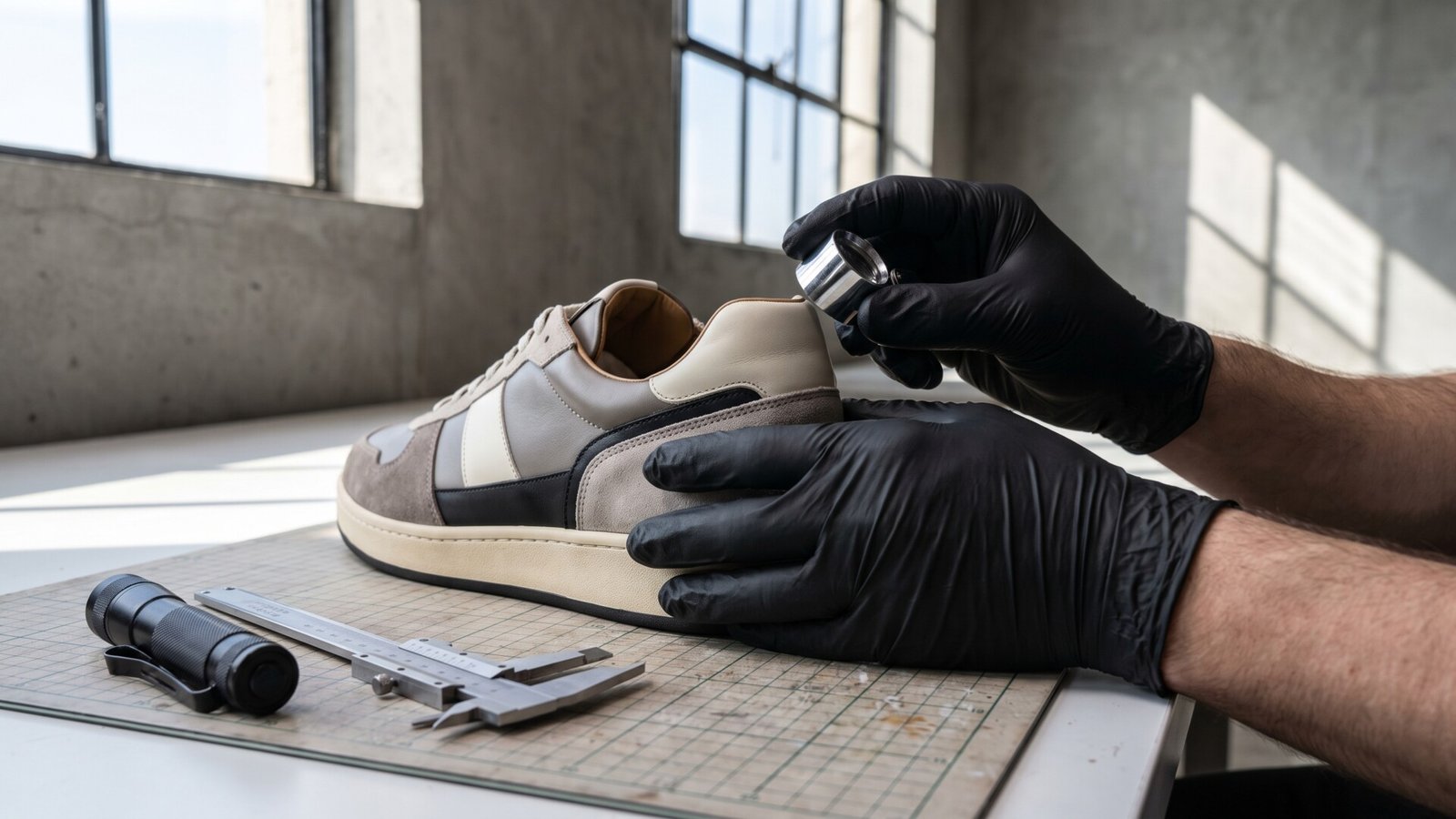
You don’t need a lab to catch most fakes. Here are tools that help :
Magnifying glass or jeweler’s loupe – Spot tiny flaws in stitching, printing, and materials that the naked eye misses.
Bright light source – Natural daylight or a bright LED lamp reveals color mismatches and uneven textures.
UV light – Many brands embed invisible ink or security marks on tags and boxes that only show under UV.
Digital scale – Compare weight to official specifications.
Reference images – Save official product photos from brand websites and trusted sneaker forums for side-by-side comparison.
Reverse image search – Run seller photos through Google Images to see if they’ve been lifted from other listings.
Professional Authentication Services
Sometimes DIY isn’t enough. For high-value pairs or when something feels off, professional authentication is worth every penny.
Legit App
Legit App has become the go-to for sneaker authentication, with millions of cases processed. Here’s how it works:
- You submit detailed photos through their app
- AI runs a preliminary check
- Authenticator #1 reviews
- Authenticator #2 reviews independently
- Within hours to a couple days, you get a detailed authenticity report
If any details are unclear, they’ll ask for better photos and pause the process until they have them. If opinions differ among authenticators, they keep digging until it’s crystal clear.
Legit App’s authenticators are serious about their craft. Broly, one of their chief authenticators, spent four years self-studying after getting burned on a fake Foamposite. Now he tracks authentication by factory, not just by shoe model, because each factory leaves its own fingerprint.
Austin, another lead authenticator, notes that they check 2000 cases a day and have developed factory-specific knowledge that lets them distinguish quality control issues from actual fakes.
Legit App offers a 90-day financial guarantee on all items they authenticate.
SNKRDUNK Lab
SNKRDUNK maintains Japan’s largest database of counterfeit products and achieves 99.97% authentication accuracy. They use X-ray, infrared, and microscopes to authenticate every item.
Their authentication process is comprehensive, examining multiple factors including UV reactions, microscopic printing patterns, and even internal plate structures.
StockX and GOAT
These platforms authenticate before shipping to buyers. StockX uses a dual-tier system: automated image analysis flags suspicious pairs for Level 2 review, where three certified authenticators cross-reference 17 physical checkpoints. GOAT’s “GOAT Clean” program adds UV-reactive ink verification for certain releases.
However, note that authentication accuracy drops slightly for items without complete original packaging.
Real Stories, Real Lessons
Jared’s Near Miss – We mentioned him earlier. By requesting detailed photos and cross-referencing with authentication groups, he saved $2,000.
Sarah’s Lesson – She snagged a “limited edition” pair for half retail. When they arrived, the smell was off, stitching sloppy, packaging missing. The lesson: if it’s too good to be true, it usually is.
Jake’s Refund Nightmare – He fell for a seller with amazing photos but no verified history. No return policy meant his refund request got stonewalled. His advice: “Always click through that seller profile. The red flags are there if you look closely”.
Mia’s Success – She used an authentication service to verify her purchase and confidently secured her dream sneakers from a small boutique online. “It’s like hiring a sneaker detective before making the call”.
Authentication Checklist
Before you finalize any purchase, run through this checklist :
- Seller has positive reviews and verification history
- Photos match official brand images in every detail
- Seller answered questions promptly and clearly
- Box matches release era (font, logo, barcode type)
- Tongue label uses correct font, spacing, and fabric
- Stitching is consistent, tight, and free of loose threads
- Materials feel premium—no plasticky texture
- No strong chemical smell
- Midsole and outsole align perfectly
- Logo placement is crisp and centered
- Insole includes correct branding and serial info (if applicable)
- Colorways match official product images exactly
- Includes original accessories (dust bags, extra laces)
- Weight feels appropriate (if you have reference)
- Purchased through platform with buyer protection
- Considered professional authentication for high-value pairs
Common Authentication Mistakes
Even experienced collectors make mistakes. Here’s what to avoid :
Trusting price alone. A high price doesn’t guarantee authenticity, and a low price isn’t always fake. Scammers know how to price to seem legit.
Relying solely on packaging. Some replicas come with near-perfect boxes, tags, and dust bags. Packaging helps, but it shouldn’t be your only check.
Skipping model-specific research. Every release has unique details. You need to know what the actual shoe should look like, not just the brand generally.
Ignoring smell and feel. Strong chemical odors and cheap-feeling materials are major red flags.
Not requesting enough photos. If buying online, you can’t have too many detailed shots.
Using unprotected payment methods. Friends and Family on PayPal? No buyer protection. Bank transfer? Even worse.
Assuming authentication services are foolproof. They’re excellent, but accuracy isn’t 100%. Use them as part of a broader strategy.
The Bottom Line
Look, authenticating designer sneakers isn’t about luck. It’s about discipline, observation, and access to reliable information.
The counterfeit game keeps evolving. Manufacturing techniques improve. Super-fakes get harder to spot. But here’s the thing: authenticators evolve too. They track by factory, not just model. They use UV light, IR cameras, microscopes, and X-rays. They build databases of counterfeit products and share intelligence across platforms.
As a buyer, you don’t need to match that level of expertise. But you do need to be systematic. Use the checklist. Request photos. Know what to look for. And when in doubt, pay for professional authentication.
Broly from Legit App puts it perfectly: “Forget just ‘spotting differences’—this work demands serious dedication. Researching the details of a single shoe can take months. You need extreme attention to detail to catch every telltale sign”.
You don’t have months. But you can learn the basics, build relationships with trusted sellers, and use the tools available.
At Street Sneakers Vault, we believe knowledge is the best protection. The more you know, the harder you are to fool.
Stay vigilant. Stay informed. And never let hype override scrutiny.