Hoka Bondi 8 Review
Alright, let’s talk about the Hoka Bondi 8. You’re here because you’ve seen these chunky, marshmallow-looking sneakers everywhere, and you’re wondering if the hype is real or if it’s just good marketing. The quick verdict is this: the Hoka Bondi 8 is one of the best choices out there for soft, stable everyday cushioning, especially if you spend hours on your feet walking or standing on hard floors. But if you’re looking for a speed demon for running or a sleek sneaker to dress up, this isn’t it.
The reason buyers get stuck is that the Bondi 8 looks incredibly comfortable—and it is—but its bulky shape, firm rocker feel, and premium price tag make the purchase less obvious than it seems. The core tradeoff you’re signing up for is maximum underfoot protection and stability versus added weight, less flexibility, and a look that doesn’t blend into the background.
This review is going to break down exactly who should cop a pair, who should pass, and everything you need to know about fit, durability, and whether it’s worth your hard-earned cash.
At a Glance: Hoka Bondi 8 Verdict
Before we get into the weeds, here’s the quick breakdown. This is a shoe that solves a very specific problem incredibly well, but it’s not a one-size-fits-all answer.
| Category | Hoka Bondi 8 assessment |
|---|---|
| Overall use | Walking, standing, commuting, daily wear |
| Cushioning | Plush, protective, and stable |
| Fit | Generally true to size, with wide options available |
| Best feature | Reduces the harshness of hard surfaces over long days |
| Main drawback | Bulky appearance and limited agility |
| Best buyer | Someone prioritizing comfort and protection over speed |
| Value | Strong if worn frequently; weaker as an occasional sneaker |
The quick verdict box:
- Best for: Walking, standing all day, travel, casual daily wear, and people who prefer substantial cushioning.
- Not ideal for: Fast running, gym workouts requiring lateral movement, narrow minimalist styling, or buyers wanting a lightweight sneaker.
- Editor’s choice: Hoka Bondi 8 for maximum everyday comfort, provided the buyer accepts its size and appearance.
Hoka Bondi 8 Design and What It Is Built To Do
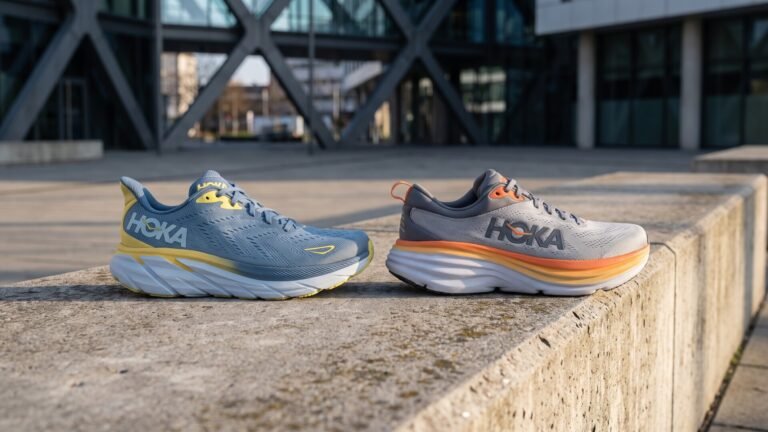
Let’s get one thing straight: the Bondi 8 is not trying to be a minimalist shoe. It’s the polar opposite. This is Hoka’s max-cushion cruiser, designed from the ground up to be the most protective, planted ride in their lineup. The high-stack, broad-based design creates a feeling of being lifted up and insulated from the ground, rather than feeling every pebble and crack in the pavement.
The secret sauce isn’t just the foam, though. It’s the late-stage Meta-Rocker. In plain English, this is a curved sole geometry that encourages a smooth, rolling transition from heel to toe. Think of a rocking chair, but for your feet. This rocker action can make walking feel almost effortless, propelling you forward. It’s a brilliant design for reducing fatigue, but it can feel unusual if you’re used to flat, flexible shoes that bend naturally with your foot.
The upper is where the Bondi 8 shows its softer side. It uses an engineered mesh that’s breathable and adapts to the shape of your foot. The padded collar and tongue are plush, locking your heel in place without any digging or rubbing. It’s a comfort-first construction that makes slipping the shoe on feel like a small event.
Now, where does it sit in the Hoka family? If you’re considering the Bondi 8, you’re probably also looking at its lighter sibling, the Clifton 9. Think of it this way: the Clifton is the versatile all-rounder—lighter, more flexible, and a better fit for a wider range of activities. The Bondi, on the other hand, is the heavy-duty comfort specialist. It takes the Clifton’s cushioning and dials it up to eleven, adding more foam, a wider base, and more substantial structure. You buy the Bondi when maximum protection is the absolute priority, and you’re willing to trade some agility and weight to get it.
Comfort for Walking, Standing, and Daily Wear
This is the main event. Nobody buys a Bondi 8 for its sleek profile. They buy it for the way it makes their feet and legs feel after a long day. Let’s dig into how that comfort holds up in different situations.
Walking Comfort
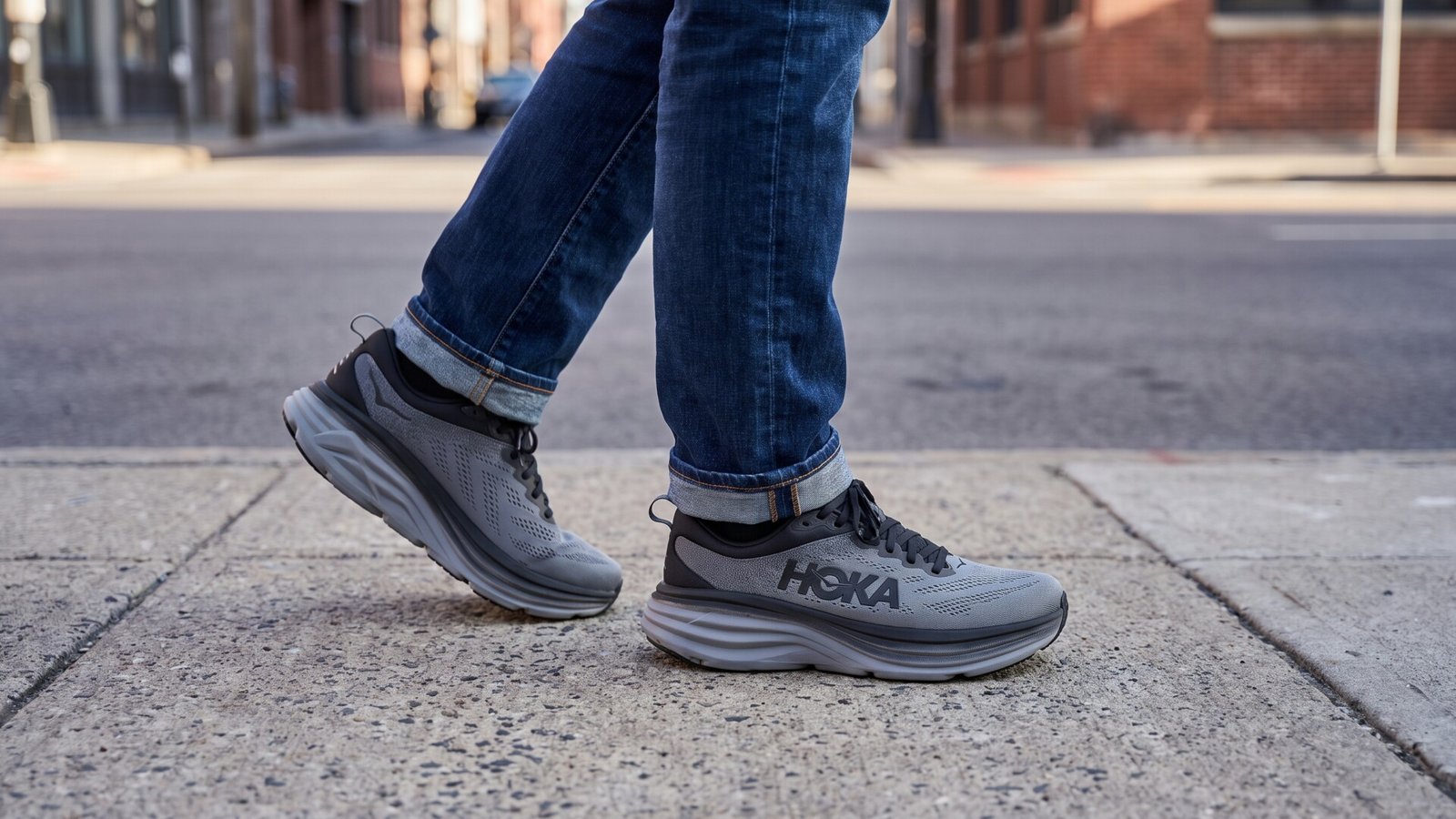
If your world is paved in concrete, the Bondi 8 is your best friend. The combination of the ultra-soft midsole, the broad geometry, and the rocker-assisted transitions work together to take the sting out of every step. Where a firmer shoe would send shockwaves up your legs, the Bondi 8 just… absorbs it. Walking on sidewalks, through airports, or around a city for hours feels less like a chore and more like a glide.
The tradeoff here is ground feel. You are insulated from the surface, which is great for impact protection but not so great if you want to feel connected to what you’re walking on. This shoe is naturally suited to a steady, even pace—long walks and easy strolls. It’s not built for quick changes of direction, sudden stops, or navigating rocky, uneven trails where you need to feel the terrain underfoot.
Standing All Day
This is where the Bondi 8 truly earns its keep. For anyone in retail, healthcare, or any job that keeps you upright on hard floors for hours, this shoe is a legitimate game-changer. The thick foam doesn’t just cushion your heel; it provides a stable, wide platform that helps distribute pressure across your entire foot. It reduces the fatigue that comes from your feet and lower back working overtime to keep you balanced on a hard surface.
But here’s the honest part: cushioning alone doesn’t guarantee comfort. If the shoe is the wrong width or you have the laces cranked down too tight, you’ll still get pressure points. A hidden drawback for some is that a shoe this soft at first can still create problems if your forefoot is being squeezed. The magic of the Bondi 8 only works if the fit is right. It’s a tool for comfort, not a miracle cure for a bad fit.
Daily Wear and Travel
For daily errands and long urban days, the Bondi 8 is a solid pick. Slipping them on to run to the grocery store, grab coffee, or walk the dog is like putting your feet in a pair of slippers that happen to look like sneakers. They’re also a popular choice for travel, and for good reason—after a long flight, your feet can swell, and having that massive cushion of foam to land on during a layover is a godsend.
The downside? They are bulky. If you’re a one-bag traveler trying to pack light, these shoes will take up a huge amount of space. And in crowded airports or city streets, they can feel a little clunky. For daily wear, we’d recommend pairing them with moisture-managing socks to keep your feet dry. And if you’re thinking about adding insoles, only do so if the stock fit is comfortable but you want a bit more arch support. An aftermarket insole will not fix a shoe that is fundamentally the wrong size.
Fit, Sizing, and Wide-Foot Guidance
Let’s talk fit, because this is where most people get it wrong. The general consensus is that the Bondi 8 fits true to size for most people. If you’re a size 10 in most sneakers, a size 10 will likely work. But the internal feel can vary based on your foot shape and volume.
Here’s the critical part: who should consider the wide version? If you have a broad forefoot, experience bunion pressure, have high-volume feet, or simply like a little more room for your toes to splay, then you should absolutely look at the wide (2E) option. Don’t think of it as a niche product—it’s a lifesaver for a huge number of people.
A common mistake is thinking that a wide shoe means a longer shoe. It doesn’t. A wide shoe gives you more space across the footbed, not more length. When you’re trying them on, you should prioritize three things: enough toe room (about a thumb’s width from your longest toe), a secure heel that doesn’t slip, and absolutely no feeling of pressure across the widest part of your foot.
What about break-in? The upper will soften and mold to your foot a little with wear, but don’t expect a dramatic transformation. If you feel persistent rubbing, numbness, or pressure from day one, that’s not a normal break-in period—that’s a fit problem. Don’t try to “power through” a shoe that’s too tight. If you’re between sizes or have a broad forefoot and a narrow heel, we strongly recommend trying both the regular and wide widths. The right width will make a world of difference in how the shoe performs for you.
Durability and Long-Term Ownership
So, you’ve dropped the cash. How long will they last? The Bondi 8’s durability is a mixed bag that depends on how you define it. The outsole features durable rubber in high-contact zones, but there are also large areas of exposed foam, particularly in the midfoot. Over time, you’ll see wear on the rubber in the heel and toe, which is normal. The exposed foam can get scuffed and nicked, but that’s mostly cosmetic.
Here’s the thing that surprises a lot of owners: visible durability doesn’t equal useful life. A Bondi 8 can look perfectly fine on the outside—upper intact, outsole still gripping—while the midsole has slowly lost its original spring and softness. The foam compresses over time, and after several hundred miles, the shoe will feel noticeably firmer and less protective than it did on day one. The cushioning is the product, and that’s what wears out first.
As for long-term complaints, you’ll hear about a few common things: compression of the cushioning, creasing in the midsole foam, some wear on the heel lining if you tend to slip your foot in without untying the laces, and the outsole smoothing out in high-abrasion areas.
Here’s an ownership framework to keep in mind: if you’re a frequent walker or on your feet for work, this shoe is a workhorse. Wearing it 5-6 times a week for a year is incredible value. But if you buy them as an occasional fashion sneaker to wear once a week, you’re paying a premium for a lot of cushioning that’s just sitting in your closet. The cost-per-wear only makes sense if you’re actually using them for what they’re built for.
What Most Buyers Get Wrong About the Bondi 8
There are a few misconceptions floating around about this shoe that need to be cleared up. First, people think the Bondi 8 is simply “the softest Hoka.” It’s not just about softness. In fact, compared to some other max-cushion shoes, the Bondi 8’s foam isn’t the squishiest. Its real appeal is the combination of cushioning, inherent stability, and that rolling geometry. It’s a system designed to make long days easier, not just a pillow for your feet.
Second, more cushioning doesn’t automatically make it better for everything. The high stack height and structured rocker reduce your foot’s ability to feel the ground and move nimbly. This makes it a poor choice for gym training, court sports, or fast interval running where you need agility and a stable base for lateral movements. Using a high-stack shoe like this for lifting heavy weights, for example, can actually be a disadvantage because of the instability.
Third, let’s talk about the fashion. The Bondi 8’s oversized, chunky shape is undeniably part of its current streetwear appeal. It’s a statement piece. But that also means it won’t work with every wardrobe or workplace dress code. It’s a sneaker that dominates an outfit. If you’re looking for something to blend in or pair with slimmer trousers, this isn’t it.
Finally, a crucial piece of advice: do not buy a larger size to create more comfort. Sizing up to get a wider toe box will often just cause heel slippage and foot fatigue as your foot slides around. The correct width and shape are far more important than extra length. If the regular width feels snug, get the wide version. That’s what it’s there for.
Real-World Use Cases: Where the Bondi 8 Makes Sense
To make this easy, here’s a quick breakdown of who should actually be looking at the Bondi 8.
| Use case | Recommendation | Why |
|---|---|---|
| Long walks | Strong choice | Protective cushioning and smooth transitions |
| Standing all day | Strong choice with correct fit | Broad platform and reduced harshness on hard floors |
| Travel | Good choice | Comfortable for urban walking, but bulky to pack |
| Easy running | Suitable for some runners | Cushioned and stable, but not especially lively |
| Speed workouts | Weak choice | Heavy, structured, and less agile |
| Gym training | Limited | Better for treadmill work than lateral movement or lifting |
| Casual streetwear | Style-dependent | Popular chunky profile, but not universally versatile |
Let’s put this into a few real-world scenarios:
- The Commuter: You walk a few miles to and from the train station on pavement every day, and you want one dependable pair of shoes that can handle it all without your feet aching by Friday. The Bondi 8 is a perfect match.
- The Healthcare Worker: You’re on your feet for 10-hour shifts on hospital concrete. You don’t care about style, you care about protection and not feeling like your lower back is on fire when you get home. The Bondi 8 is an investment in your body.
- The Traveler: You have a big trip to a city where you know you’ll be sightseeing for 8+ hours a day. You want maximum comfort, but you’re also trying to pack light. The Bondi 8 is a great choice, but you need to be prepared for the bulk in your bag.
- The Runner: You’re a casual runner who wants a shoe for easy, slow miles. The Bondi 8 can work, but if speed and versatility matter more than maximum cushioning, you should be looking at a lighter model like the Clifton 9.
Value, Price, and Alternatives
The Bondi 8 sits at a premium price point, typically retailing around $165. That’s a significant investment for a sneaker, and it’s fair to ask if it’s worth it. The answer depends almost entirely on how you plan to use it.
This is where cost-per-wear comes into play. If you’re using these shoes several times a week for walking or work, that $165 price tag gets spread across hundreds of uses. Suddenly, it’s a very reasonable investment in your daily comfort and long-term joint health. But if you’re buying them mainly for occasional outfits, that’s a lot of money for a shoe that’s sitting in your closet most of the time.
The good news is that the Bondi 8 has been out for a while, so you can often find it on sale. A discounted Bondi 8 can be an absolute steal. But you should also know what else is out there before you commit.
- Hoka Clifton 9: This is the Bondi’s lighter, more versatile sibling. If you want a shoe that can do a bit of everything—walking, easy runs, gym work—and you don’t need maximum cushioning, the Clifton 9 is often the smarter buy. It’s also usually a bit cheaper.
- Hoka Bondi 9: The newest version is out, and it refines the formula with a slightly softer foam and a reworked upper. If you want the latest and greatest, it’s worth looking at. But if the Bondi 8 is significantly discounted, it becomes the better value proposition, as the differences are incremental, not revolutionary.
- New Balance Fresh Foam X 1080v13: This is a fantastic alternative if you want premium cushioning but find the Bondi’s styling a little too imposing. The 1080v13 offers a plush, smooth ride with a more conventional, sleeker profile that’s easier to dress up or down.
- ASICS Gel-Nimbus 26: Another top-tier max-cushion shoe. If you prefer a more traditional running-shoe feel with a slightly firmer, more responsive ride than the Bondi, the Nimbus 26 is an excellent choice with a great reputation for comfort and durability.
So, when should you buy? Buy the Bondi 8 at full price if you know it’s exactly what you need for a specific purpose—like a demanding job or a major walking trip. Wait for a sale if you’re on the fence or if it’s more of a “nice-to-have” purchase. And definitely consider an alternative if you want a lighter feel or a less bulky look.
Who Should Buy the Hoka Bondi 8?
Let’s make this crystal clear.
- Buy it if your priority is protecting your feet from long hours on hard surfaces. This is its superpower.
- Buy it if you prefer a stable, substantial shoe over a lightweight or flexible one. You like the feeling of being planted and secure.
- Buy it if you walk frequently enough to spread the cost across regular wear. This is a daily driver, not a special occasion shoe.
- Consider the wide version if the regular fit creates forefoot pressure or if you need more toe space. Don’t suffer in the wrong width.
- Choose it over the Clifton 9 when maximum cushioning and stability matter more than weight. If you want the ultimate Hoka comfort experience, this is it.
Who Should Skip the Hoka Bondi 8?
And here’s who should walk away.
- Skip it if you want a sleek sneaker that disappears under clothing. This shoe makes a statement, whether you like it or not.
- Skip it if you need one shoe for running, gym work, casual wear, and fast movement. It’s a specialist, not an all-rounder.
- Skip it if you dislike rocker-shaped soles or high-stack shoes. The feel underfoot is unusual and not for everyone.
- Skip it if you are buying mainly for occasional wear and can get similar comfort from a discounted alternative. Don’t pay a premium for a shoe you’ll barely use.
- And finally, avoid assuming the Bondi 8 will solve foot discomfort caused by an incorrect size or an underlying medical issue. If you have persistent pain, see a professional. A great shoe can help, but it’s not a substitute for medical advice.
Final Verdict: Is the Hoka Bondi 8 Worth It?
So, after all that, is the Hoka Bondi 8 worth it? For its intended purpose, yes, absolutely. It’s a clear winner for walking, standing, commuting, travel, and daily use where impact protection is your main concern. Its biggest strengths are its incredible comfort over hard surfaces, its inherent stability, and its ability to keep your feet and legs feeling fresh during long days.
Its biggest weaknesses are its bulk, its limited agility for anything beyond easy movement, its very distinctive appearance, and a price tag that only makes sense if you’re actually going to use the shoe for what it’s built for.
Here’s our final recommendation: Buy the Hoka Bondi 8 if comfort and protection are your absolute priority. If you want a lighter, more versatile everyday option, go with the [Internal: Hoka Clifton 9]. If you prefer the idea of the latest Bondi model, the [Internal: Hoka Bondi 9] is worth a look, but only if the price gap is reasonable.
Think about the two-year ownership angle. You’ll be happiest with this purchase if you use the Bondi 8 as a regular walking or work shoe, racking up the miles and letting it do its job. It’s an investment in your daily comfort that pays off every time you lace up. But if you buy it as a rarely worn fashion sneaker, you’ll probably find yourself wondering what the big deal was. Use it for what it’s for, and it’s one of the best purchases you can make for your feet.
Frequently Asked Questions About Hoka Bondi 8 Review
Is the Hoka Bondi 8 good for walking?
Yes, it’s excellent for walking. Its cushioning, broad platform, and rocker geometry make it ideal for steady walking on hard urban surfaces like sidewalks and concrete. The rocker helps propel you forward, reducing fatigue. However, people who prefer flexible, low-profile shoes might find its structured feel too rigid.
Is the Hoka Bondi 8 good for standing all day?
It can work very well for long periods on concrete or hard floors, provided the width and heel fit are correct. The thick foam and stable platform help reduce pressure and fatigue. But remember that softness alone doesn’t guarantee comfort—a proper fit is essential.
Does the Hoka Bondi 8 run true to size?
For many people, yes, the Bondi 8 generally fits true to size. However, it’’’s more important to check the width and consider your foot volume. If you have a broader forefoot, you should look at the wide version rather than automatically sizing up.
Is the Hoka Bondi 8 good for wide feet?
Yes, Hoka offers the Bondi 8 in a wide (2E) width, which is a great option for people with a broad forefoot, bunion pressure, or high-volume feet. The wide version provides more space across the footbed, which is preferable to buying a longer regular-width shoe.
Is the Hoka Bondi 8 good for running?
It depends on the type of running. For easy, slow, recovery runs, it can be a good choice because of its cushioning and stability. However, for speed workouts or tempo runs, its bulk and rocker design make it less appealing. It’s a cruiser, not a racehorse.
Is the Hoka Bondi 8 better than the Clifton 9?
That depends on what you need. The Bondi 8 is better if you want maximum cushioning and stability above all else. The Clifton 9 is better if you want a lighter, more versatile shoe that feels more natural for everyday wear and can handle a wider range of activities.
How long does the Hoka Bondi 8 last?
There’s no single guaranteed mileage. The useful life depends on your body weight, how often you walk, the surfaces you cover, whether you rotate shoes, and your gait. As a general rule, you’ll likely notice the midsole foam losing its original softness and bounce before the shoe starts to look worn out. Most people find they get several hundred miles or about a year of regular use before the cushioning feels significantly degraded.