Iconic Sneakers of the 90s — The Kicks That Defined a Decade
It is 1996, you are fourteen, and you are standing in a Foot Locker that smells like rubber and carpet cleaner. The Air Max 95 on the wall is not a shoe so much as a living thing, all ribbed panels and neon spine, and you already know you are not leaving without it. Your mom says absolutely not. You leave without it. Twenty-nine years later you are on a resale site at 11pm paying four times retail for the same silhouette.
That is the 90s sneaker story in one scene. The shoes were not just shoes. They were the first thing you ever wanted that you could not have, and the wanting never really stopped.
But here is the correction most lists will not give you. Not every famous 90s sneaker was important for the same reason. Some were performance machines that changed what a shoe could do. Some were lifestyle shoes that happened to be in the right music video. Some were cheap, everywhere, and culturally enormous. And a few are genuinely bad to walk in, no matter how much you love the photo of them.
We are going to separate those things. Which ones still hold up on your feet in 2026, which ones only hold up on a shelf, and which ones you should actually spend money on.
The 90s Sneaker Landscape: Why This Decade Produced So Many Icons
Start with visibility. In the 80s, a sneaker was something you bought for a sport. By the mid-90s, it was something you bought to be seen in. Basketball, hip-hop, skateboarding, breakdancing, music videos, and a sportswear ad industry that figured out it could sell attitude instead of arch support – all of it hit at once.
The result was a decade that split sneakers into two lanes, and buyers today still confuse them.
Performance-led icons were engineered to do something. The Air Jordan 11 had patent leather and a carbon fiber plate. The Reebok Pump had an actual inflatable bladder. The Nike Air Max 95 put visible cushioning in the forefoot for the first time in the line. These shoes were expensive because they were technology.
Lifestyle staples were not built to win anything. The Nike Air Force 1, Puma Suede, Converse Chuck Taylor, and Reebok Classic Leather were simple, cheap-ish, and everywhere. They became iconic through repetition – worn by everyone, in every city, until they stopped being a product and became a uniform.
That distinction matters more than any spec sheet. A shoe can be historically enormous and still be a mediocre purchase. Chucks are one of the most important sneakers ever made and one of the worst things you can put on your feet for a ten-hour shift.
Why the decade’s design language keeps coming back
Look at what is on shelves right now. Chunky midsoles. Visible air. High-tops. Strong color blocking. Logos you can read from across the street. That is 90s design, and it never left because it solved a problem: it made a shoe legible from a distance, which is exactly what a sneaker needs to be when it is doing cultural work.
The other reason is that 90s shapes flatter modern clothing. Baggy denim, cargos, wide-leg trousers, oversized hoodies – all of that needs a shoe with some mass under it. A slim, low-profile runner disappears under a baggy pant. An Air Max 95 anchors it.
The buyer’s problem with this decade
Here is the thing nobody tells you when you are shopping for a retro. The shoe you are buying in 2026 is usually not the shoe that was released in 1995. Shapes get retooled. Foams get reformulated. Materials get swapped for cost. Sometimes the retro is more comfortable than the original. Sometimes it is a completely different shoe wearing the same name.
So the question is not “was this sneaker iconic.” It was. The question is “is the version I can buy today worth what it costs.” That is what the rest of this breaks down.
The Sneakers That Defined the Decade
Nine models, in rough order of how much they still matter. For each one: what it did culturally, who it is actually for now, and what you should know before you pay.
Nike Air Max 95
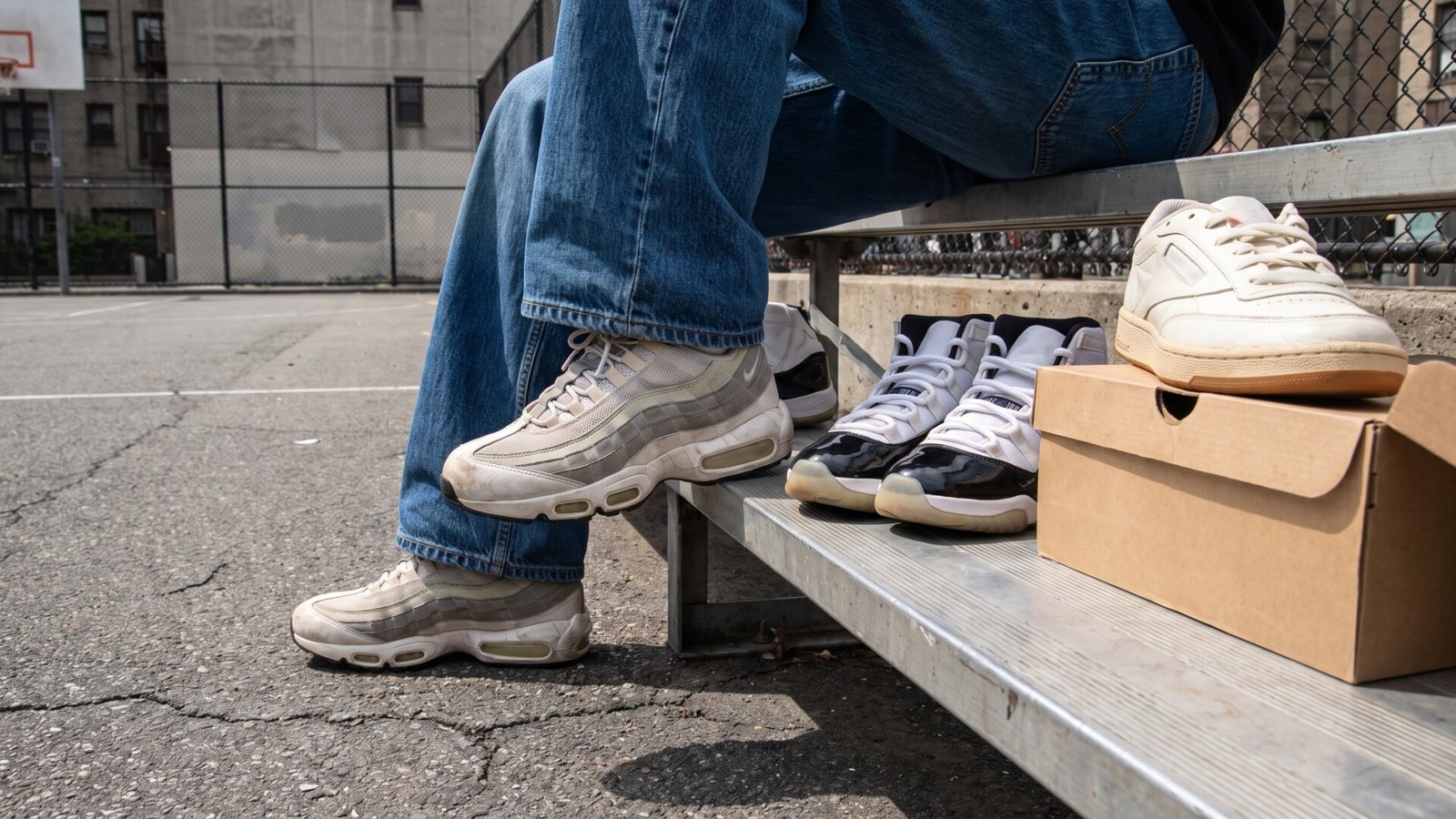
Sergio Lozano designed the upper to mimic human anatomy – the layered panels are muscle fiber, the spine is the ribcage, the gradient is skin. Nike put visible Air in the forefoot for the first time. It was a running shoe that nobody ran in, because the moment it hit the street it became something else entirely.
The neon colorway is the one everybody pictures. Volt yellow, gradient grey, that aggressive forward lean. It still looks more futuristic than nostalgic, which is rare for a 30-year-old design.
What you are actually buying: a statement. The 95 runs bulky, the fit is on the narrow side for a shoe that looks this wide, and the cushioning is firmer than you would expect from all that visible Air. It is not a discreet sneaker and it does not want to be. Pair it with slim trousers and it looks wrong. Pair it with relaxed denim and it looks like it was designed for exactly that.
Cop if you want the decade’s most distinctive technical silhouette and you dress with volume. Pass if you want one sneaker that disappears into an outfit.
Reebok Pump
The Pump made fit technology visible. You squeezed a basketball-shaped bladder on the tongue, air pushed into the collar, and the shoe locked around your foot. It was a gimmick in the best sense – a gimmick you could feel.
Reebok built an entire ad campaign around it, put it on NBA courts, and sold the idea that footwear could be futuristic. In a decade obsessed with technology you could see, the Pump was the purest expression of that.
Real talk about the current versions: the Pump is a style purchase now. The inflation system on modern retros works, but nobody should buy these expecting the on-court feel of a 1991 original. Buy it because you want a bold high-top with a story, not because you think the bladder is going to change how you walk.
Cop if you collect basketball history or want a high-top that does something. Pass if you want a clean, minimal everyday shoe.
Air Jordan 11
Released in 1995, the 11 is the decade’s best example of performance footwear turning into formalwear. Patent leather on a basketball shoe was genuinely strange at the time. It read as dressy, which is exactly why it crossed over.
Concord, Bred, and the Space Jam association turned it into a status object that had nothing to do with basketball. People who never watched a game wanted the shiny one.
The practical downside is the patent leather itself. It creases. It scuffs. It shows every mark and it does not clean up the way smooth leather does. And the glossy panel makes the shoe harder to wear casually than a Jordan 1 or an Air Force 1 – it wants a decent outfit, not gym shorts.
Cop if you want the decade’s most collectible crossover and you will actually wear it with intent. Pass if you want a beat-around daily shoe.
Nike Air Force 1
The AF1 predates the 90s by a decade, but the 90s is when it became the uniform. White-on-white, high and low, worn by everyone from DJs to dealers to kids who just wanted to look clean. Regional scenes adopted it, customized it, and made it mean something different in every city.
High versus Low is a real decision, not a colorway choice. The High gives you ankle coverage and more visual weight – it reads more deliberate, more 90s. The Low is lighter, easier to style, and works with shorts. Both run on the same sole.
What owners consistently report: the leather starts stiff and takes a few wears to break in, and the midsole yellows and scuffs if you do not stay on top of cleaning. White AF1s are a maintenance commitment. That is the tax on the cleanest look in sneakers.
Cop if you want one 90s sneaker that works with jeans, cargos, shorts, and basically everything else. Pass if you are not going to clean them.
Vans Old Skool
The side stripe, the suede toe box, the vulcanized rubber sole – the Old Skool is visual shorthand for skate culture, and skate culture is one of the 90s’ biggest exports. Skate teams, skate media, and a whole aesthetic built around the idea that you did not need to look expensive to look right.
Here is the honest split. As a skate shoe, it is genuinely functional – the suede reinforcement is there because canvas tears, and the vulcanized sole gives board feel. As an all-day walking shoe, it is thin. The cushioning is minimal and the support is basically the shape of the rubber.
The classic black and white is the one. It goes with everything, it ages gracefully, and it never looks like you are trying too hard.
Cop if you want low-profile skate styling and you are not on your feet for ten hours. Pass if you need cushioning.
Puma Suede
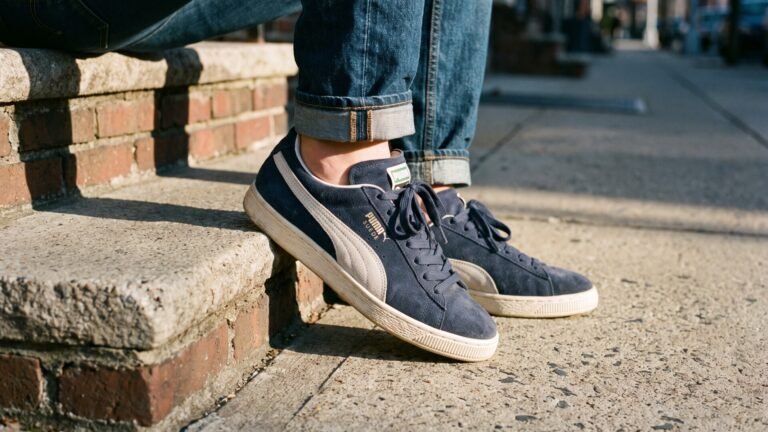
The Suede is the shoe that carried breakdancing, early hip-hop, and street crews out of the parks and into the culture. Low profile, soft suede upper, saturated colors – blue, red, green, black. It was never trying to look technical. It was trying to look like you.
That is the whole point. Where the Air Max 95 and Jordan 11 shout, the Suede speaks. It is a different kind of 90s sneaker, and for a lot of people it is a more honest one.
The tradeoff is underfoot. There is not much there. For commuting, standing, or long days, the Suede is a style choice with a comfort cost. Wearers who love it accept that. Wearers who need support should look elsewhere.
Cop if you want authentic 90s streetwear without visual bulk. Pass if you need cushioning under your day.
Converse Chuck Taylor All-Star
Chucks were the great equalizer of the 90s. Bands wore them. Skaters wore them. Students wore them. People who did not care about sneakers at all wore them. Canvas upper, rubber toe cap, and a silhouette that has not needed updating in a century.
High or Low is the only real question. The High gives you the classic profile and a bit more ankle coverage. The Low is lighter and reads more casual. Both come in every color you can imagine, which is why they work with denim, cargos, shorts, and even casual tailoring.
The limitation is real and worth saying plainly: classic Chucks are flexible and lightweight, but they are not a supportive shoe. Thin underfoot feel, minimal arch support, no cushioning to speak of. They are a style purchase and a cultural purchase. They are not a walking shoe.
Cop if you want the most versatile silhouette in the decade and you understand what you are getting. Pass if your feet need help.
Nike Air Huarache
Tinker Hatfield‘s sock-like construction was genuinely radical. The neoprene inner bootie hugged the foot, the heel cage supported it, and the whole thing looked like it came from a future where shoes were grown rather than built. It was an early example of a performance design that immediately became a lifestyle shoe.
The fit is the whole story. The internal sleeve runs snug, which works beautifully for narrow and average feet and can be genuinely uncomfortable for wider ones. Sizing also drifts between releases, so a 10 in one retro is not always a 10 in another.
Cop if you want a technical-looking 90s sneaker and you are willing to try before you buy. Pass if you have wide feet and no patience for returns.
Air Jordan 4
It launched in 1989, but the 4’s cultural weight is a 90s thing. Michael Jordan, Spike Lee, basketball visibility, and design details – mesh panels, plastic wing eyelets, that clean mid-cut shape – made it instantly recognizable in a way few shoes manage.
Compared to the 11, the 4 is the easier wear. It is more visibly rugged, it takes a casual outfit without complaint, and it does not demand the same level of styling. The 11 is sleeker and more formal. The 4 is the one you can actually live in.
The catch is price. Jordan 4 retros carry resale demand, and you can end up paying a premium for a shoe you are going to wear to the grocery store. New pairs also run stiff for the first several wears.
Cop if you want the best blend of basketball history and streetwear relevance. Pass if you are not prepared to pay the Jordan tax.
Reebok Classic Leather
The understated one. Neutral colorways, a clean low profile, and none of the aggression of the decade’s technical runners. The Classic Leather was the sneaker you wore to school, to work, to travel – the one that did not announce anything.
That is its strength and its weakness. It has less cultural flash than everything else on this list. It also costs less, styles easier, and works in more situations than almost any of them.
Cop if you want a practical 90s look without committing to a loud silhouette. Pass if you want the sneaker to be the point of the outfit.
What Most Buyers Get Wrong About 90s Sneakers
Three mistakes show up over and over.
Mistake one: assuming iconic means comfortable. It does not. Chucks, Old Skools, Puma Suedes, and Classic Leathers are casual-use shoes. None of them is interchangeable with a modern walking shoe, and buying one expecting that is how you end up with a $90 mistake.
Mistake two: assuming original is always better. A deadstock pair from 1995 is not a time capsule. Foam degrades. Adhesives dry out. Rubber hardens. A shoe that has been sitting in a box for thirty years can come apart the first time you wear it, and there is no warranty on that. Unworn does not mean intact.
Mistake three: assuming a retro is the original. It is not. Current retros often differ in shape, materials, cushioning, and finishing. Sometimes the difference is small. Sometimes the shoe is noticeably different in hand. Neither version is automatically better – but you should know which one you are buying.
A framework that actually helps
Stop ranking sneakers by fame. Rank them by what you are going to do.
- Intended use first. Walking, standing, commuting, or sitting? That eliminates half the list immediately.
- Cultural connection second. Which decade story do you actually care about – basketball, skate, hip-hop, running?
- Rarity and resale third. Only after the first two are settled, because a valuable shoe you cannot wear is a shelf decoration.
Run every pair through that order and the decision usually makes itself.
Which 90s Sneakers Still Make Sense to Buy Today?
| Sneaker | Best for | Style impact | Comfort for casual wear | Main drawback | Value today |
|---|---|---|---|---|---|
| Nike Air Max 95 | Statement outfits, tech-runner style | Very high | Moderate | Bulky shape | Best when discounted |
| Air Jordan 11 | Collecting, occasion wear | Very high | Moderate | Patent leather, price | Strong cultural value |
| Nike Air Force 1 | One-pair versatility | High | Moderate | Stiff at first, creases | Strong everyday value |
| Vans Old Skool | Skate-inspired casual | High | Low to moderate | Thin cushioning | Good at regular retail |
| Puma Suede | Low-profile streetwear | High | Moderate | Minimal support | Good value |
| Converse Chuck Taylor | Simple, flexible styling | High | Low for long walks | Thin underfoot | Affordable, durable for casual use |
| Nike Air Huarache | Futuristic 90s styling | High | Moderate | Fit inconsistency | Buy only after trying |
| Air Jordan 4 | Basketball heritage, streetwear | Very high | Moderate | Expensive, stiff new | Best for committed fans |
| Reebok Classic Leather | Everyday understated wear | Moderate | Moderate | Less distinctive | Often the value pick |
The short version:
- Editor’s choice: Nike Air Force 1. Widest styling range, easiest availability, strongest ownership value. If you buy one pair off this list, this is it.
- Style pick: Nike Air Max 95. Nothing else on the list looks like it.
- Collector pick: Air Jordan 11, with the Air Jordan 4 as the easier casual alternative.
- Value pick: Reebok Classic Leather if you want understated, Puma Suede if you want expressive.
Styling 90s Sneakers Without Looking Like You Are Wearing a Costume
The costume problem is real and it almost always comes from doing too much at once. One strong 90s element reads as style. Four read as a theme party.
Pick one loud piece. Chunky Air Max 95s with relaxed denim and a plain tee. Or a bright Puma Suede colorway carrying an otherwise neutral outfit. The sneaker is doing the work – let it.
Balance your proportions. Baggy jeans, cargos, relaxed shorts, oversized hoodies, graphic tees, windbreakers, denim jackets – all of it works, but not all at once. If the pants are wide, keep the top closer to your actual size. If the top is oversized, keep the pants straighter.
Style the cleaner models differently. Air Force 1s and Classic Leathers work with straight-leg trousers and a simple jacket. Chucks and Old Skools suit denim and skate-inspired layers – flannels, hoodies, work jackets.
Skip the matching. Do not coordinate your sneaker to your hat to your shirt. Do not stack logos. Do not recreate a photo you saw on a nostalgia account. The people who wore these shoes in 1996 were not trying to look like 1996. They were just getting dressed.
The Hidden Cost of Choosing the Wrong Pair
Price is not what a sneaker costs. Price is what it costs divided by how often you wear it.
A $60 pair you wear twice is worse value than a $180 pair you wear every week for two years. Do that math before you buy, because it changes the answer more often than any spec does.
What goes wrong, and when
White Air Force 1s need regular cleaning or they stop being white. Suede picks up stains and needs protection before the first wear, not after. Patent leather on the Jordan 11 shows every scuff and does not buff out. Canvas on Chucks offers essentially no weather resistance – one good rain and you are squishing. And genuinely old pairs can have aging you cannot see until the sole separates.
The resale reality check
Most general-release retros do not appreciate. Being from a famous decade is not a value proposition. What moves price is condition, colorway, size, release history, and current demand – and demand is fickle. Plenty of 90s retros that people bought as “investments” are worth roughly what they paid, minus fees.
Buy current, wearable releases for regular use. Treat genuinely vintage or rare pairs as collectibles, and only after you have verified condition.
Buying and Caring for 90s-Inspired Sneakers
If you are buying older or deadstock pairs, check four things: the release date, the material condition, the return policy, and the seller’s reputation. A seller who will not accept returns on a thirty-year-old shoe is telling you something.
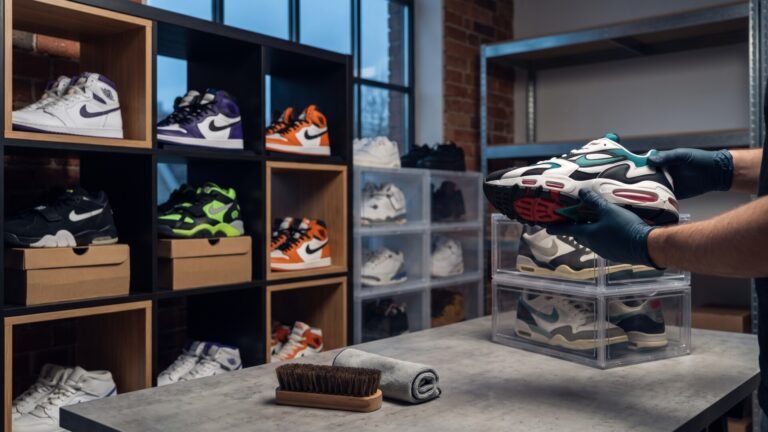
For care, match the product to the material. A basic kit covers most of it:
- Sneaker cleaning kit with a soft brush for uppers and a stiffer one for midsoles
- Suede eraser and brush for Puma Suede, Old Skool panels, and Classic Leather
- Microfiber cloths for drying and buffing
- Protector spray applied before the first wear, not after the first stain
- Replacement laces – cheap, and they reset a tired pair instantly
Do not use a leather cleaner on suede or a suede brush on patent. That is how a $150 shoe becomes a $40 shoe.
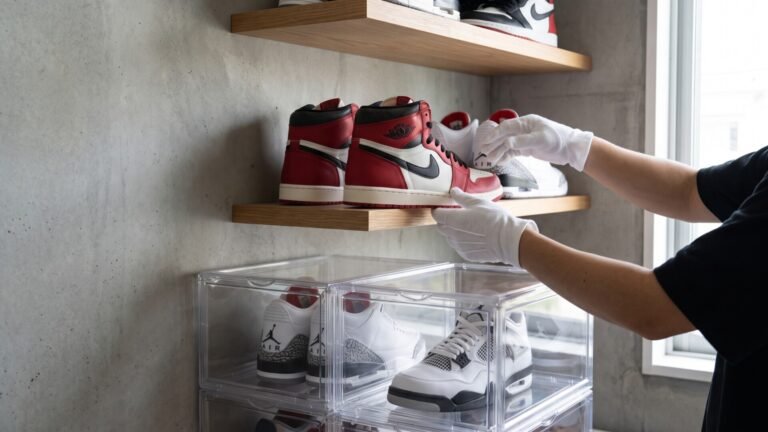
Storage basics: keep pairs cool and dry, out of prolonged heat, with shoe trees or stuffing to hold the shape. And do not assume an original box means good condition. Boxes survive better than shoes do.
Fit checks that matter
For wide feet and long days, prioritize toe room and underfoot comfort over hitting the exact vintage silhouette. Supportive insoles can help, but only if they do not crowd the shoe – a cramped fit is worse than no insole at all. Buy from somewhere with returns, especially for the Huarache and any Jordan retro, because fit shifts between releases.
Final Verdict: The 90s Sneaker Icons Worth Buying Now
Nike Air Force 1 is the overall winner. It carries real 90s cultural weight, it goes with more outfits than anything else here, and you can buy it today without a resale markup or a lucky drop. That combination is rare.
Nike Air Max 95 is the pick if you want the decade’s most distinctive design and you dress with volume. Accept the bulk. It is the point.
For everyday wear on a budget, Vans Old Skool, Puma Suede, Converse Chuck Taylor, and Reebok Classic Leather all do the job – with the understanding that none of them is built for serious walking without help.
For collecting and status, Air Jordan 11 and Air Jordan 4 are the ones, as long as you are buying them for the right reasons.
The rule underneath all of it: buy the sneaker whose original cultural role matches how you will actually wear it. Not the one with the strongest nostalgia. Not the one with the highest resale. The one that fits your actual life.
The Cheaper Truth
You do not need the grail. You need the pair you will actually wear.
The Reebok Classic Leather at regular retail, or a Puma Suede in a color you like, will do more for your rotation than a resale-priced Air Jordan 11 that sits in a box because you are scared to crease it. The Air Force 1 is the safest money on this list, and it is not the expensive one.
Spend more only when you have a specific reason: you want the Air Max 95’s silhouette and nothing else will do, or you are collecting Jordans on purpose and you know why. Everyone else can stop researching and go buy the white ones.
Frequently Asked Questions About 90s Iconic Sneakers
What is the most iconic sneaker of the 90s?
Depends on how you measure it. By pure cultural recognition, the **Nike Air Force 1**, **Air Jordan 11**, **Nike Air Max 95**, and **Air Jordan 4** are the strongest candidates. If you want one answer that covers the most ground, the Air Force 1 wins – it was everywhere, it crossed every scene, and it is still on shelves.
Are 90s sneakers still fashionable?
Yes, and not in a nostalgia way. Chunky runners, visible technology, skate shoes, high-tops, and relaxed clothing proportions are all current. Whether a pair looks modern or costume-like comes down to styling and condition. A clean pair styled with one strong element looks current. A beat pair styled head-to-toe retro does not.
What are the best 90s sneakers for everyday wear?
**Nike Air Force 1**, **Reebok Classic Leather**, **Puma Suede**, and **Vans Old Skool**. All four work with normal clothes and normal days. Just separate everyday style from all-day walking comfort – if you are on your feet for hours, none of these is a walking shoe.
Are original 90s sneakers worth buying?
Only for collectors who can verify condition. Foam, adhesives, rubber, and fabric all degrade with age, and a deadstock pair can fall apart on the first wear. If you plan to actually wear them, buy a current retro instead.
Which 90s sneakers are best for wide feet?
Check the specific release, because fit changes between models and production runs. Classic low-profile styles tend to feel restrictive; roomier retros are more forgiving. Buy from a retailer with returns rather than trusting the model name.
Do 90s sneakers have resale value?
A minority do. Condition, original packaging, colorway, size, scarcity, and current demand matter far more than age. Most general-release retros are worth roughly retail or less on the secondary market.
What should I wear with 90s sneakers?
Relaxed denim, cargos, oversized sweatshirts, graphic tees, windbreakers, and simple outerwear. One strong retro element usually looks better than a full recreation – let the sneakers carry the outfit and keep everything else calm.