Top 10 Air Jordans for Collectors
Air Jordan — More Than a Sneaker
Air Jordans are history, culture and, for some buyers, an investment in a single box. Since 1985 the line has shaped sneaker communities worldwide, and collectors do not just buy these shoes. They hunt them, protect them and, if they are sensible, wear some of them.
This list covers the top 10 Air Jordans for collectors: the pairs with the strongest stories and the clearest place in Jordan history. Each entry gives the year, the designer where it is documented and current retail in USD where we could verify it. Resale prices move daily, so we do not quote them as promises. For the full catalog, our Air Jordan Sneakers guide covers every key release, and our Nike sneakers hub places Jordan Brand inside the wider Nike story.
Which Jordan Should You Collect First?
Most “best collectible Jordans” lists rank pairs by hype. A more useful question is what kind of collector you want to be, because the same story can be a museum piece in its original form and an everyday shoe as a retro. One check before any purchase: count how often the colorway has been reissued. The Concord debuted in 1995 and returned in 2000, 2011 and 2018. The Fire Red 5 came back in 2006, 2013 and 2025. The Flu Game 12 has been reissued too, including in 2016 and 2025. Each reissue makes the story easier to buy at retail, so scarcity lives in the originals, not the retros. If you can afford only one pair for now, buy the retro of the story you care about most and wear it. Handle a few retros before you spend grail money on an original. Pick your lane first, then the pair.
Choose a grail-tier original if you:
- Want a 1985-era pair as a display piece
- Can budget for authentication, careful storage and insurance
- Care more about provenance than about wearing the shoe
Choose a story retro if you:
- Want the moment: the Concord’s playoff fine, the Flu Game, the Last Shot
- Can pay retail or a modest resale premium instead of grail prices
- Like a pair you can display now and wear later
Choose a wearable general release if you:
- Plan to wear them every week
- Are working to a retail budget of roughly $180 to $230 a pair
- Are building a first collection around the 1, 4 and 6 silhouettes
The Top 10 at a Glance
| Pair | Year | Collector story | Current retail (USD) |
|---|---|---|---|
| Air Jordan 1 “Chicago” | 1985 | The original blueprint | High OG retros from about $180 |
| Air Jordan 3 “Black Cement” | 1988 | Jumpman debut, visible Air | About $215-$230 |
| Air Jordan 4 “White Cement” | 1989 | Seen in Do the Right Thing | About $220-$230 |
| Air Jordan 5 “Fire Red” | 1990 | Reflective tongue, shark-tooth midsole | $215 (2025 release) |
| Air Jordan 6 “Infrared” | 1991 | First championship shoe | About $215 |
| Air Jordan 11 “Concord” | 1995 | Patent leather, playoff fine | Varies by release |
| Air Jordan 12 “Flu Game” | 1996 | 1997 Finals Game 5 | Varies by release |
| Air Jordan 13 “He Got Game” | 1997 | Panther-inspired sole | About $215 |
| Air Jordan 14 “Last Shot” | 1998 | Final Bulls shot | Varies by release |
| Air Jordan 1 “Bred” | 1985 | The “Banned” legend | From about $180, varies |
Retail figures come from Nike.com and major US retailer listings checked in November 2026. They are approximate because prices shift by release, size run and region. Where we could not confirm a current price, the table says so.
1. Air Jordan 1 “Chicago”
The Air Jordan 1 is where it all began. Designed by Peter Moore and released in 1985 at $65, it set the template for the whole line. The white, black and varsity red “Chicago” colorway is the one collectors treat as the foundation of a Jordan collection, and original 1985 pairs sit in auction-house territory: a vintage Chicago was listed at $32,000 in a Sotheby’s collector guide.
One correction to a common story: the “banned” legend belongs to the black and red colorway, not the Chicago, and it is murkier than the ad suggests (more under number 10). Retros arrive regularly, and current Air Jordan 1 Retro High OG releases are listed around $180 on Nike.com. For a cheaper way into the silhouette, the Air Jordan 1 Low and Mid are listed around $120 and $130 before sale discounts. Collectors generally treat the High OG as the collectible form, since the 1985 original was a high-top. Lows and Mids are better bought to wear.
Want the everyday Low? Shop the Air Jordan 1 Low – Men’s →Women’s →
Collecting other Jordan 1s? Read our guide to spotting fake Travis Scott Jordan 1 Lows to see what authentication looks like in practice.
2. Air Jordan 3 “Black Cement”
Released in 1988, the Air Jordan 3 was the first Jordan shaped by Tinker Hatfield’s design influence and the model that debuted the Jumpman logo. The Black Cement features elephant print accents and visible Air cushioning in the heel.
It is one of the more wearable collector pieces. Current Air Jordan 3 retros are listed at roughly $215 to $230 for men’s.
3. Air Jordan 4 “White Cement”
The Air Jordan 4, released in 1989 and designed by Tinker Hatfield, features mesh panels, lacing wings and bold midsole accents. It was the first Air Jordan released on the global market. The original four colorways were Black/Cement (“Bred”), White/Cement, White/Fire Red and White/Military Blue.
Its culture credit is specific: the White Cement pair appears in Spike Lee’s Do the Right Thing (1989), on the character Buggin Out, whose clean pair gets scuffed. Current 4 retros are listed around $220 to $230 for men’s, which makes it a wearable entry and a live resale story. See our look at the 2026 Jordan 4 Bred reissue and whether Jordan 4s are still a good investment.
4. Air Jordan 5 “Fire Red”
The Air Jordan 5, released in 1990 and designed by Tinker Hatfield, is known for its reflective tongue, translucent sole and shark-tooth midsole design. The Fire Red colorway is the one most collectors picture first, and it had a pop-culture run on The Fresh Prince of Bel-Air, where Will Smith wore several colorways. The black-tongue Fire Red returned on September 13, 2025, for the model’s 35th anniversary, at a $215 retail price.
Because the 5 is a pair people want to wear and keep clean, it helps to know about crease protectors and whether they actually work.
Need a set of crease protectors? Find it on Amazon →
5. Air Jordan 6 “Infrared”
Released in 1991, the Air Jordan 6 is the sneaker Michael Jordan wore while winning his first NBA championship. The Infrared colorway is vibrant but clean, with perforations, molded heel tabs and Jumpman detailing. Current Air Jordan 6 retros are listed around $215 for men’s.
6. Air Jordan 11 “Concord”
The Air Jordan 11, designed by Tinker Hatfield, was the first Air Jordan to use patent leather, paired with a ballistic mesh upper. Jordan debuted the white-and-black Concord in the 1995 playoffs against Orlando, while his teammates wore black shoes, and was fined $5,000 for the mismatch. The public release followed on November 1, 1995, at $125.
One common mix-up: the Concord is not the pair from Space Jam. The film’s shoe is the all-black “Space Jam” colorway, which did not reach stores until 2000. The Concord has been reissued in 2000, 2011 and 2018, so a recent retro is easy to find. The 1995 original is the collector’s prize.
7. Air Jordan 12 “Flu Game”
The Air Jordan 12, released in 1996, features a “Rising Sun” motif. The black and red Flu Game colorway was worn in Game 5 of the 1997 NBA Finals, when Jordan played despite being ill. It is a story-first collector pair, the leather construction holds up well for wear, and retro releases in 2016 and 2025 mean you can own the look without chasing an original.
8. Air Jordan 13 “He Got Game”
The Air Jordan 13, designed by Tinker Hatfield, takes its panther-inspired sole and holographic eye from the black panther concept. The He Got Game colorway is tied to Spike Lee’s 1998 film of the same name. Current Air Jordan 13 retros are listed around $215 for men’s.
The 13 also holds the headline price for the line: in April 2023, a pair of Jordan’s game-worn “Last Dance” Air Jordan 13s from the 1998 Finals sold for $2.2 million at auction, a record for sneakers. That is a game-worn artifact, not a retail pair, but it shows why the model has a place in collector conversations.
9. Air Jordan 14 “Last Shot”
The Air Jordan 14, released in 1998 and co-designed by Hatfield and Mark Smith, was inspired by Jordan’s Ferrari 550 Maranello. The black and red “Last Shot” colorway is the pair he wore when he hit the go-ahead shot over Bryon Russell in Game 6 of the 1998 NBA Finals on June 14, his final game with the Bulls. The black and red pair did not reach stores until March 1999, so it is the collector’s way to own the last chapter of that era.
10. Air Jordan 1 Retro High OG “Bred”
Rounding out the list is the Air Jordan 1 Bred (black and red), the “Banned” colorway. The real story is more complicated than the commercial. The NBA’s rule was that a player’s shoes had to match their uniform and teammates’ shoes. According to sneaker historian Marvin Barias, the shoe the NBA objected to in an October 1984 exhibition game was the Nike Air Ship “Bred,” not the Jordan 1. Nike’s claim that it paid every fine has never been proven, but the “Banned” ad did the job and helped build the shoe’s reputation.
Either way, the Bred 1 is a historical artifact for a collection. It is also back in conversation with the Jordan 4 Bred reissue covered under number 3.
Rare Jordans Beyond the Ten
Three pairs worth knowing sit outside the main list, written from general sneaker history rather than a specific source we checked: the Air Jordan 2 (known for being made in Italy), the Air Jordan 7 (tied to the 1992 Olympic “Dream Team”) and the Air Jordan 9.
Collaborations are the other route to a rare pair. Partnerships with Off-White, Dior and Travis Scott produced Jordan 1s that were scarce from release day, and they are bought for scarcity rather than for the silhouette. Player exclusives (PEs) are colorways made for athletes and never sold at retail, which is why one shoe can be common as a general release and rare as a PE. For more on how collabs reshaped sneaker collecting, see Streetwear Sneakers That Defined the 2020s, and for the wider Nike picture read Nike sneakers that shaped streetwear.
What Makes a Jordan Collectible
- Story: A pair tied to a moment in basketball, film or music keeps its following longer than a colorway with no narrative.
- Supply: Check the production run and the reissue history. Limited collaborations and player exclusives are scarce by design, while general releases are made in volume.
- OG or retro: OG pairs come from the first production run and are rare and often too fragile to wear. Retros re-release the design, but shape and materials differ between years, so research the specific release.
- Condition: Deadstock (DS, never worn) pairs with the original box generally command more, but a clean wearable pair is still a good collection piece.
- Proof: Authentication matters more as prices rise. Keep receipts, tags and box labels with the pair. When buying, match the style code on the box label to the official product listing and ask for clear photos of the tag, insole and outsole before you pay. A price far below market is a warning sign, not a bargain.
How Much Does a Jordan Collection Cost?
Prices fall into three tiers. At the entry level, the Air Jordan 1 Low and Mid list around $120 and $130. The core of most collections is retro pairs at roughly $180 to $230: the 1 High OG near $180, the 4 at about $220 to $230, and the 5, 6 and 13 near $215. Above that, original and vintage pairs trade on condition and provenance, with 1985 Chicago pairs listed in the tens of thousands of dollars and a game-worn 13 reaching $2.2 million.
It helps to remember where retail started. The Air Jordan 1 cost $65 in 1985 and the Concord 11 cost $125 in 1995, so a $180 High OG retro costs nearly three times the original sticker price in nominal dollars. Keep that in mind when a seller pitches a retro as an investment: retail has already risen, and resale fees and fakes take a further share.
Storing and Displaying Collector Pairs
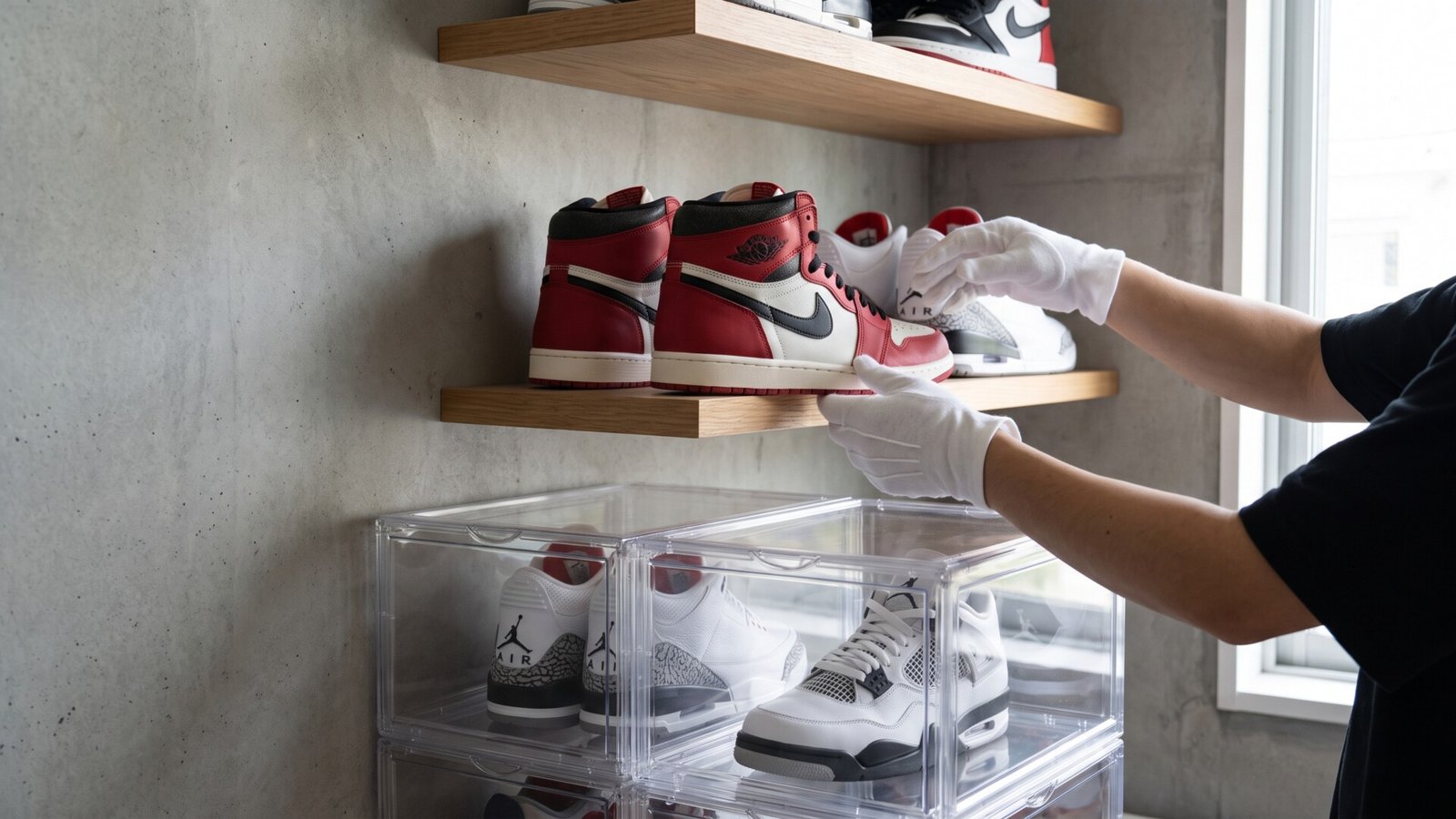
Age works against old Jordans. Translucent outsoles yellow and darken over time, and older foam and glue can break down, which is why many vintage pairs are too fragile to wear. A few habits slow the damage. Keep pairs out of direct sunlight, store them somewhere cool and dry rather than an attic or garage, and keep them in the original box when you are not displaying them. Stuff the toe box with acid-free tissue to hold the shape, and rotate display pairs so no single shoe sits under light for years. If you plan to keep a pair deadstock, do not try it on repeatedly, and if you wear a retro, a crease protector helps.
Tips for Collectors
- Start with what you love: A collection built on resale predictions is a gamble. See our flip guide for the market-side view.
- Research retros carefully: Some are faithful to the original, others are not.
- Authenticate every pair: Use our guide to avoiding fakes and buy from trusted sources.
- Look for collabs and exclusives: Limited editions can become the crown jewels, but they also carry the most risk.
- Keep the box: The box and its label are part of the pair’s record and its value.
Patience and knowledge are as important as money. Collecting is a lifestyle, not a quick flip. For more history in this series, read Iconic Sneakers of the 90s and Iconic 90s Sneakers to Collect.
Frequently Asked Questions About Collecting Air Jordans
Which Air Jordan is the rarest?
It depends on what you mean by rare. Original 1985 pairs, player exclusives and game-worn pairs sit at the top, and the record is $2.2 million for a game-worn Air Jordan 13 sold in April 2023. Among retail releases, limited collaborations are usually the scarcest because only a small run reaches stores.
Which Jordan 1 colorways are the most collectible?
The Chicago and Bred lead because they are the original 1985 colorways with the strongest stories. After them, collaborations such as Off-White, Dior and Travis Scott are chased for scarcity. A recent retro of any of them is a far more affordable entry than a vintage pair.
Are retro Jordans collectible, or only OG pairs?
Both, in different ways. OG pairs are collected for age and rarity, while retros are collected for the story, and the scarcest retros are limited or anniversary releases. A retro is rarely rare on its own, so check how many times the colorway has been reissued before paying a premium.
Where should I buy collectible Jordans?
Start with official Nike and Jordan Brand releases and authorized retailers. For sold-out or older pairs, use resale marketplaces that authenticate every pair, and compare the listing photos against a trusted legit-check guide before you pay.
Are Air Jordans a good investment?
Some pairs have appreciated, but prices are volatile and not guaranteed, and fees and fakes eat into returns. Buy what you want to own and treat any resale gain as a bonus rather than the plan.
Should I wear my collector Jordans?
It is up to you. Many collectors wear general-release pairs and keep OG, rare or deadstock pairs for display. Cool, dry storage and crease protection help the pairs you wear, and keeping the box helps preserve the value of the ones you do not.
Conclusion
Air Jordans are cultural touchstones, and the best collections are built around stories the owner actually cares about. From the Chicago 1s to the Last Shot 14s, each of these pairs tells a part of Michael Jordan’s career and the street culture that adopted it.
Whether you are a seasoned collector or building your first serious rotation, start with one or two pairs you will actually enjoy, learn how to authenticate them, and expand from there.