Nike Sneakers That Shaped Streetwear
Nike Streetwear Shoes: From Courts, Tracks and Skate Parks to the Street
Nike did not set out to make streetwear. Almost every pair on this list began as a basketball, running or skate shoe and was claimed by people who had little to do with the sport. That gives Nike’s street story three routes: the court (Air Force 1, Blazer, Air Jordan 1, Dunk, Air More Uptempo), the track (Cortez, the Air Max line, Huarache, Presto) and the skate park (SB Dunk). Below are the Nike streetwear shoes that mattered most, in the order they appeared, with the designers, dates and moments that check out, current prices in USD, and a guide to which pair to buy first.
Nike is only one side of the story. For the rest, see how Adidas shaped street culture, how Puma defined street culture and the history of ASICS sneakers.
The Nike Streetwear Icons at a Glance
| Sneaker | Year | Started as | Why it mattered |
|---|---|---|---|
| Cortez | 1972 | Running | Bowerman’s runner became an everyday staple |
| Blazer | 1973 | Basketball | Plain leather canvas, reworked by Off-White |
| Air Force 1 | 1982 | Basketball | First basketball shoe with Nike Air |
| Air Jordan 1 | 1985 | Basketball | Blueprint for sneaker culture |
| Dunk | 1985 | Basketball | College-colors shoe adopted by skaters |
| Air Max 1 | 1987 | Running | Put visible Air on the street |
| Air Max 90 | 1990 | Running | Everyday Air Max classic |
| Air Huarache | 1991 | Running | Sock-like fit, minimal branding |
| Air Max 95 | 1995 | Running | Anatomy-inspired design |
| Air More Uptempo | 1996 | Basketball | Oversized AIR lettering |
| Air Max 97 | 1997 | Running | Full-length visible Air, silver ripples |
| Air Presto | 2000 | Running | T-shirt-style comfort and sizing |
| SB Dunk | 2002 | Skate | Skate-ready Dunk and hype releases |
Cortez — The Running Shoe That Went Mainstream
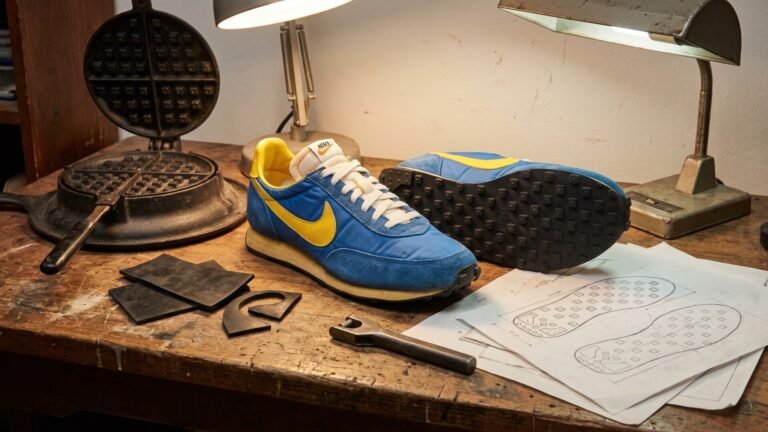
Credited to Nike co-founder Bill Bowerman, the Cortez was released in 1972 and was one of the first running shoes Nike sold under its own name. The design traces back to Bowerman’s work with Onitsuka Tiger in the 1960s, when his company was still called Blue Ribbon Sports. It is the oldest design here and the simplest: a lightweight leather runner with a clean profile that goes with almost anything. Two moments carried it beyond running. Whitney Houston wore a pair for the national anthem at the 1991 Super Bowl, and Forrest Gump ran across America in them in 1994. For other early Nike silhouettes, see the history of the Nike Waffle Trainer.
Find the Cortez – Men’s →Women’s →
Blazer — A Plain Canvas for Designers
The Blazer arrived in 1973 as one of Nike’s earliest basketball shoes: a leather upper, an oversized Swoosh and little else. That plainness made it an easy canvas. When Virgil Abloh reconstructed ten Nike icons for Off-White’s 2017 project “The Ten”, the Blazer Mid was one of five shoes in the “Revealing” group, alongside the Air Jordan 1, Air Max 90, Presto and VaporMax. The Blazer Mid ’77 Vintage is its everyday form today.
Air Force 1 — The Original Street Icon
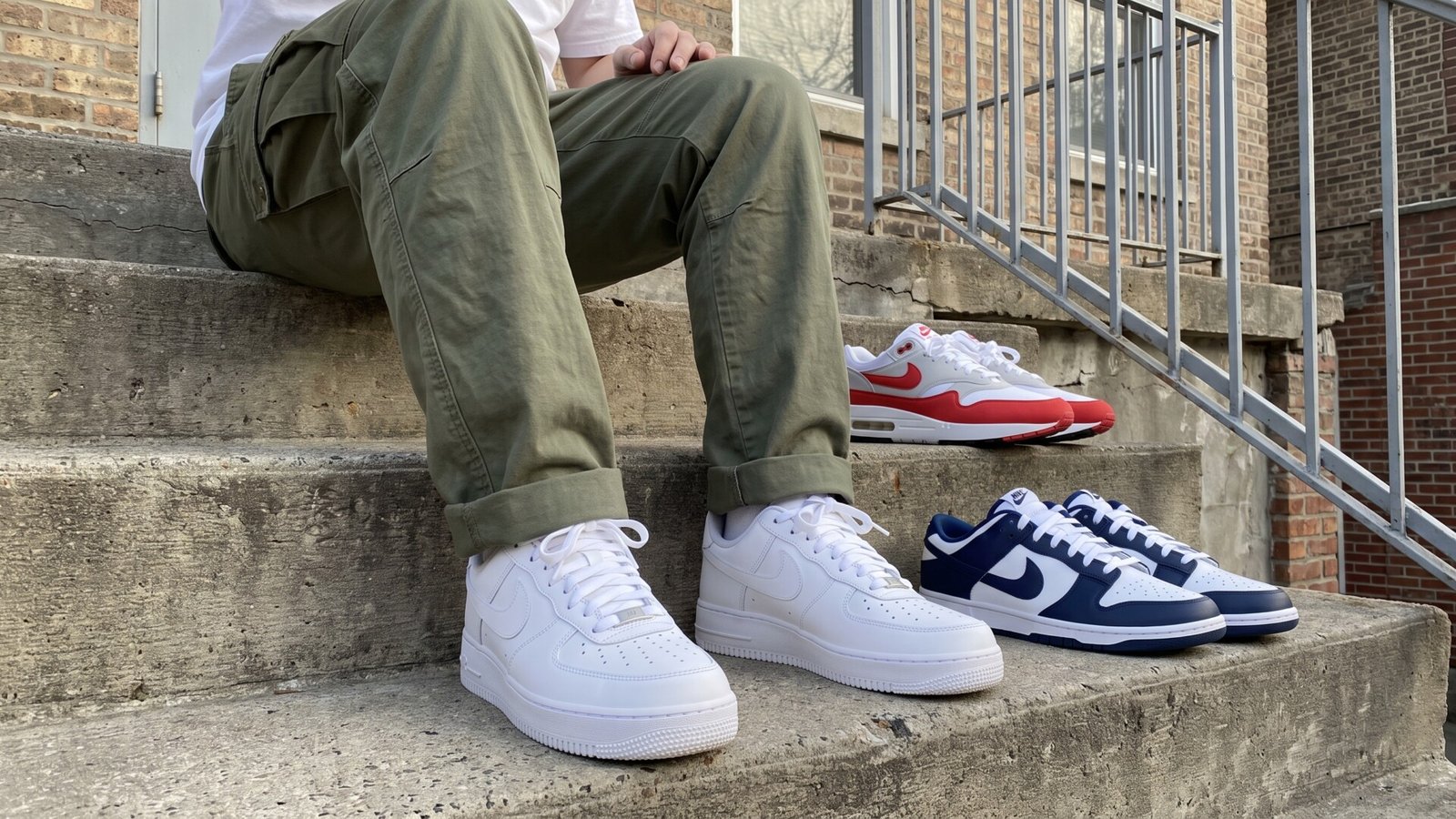
Designed by Bruce Kilgore and introduced in 1982, the Nike Air Force 1 was the first basketball shoe to use Nike Air technology. Nike now calls it its best-selling shoe of all time, with more than 2,000 iterations, and says Kilgore’s one goal was that it “had better work”. Its clean leather silhouette and thick sole made it perfect for everyday wear, but retail turned it into culture. In 1985, three Baltimore retailers re-released the shoe in royal blue and chocolate brown, and all 3,000 pairs sold out quickly. From 1986 to 1991, select retailers released one-off designs, and sneaker culture spread up the East Coast from Baltimore.
Custom colorways, graffiti designs and exclusive drops carried the AF1 through hip-hop and urban fashion, and collaborations with Virgil Abloh, Travis Scott and Supreme pushed it further.
Buy it today: The Air Force 1 ’07 lists at about $115–$130 on Nike.com, depending on the colorway. See how it compares in Air Force 1 vs Adidas Stan Smith or find lookalikes in best sneakers similar to Air Force 1.
Get the Air Force 1 ’07 – Men’s →Women’s →
Air Jordan 1 — Streetwear’s Holy Grail
The Air Jordan 1, designed by Peter Moore and released in 1985, built the template for sneaker culture. Its high-top shape and color-blocking, plus Nike’s “Banned” ad campaign, made it a symbol of rebellion. Chicago, Bred and Royal remain the most sought-after colorways in both OG and retro forms, and Abloh’s 2017 Off-White version showed the shape could carry high fashion. For the collector’s view, read our top 10 Air Jordans for collectors.
Dunk — From College Courts to Skate Culture
Peter Moore, fresh from the Air Jordan 1, sketched the Nike Dunk as the “College Color High” for Nike’s College Colors program. It launched in 1985 under the tagline “Be True To Your School”, with team colorways for twelve universities, including UNLV, Arizona, Iowa, Michigan, Georgetown, Syracuse and Kentucky. Skaters gave it a second life, and the Dunk SB series added padding and grip. Today the standard Dunk Low is one of the most popular lifestyle shoes around.
Hype collaborations, including Travis Scott and Ben & Jerry’s (the “Chunky Dunky” from 2020), made the Dunk a cultural icon that bridges sports, skate and streetwear.
Buy it today: Men’s Dunk Low Retro pairs list at $120–$130 on Nike.com.
Shop the Dunk Low – Men’s →Women’s →
Air Max 1 — Where Style Meets Innovation
Designed by Tinker Hatfield, an architect who joined Nike in 1981, the Air Max 1 drew on the exposed structure of the Centre Pompidou in Paris and put visible Air in the heel. Nike had first used Air cushioning in footwear in 1978, and the Air Max 1 let people see it, which turned a technical feature into a style statement. Nike marks Air Max Day on March 26, the date of the 1987 release, and collaborations with Patta and atmos brought the shoe to new generations. General-release pairs run about $140–$150 at major US retailers.
Air Max 90 — Comfort Meets Style
Released in 1990 and also designed by Tinker Hatfield, the Air Max 90 pairs a visible Air unit with a layered upper and bold colorways. In 2017, Virgil Abloh rebuilt it for the “Revealing” group of Off-White’s collection with Nike; our Nike x Off-White collaboration review covers the full project. Men’s pairs list at $135–$145 at Nike and major US retailers.
See the Air Max 90 – Men’s →Women’s →
Air Huarache — The Sock-Like Runner
Released in 1991 and designed by Tinker Hatfield, the Air Huarache brought a sock-like neoprene fit and minimal branding to a running shoe. It crossed into streetwear because it was comfortable, distinctive and clean, and its stretch fit later inspired the Presto. Retros and collaborations keep it in rotation.
Air Max 95 — The Anatomy Lesson
Designed by Sergio Lozano and introduced in 1995, the Air Max 95 took its cues from the human body: the lacing resembles ribs, the outsole a spine, and the mesh and suede upper muscle fibers. It added visible Air in the forefoot, and the grey and neon yellow colorway remains its signature look. Original-style pairs list at $190–$200. If you remember a 1990s sneaker-store wall, our guide to the iconic sneakers of the 90s has the rest of that decade.
Air More Uptempo — Bold Statement Piece
The Air More Uptempo debuted in 1996, designed by Wilson Smith, who drew on pop art and graffiti for the giant “AIR” lettering. Scottie Pippen wore it for the 1996 season and at the Atlanta Olympics, and Brendan Fraser’s character wore a pair in George of the Jungle (1997). Supreme’s 2017 “Suptempo” brought the shape back to streetwear. If you like this era, our guide to iconic 90s sneakers to collect goes further.
Air Max 97 — Sleek Speed Meets Street Cred
Designed by Christian Tresser and released in 1997 at $150, the Air Max 97 was the first Air Max with a full-length visible Air unit. The popular story that Japanese bullet trains inspired it is a myth, according to Nike’s own history of the shoe: Tresser has said the ripples came from a drop of water and the metallic silver from mountain bike parts. The silver colorway became a streetwear staple, and Off-White’s 2017 version and the Sean Wotherspoon Air Max 1/97 hybrid pushed it into collector territory.
Buy it today: Men’s pairs list at $175–$185 on Nike.com. Nike says the shoe fits small and recommends going up half a size.
Check available sizes – Men’s →Women’s →
Air Presto — The T-Shirt for Your Foot
Designed by Tobie Hatfield, Tinker’s younger brother, the Nike Air Presto arrived in 2000 with a stretch spacer-mesh upper, a V-notch collar and a tagline that said it all: “T-shirt for the foot”. It was sold in letter sizes rather than numbers, so check Nike’s size chart before you buy. The idea began in the 1990s, when Hatfield put on a new running shoe at a production meeting in Korea and felt the collar splay out. His fix was the V-notch. He gave the first prototype, a size 9, to a co-worker who wore an 11, and the tester never noticed the fit was off, which led Hatfield to size the shoe like a T-shirt. Off-White reworked the Presto in 2017, which helped keep it a collector favorite.
SB Dunk — Skate Culture Revolution
The Nike SB Dunk officially arrived in 2002. Padded tongues, Zoom Air insoles and grippy outsoles made it skate-ready, while bold colorways made it street-ready. Richard Mulder, Reese Forbes and Danny Supa were among the first Nike SB skaters, and each got a signature Dunk SB colorway.
Two 2005 releases are the stuff of legend. Jeff Staple’s “Pigeon” went on sale in New York on February 22, 2005, in only 150 pairs, 30 each at five boutiques, and the crowds outside his Reed Space store made the news. The “Tiffany” Dunk SB by Nick Tershay of Diamond Supply Co. is the other grail from that year, and the “Heineken” is another early collector favorite. These limited editions fueled hype culture. Compare today’s versions with the standard model in SB Dunk vs regular Dunk.
Newer Runners on the Street: Air Max Plus and Zoom Vomero 5
Two runners drive much of Nike’s recent street momentum. The Air Max Plus launched in 1998 with Tuned Air cushioning and a plastic cage over a mesh upper. Nike says it fits small and recommends a half size up, and men’s pairs list at $180–$190. Our Air Max Plus review covers why it is peaking. The Zoom Vomero 5, which Nike pitches as early-2000s running updated for today, lists at $160–$180 in the US and is covered in why it is the most comfortable sneaker of 2026. Like the Cortez and Air Max 1 before them, both started as performance shoes.
Two more modern shapes are worth knowing. The Air VaporMax was one of the five shoes in the 2017 Off-White “Revealing” group, and the Air Max 270, launched in 2018, was Nike’s first Air Max built specifically for lifestyle wear rather than running. Both put Air technology front and center in a modern shape instead of an archive look, which suits buyers who want something current rather than a heritage pair.
See all colorways – Men’s →Women’s →
Who Should Buy Which Nike Streetwear Shoes?
If you are shopping rather than collecting, match the shoe to how you will wear it. Prices are US list prices at the time of writing, and retailers often discount.
Choose the Air Force 1 ’07 if you:
- Want one clean pair that works with everything, from about $115
- Prefer a chunky leather shape over a sporty one
- Are building a wardrobe on a budget: see the best Nike sneakers under $150
Choose the Dunk Low if you:
- Want more color and a lower, slimmer retro-court profile than the AF1
- Like skate-inspired style at $120–$130
- Would rather buy general-release pairs than chase resale
Choose the Air Max 90 if you:
- Want visible Air without the Air Max 97’s higher price ($135–$145 vs $175–$185)
- Prefer a layered runner shape in simple colorways
- Like the Off-White lineage and its fashion crossover
Choose the Zoom Vomero 5 if you:
- Put comfort first and want Zoom Air cushioning ($160–$180)
- Like the current early-2000s runner look
- Want more attitude? Compare the Air Max Plus at $180–$190
Nike Streetwear Shoe Prices at a Glance
These are US list prices at the time of writing. Sale prices are often lower, and limited releases sell for far more on resale.
| Model | US list price | Best for |
|---|---|---|
| Air Force 1 ’07 | $115–$130 | One do-everything pair |
| Dunk Low Retro | $120–$130 | Color and a skate-court look |
| Air Max 1 | $140–$150 | The original visible Air |
| Air Max 90 | $135–$145 | Everyday Air Max |
| Zoom Vomero 5 | $160–$180 | Comfort first |
| Air Max 97 | $175–$185 | Sleek silver statement |
| Air Max Plus | $180–$190 | The loudest look |
| Air Max 95 OG | $190–$200 | Anatomy-inspired classic |
Nike or Adidas: Which Dominates Street Style?
Neither brand wins outright; they win in different ways. Nike’s street icons mostly began as performance shoes and gained status through retail exclusives, collaborations and limited drops, which is why so many entries above are tied to a specific release or moment. Adidas leans more on court and terrace classics such as the Superstar, Gazelle and Samba, and you can see how that played out in why the Adidas Samba became popular again. If you can only own one brand’s classics, pick by silhouette: chunky and technical points to Nike, low and slim points to Adidas. A practical test is your trousers. Wide-leg and cargo cuts balance a chunky Air Max or AF1, while slim denim keeps proportions even with a lower Dunk or Cortez.
Tips for Collectors and Streetwear Fans
- Know what you are buying: OG, retro and general-release pairs are different products with very different prices.
- Condition matters: Near-new pairs with the box generally command more, and limited-edition prices change fast. For perspective, the 2005 Pigeon Dunk retailed for $300 and has since resold for thousands of dollars, while most general-release pairs above still sell near list price.
- Authenticate before you pay: Use our guide to avoiding fakes and buy from trusted sellers.
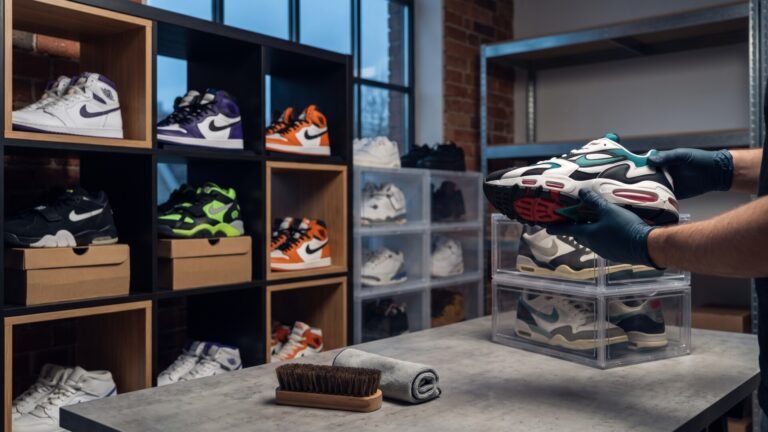
- Rotate and store well: Wear your everyday pairs and keep the delicate ones protected.
Frequently Asked Questions About Nike Streetwear Shoes
Which Nike running shoes work as streetwear?
The Air Max 90 and 97, Air Max Plus, Zoom Vomero 5, Huarache and Presto all began as runners, and so did the Cortez. For comfort, start with the Vomero 5 ($160–$180). For a louder look, pick the Air Max Plus ($180–$190). The Air Max 97 and Air Max Plus fit small, so try half a size up.
Which Nike basketball shoes are most popular in streetwear?
The Air Force 1, Air Jordan 1 and Dunk lead, with the Blazer and Air More Uptempo as more distinctive picks. The AF1 and Dunk Low are the easiest to wear every day at roughly $115–$130, while the Jordan 1 is the shoe collectors chase.
Which Nike skate shoe is the most iconic?
The SB Dunk Low. It added padding, Zoom Air and a grippy outsole to the 1985 Dunk, and releases such as the 2005 Staple Pigeon, limited to 150 pairs, turned it into a collector’s shoe. It is the model the Nike SB line was built around.
What makes Nike shoes iconic?
Three things repeat across this list: a designer with a clear idea (Kilgore, Hatfield, Moore, Tresser), technology you can see, such as Air, and a cultural moment nobody planned, from the 1985 Baltimore AF1 drop to the Pigeon riot or Forrest Gump’s Cortez. Shoes with all three tend to last.
How has Nike influenced streetwear culture?
Mostly through how it sells, not only what it makes. Retailer-exclusive AF1 colorways in the 1980s, limited SB Dunk drops in the 2000s and Off-White’s 2017 project The Ten, which rebuilt ten Nike shoes, each showed that scarcity and collaboration could sell a sneaker.
Conclusion
Nike sneakers shaped street culture by being borrowed from sport and made personal on the street. Start with the Air Force 1 or Dunk Low if you want to wear them, add an Air Max for contrast, and use the history above to decide which ones are worth chasing. For the next wave, see streetwear sneakers that defined the 2020s.