Skate Sneakers That Will Never Go Out of Style
Welcome back to Street Sneakers Vault. Today we’re talking about the skate sneakers that have stood the test of time. Not the hyped releases that come and go with the seasons. Not the collabs that cost a month’s rent on the resale market. We’re talking about the OGs: the ones that look just as right today as they did decades ago.
Skateboarding has been around since the 1950s, and sneaker culture has been intertwined with it for most of that time. Before there were “tech” shoes with air units and fancy foams, skaters grabbed whatever gripped the board and didn’t fall apart after three ollies. Some of those shoes faded into obscurity. Others became legends.
Here’s the thing about timeless style: it doesn’t try hard. These sneakers aren’t timeless because a marketing team decided they should be. They’re timeless because generations of skaters, punks, hip-hop fans, and regular people kept buying them. They work, and they look right.
Quick Picks: Classic Skate Sneakers at a Glance
| Sneaker | Construction | Best for |
|---|---|---|
| Vans Old Skool | Canvas and suede, vulcanized waffle sole | Everyday wear, classic skate look |
| Nike SB Dunk Low | Leather or suede, foam midsole, rubber cupsole | Skaters who want more cushioning and collectors |
| Adidas Superstar | Leather with rubber shell toe | Streetwear looks, and ADV versions for skating |
| Converse Chuck Taylor All Star | Canvas, rubber toe cap | Budget-friendly versatility |
| Converse One Star | Suede, low profile | A slightly less obvious alternative to the Chuck |
| Converse Road Classic SK OX | Canvas and suede, low-profile | Samba-style looks with a skate-ready sole |
Starting with the two oldest classics? Shop the Old Skool →Chuck Taylor All Star →
Now let’s break each one down.
Vans Old Skool: The One That Started It All
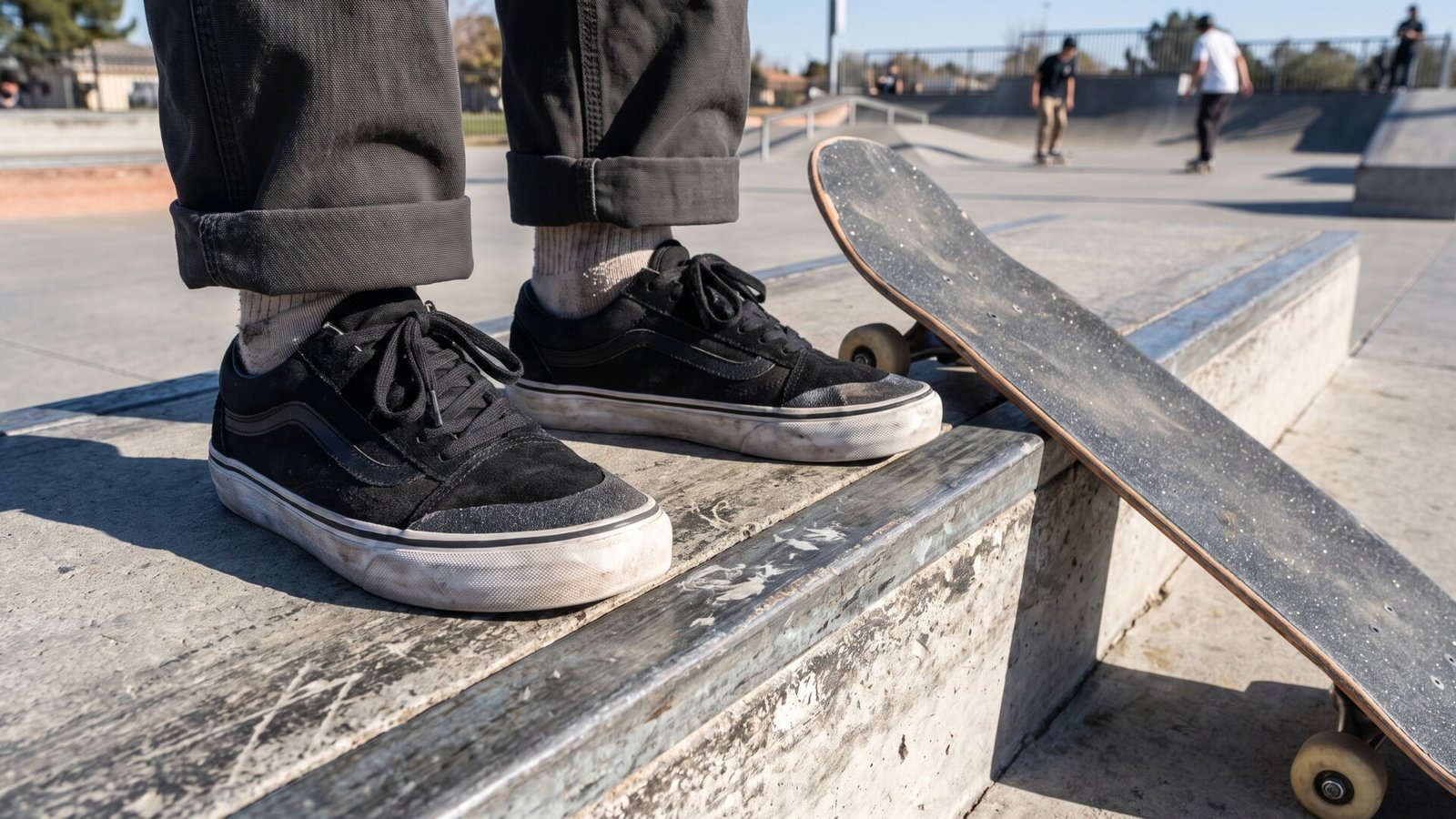
Let’s start with the obvious one, because you can’t have this conversation without the Vans Old Skool. This shoe is older than most of the people reading this article.
Vans debuted what was then called the “Style 36” in 1977. It was the first Vans shoe to feature the wavy line on the side, the Sidestripe, which started life as the “jazz stripe” and, according to Vans, was a doodle by founder Paul Van Doren. Imagine doodling something that becomes one of the most recognizable logos in footwear.
The Old Skool wasn’t just about looks. The mix of canvas and suede layers gave it durability against grip tape, and the vulcanized waffle outsole gave skaters the board feel and grip they wanted. By the 1990s it had become a staple among street skaters, and it has been adopted by plenty of other scenes along the way, including punk and hip-hop.
What makes the Old Skool timeless? A simple formula: suede and canvas upper, vulcanized construction, padded collar, and that waffle sole. It’s not packed with gimmicks, and it doesn’t try to be futuristic.
Vans keeps updating it while keeping the silhouette intact. The Skate Old Skool, for example, adds skate-focused touches such as a DuraCap underlay in key areas to protect against griptape wear and a molded heel counter, according to Vans’ product page. There are also wide and chunkier platform versions. If you like the high-top look, compare it with the Sk8-Hi in Vans Old Skool vs Sk8-Hi, or the lower-profile options in Vans Authentic vs Slip-On.
Here’s the real test of timelessness: you can buy a pair today, wear them for years, and they’ll still look right.
Price: The classic Old Skool lists at about $75 on Vans’ US site; prices vary by version and retailer.
Nike SB Dunk: From Forgotten to Unforgettable
Let’s talk about the comeback kid. The Nike SB Dunk has a story that sounds like a movie script. For a deeper look at the model, see our Nike Dunk guide.
Originally released in 1985, the Dunk was a college basketball shoe designed by Peter Moore, the same designer behind the Air Jordan 1. Skaters picked up on the Dunk in the mid-1980s because of its lean profile, durable leather, and decent traction. By the 1990s the Dunk had mostly disappeared from Nike’s focus, but skaters hadn’t forgotten it.
In 2002, Nike SB relaunched the Dunk with skate-focused upgrades, including a padded tongue and a Zoom Air insole. Nike worked with its original team riders, Reese Forbes, Gino Iannucci, Richard Mulder, and Danny Supa, and the Dunk Low Pro SB was customized to riders’ specs, which kicked off the “Colors By” series.
Then came 2005. Diamond Supply Co. founder Nick Tershay collaborated with Nike SB on a Dunk Low with a mock-croc leather upper and shiny silver Swoosh. The black and teal colorway, nicknamed the “Tiffany” Dunk, became one of the best-known sneakers of the decade and helped move the Dunk from skate shops into mainstream sneaker culture.
Other well-known SB moments include the Three Bears pack, which introduced the Dunk Pro Mid SB with its signature strap, and the Rayguns Dunk Low Pro SB, which was the first to put the SB logo on the tongue, according to Nike SB.
Two decades on, the Dunk is still a canvas for new colorways and collaborations, and it is still being skated. Today’s SB Dunk Low Pro has a suede upper, a foam midsole, and a rubber outsole with a pivot circle. If you are choosing between the SB version and the lifestyle Dunk, remember that the SB models are built with skating in mind, with extra padding and different construction. For a style comparison with another classic, see Adidas Forum vs Nike Dunk.
Prefer the lifestyle Dunk Low? Find the Dunk Low – Men’s →Dunk Low – Women’s →
Price: The SB Dunk Low Pro lists at about $115 on Nike.com. Hyped colorways and collaborations usually sell for much more on the resale market.
Adidas Superstar: The Shell Toe That Refuses to Quit
The Adidas Superstar was designed in 1969 and introduced around 1970, according to Adidas, as a basketball shoe with a full leather upper and the famous rubber shell toe. The shell toe was there to protect players’ feet on court. Nobody back then could have predicted that more than fifty years later people would still be buying shell toes.
The Superstar’s path into skate culture is different from the others on this list: it was not designed for skating, but it was adopted anyway. The shell toe is tough, the leather holds up, and the style is hard to beat. Adidas has since honored skaters including Mark Gonzales and Tyshawn Jones with their own Superstar pairs.
Adidas Skateboarding also makes skate-focused models, including the Superstar ADV, the Busenitz, and the Centennial 85 Low ADV. Check the product page to confirm you are getting an ADV (skate-oriented) version rather than the lifestyle Superstar if you plan to skate in them. More on the brand’s skate line is in Skateboarding with Adidas.
Want the lifestyle Superstar? See the Superstar – Men’s →
Price: Prices vary by version and retailer, so check current listings.
Converse Chuck Taylor All Star: The Original Original
We can’t talk about timeless skate shoes without the Chuck Taylor All Star. This shoe is ancient by sneaker standards. Converse designed the forerunner of the All Star in 1917, marketed as the “Non-Skid”, with a rubber sole and canvas upper for basketball players. Charles “Chuck” Taylor joined Converse in 1921, and his signature was added to the ankle patch in the 1920s.
The Chuck was originally a basketball shoe, but skaters later found that canvas high-tops and low-tops were cheap, gripped the board decently, and had a look nothing else could match.
Converse’s modern skate program, CONS, debuted in 2009 with a reworked low-top Chuck and the ERX 300 mid-top. Converse is owned by Nike (acquired in 2003), which has given CONS access to Nike cushioning tech. CONS had a strong run, but note that Sole Retriever reported in September 2026 that the program’s sales reps were let go and several riders left or were not renewed, so check what’s currently in stock before you plan a purchase around a specific CONS model.
The Chuck has been around for over a century because it refuses to be anything other than itself. Canvas upper, rubber toe cap, simple silhouette. You can dress it up, beat it down, or skate it until the canvas rips, and it still looks right. For a closer comparison, read Chuck 70 vs Regular Chuck Taylor.
Prefer the sturdier Chuck 70? Check out the Chuck 70 →
Price: Varies by version and materials; check current listings on Converse and at retailers.
Converse One Star: The ’70s Classic That Came Back
The Converse One Star is a 1970s silhouette that became a staple of 1990s alternative culture, where street and skate came together. It’s got a low-profile shape, the star logo on the side, and is commonly made in suede.
For years the One Star lived in the shadow of the Chuck Taylor, but plenty of skaters and sneaker fans knew its appeal: a flatter profile and a slightly more distinctive look. Converse has kept it in rotation through CONS with updated materials, and the One Star Pro has been worn by skaters like Alexis Sablone.
The New Kid on the Block: Converse Road Classic SK OX
I want to shout out something newer that already feels like a classic in the making: the Converse Road Classic SK OX.
Here’s the deal: it looks a lot like a Samba. Fashion press has compared its heel and toe paneling to the Adidas Samba, with a sole that follows the Nike Killshot 2. But it pulls from an archival Converse running shoe, the Road Machine, so it is more a case of Converse digging into its own history than copying the Samba wave.
The Road Classic SK OX combines a low profile, a mixed canvas and suede upper, and retro sport cues with a tacky rubber sole designed for skateboarding. Reports say it has been sold mainly in Japan (around 11,550 yen, roughly $78, at the time Gear Patrol covered it), so availability elsewhere may be limited.
Can’t find the Road Classic? These are easier to get. Get the Samba →Killshot 2 – Men’s →Killshot 2 – Women’s →
Will it become timeless like the Old Skool or the Chuck? Too early to tell. But it has the ingredients: heritage roots, skate functionality, and a clean design.
Skate Shoes vs Regular Sneakers: What’s Actually Different?
If you’re wondering whether to buy skate shoes or regular sneakers, the answer depends on whether you plan to skate. Skate shoes are built for the abuse of griptape and ollies, while regular lifestyle sneakers prioritize looks or cushioning. Here are the main differences:
| Feature | Skate shoe | Regular sneaker |
|---|---|---|
| Sole | Flat, grippy rubber with vulcanized or cupsole construction for board feel | Often thicker, more cushioned, sometimes curved for walking or running |
| Upper | Suede, canvas or tough leather, often reinforced where griptape rubs | Mesh, knit, or lighter materials common |
| Padding | Padded collar and tongue; extra impact protection in some models | Varies widely |
| Durability | Built to take scuffs, with reinforcements in key areas | Depends on the model |
Skate shoes also make good everyday sneakers, since the flat soles and tough materials fit casual outfits well. If you only want the look, any of the models above works. If you actually skate, look for a model built for skating, with names like SB, Skate, ADV, Pro, or CONS in the title, rather than the standard lifestyle version. Fit varies between brands, so check the size guide and recent reviews.
Brands With Real Skate Roots
If you want to put your money where the skaters are, look for brands that were built around skateboarding or have long-running skate programs:
- Vans: Skate shoes since the 1970s and the Old Skool, Era, Sk8-Hi, and Authentic.
- DC Shoes, etnies, Emerica and és: Brands that came out of skate culture. See our history of skate culture and DC Shoes.
- Nike SB: Nike’s dedicated skate line, built around the Dunk, Blazer and other models.
- Adidas Skateboarding: Skate-specific versions of the Superstar, Busenitz, Centennial 85 Low and other models.
- Converse CONS: Skate versions of the Chuck and One Star, though the program has been in flux.
- New Balance Numeric: New Balance’s skate line.
What Makes a Skate Sneaker Timeless?
Before we wrap up, let’s break down what these shoes have in common. It’s not an accident that the same names keep coming up.
Simple construction. Every shoe on this list is built around basic materials: canvas, suede, leather, rubber. No crazy gadgets that can break or become obsolete.
Skate credibility. These shoes were all adopted by skaters before they became fashion statements. You can’t market your way into skate culture; you have to earn it.
Cultural crossover. From punk to hip-hop to streetwear, these shoes moved beyond skating without leaving it behind.
Consistent availability. You can usually walk into a Vans store and buy an Old Skool, or order Chucks online whenever you want. Timeless shoes don’t play hard to get.
Room for evolution. Vans updates the Old Skool with new materials and tech, and Nike SB keeps releasing new Dunk colorways, but you still recognize each shoe. Timeless doesn’t mean frozen in time. It means growing without losing yourself.
Keeping Skate Sneakers Looking Good
Skate shoes get beaten up by design, but a little care helps them last longer. Brush off dirt, use a suede brush on suede, and wipe canvas with mild soap and water. Rotate pairs where possible and let wet shoes air-dry away from direct heat. Our Sneaker Care & Longevity hub covers cleaning, protection, and storage by material.
Frequently Asked Questions About Timeless Skate Sneakers
What are the most iconic skate sneakers of all time?
The Vans Old Skool, Nike SB Dunk, Adidas Superstar, Converse Chuck Taylor All Star and Converse One Star are among the most enduring skate-associated sneakers.
Which skate sneaker silhouette is the most iconic?
The Vans Old Skool and the Converse Chuck Taylor are often cited as the most recognizable, thanks to decades of use by skaters and across other subcultures.
Which sneaker brands have real skate roots?
Vans, DC Shoes, etnies, Emerica and és were built around skateboarding, and Nike SB, Adidas Skateboarding, Converse CONS and New Balance Numeric are skate lines from larger brands.
Are skate shoes better than regular sneakers?
It depends on how you use them. Skate shoes have flat grippy soles and tougher uppers, which suits skating and casual wear, while regular sneakers often prioritize cushioning or lightweight materials.
Can you skate in lifestyle sneakers like Chuck Taylors or Superstars?
People do, but skate-specific versions (Nike SB, Adidas ADV, Vans Skate, CONS) add reinforcements and padding that standard lifestyle models lack.
Is the Nike SB Dunk good for skating?
The SB Dunk was relaunched in 2002 specifically for skateboarding, with skate-focused features, and remains a popular skate shoe.
Final Thoughts
Trends come and go. One year everyone’s wearing chunky “dad shoes”, the next it’s sleek runners. But the shoes on this list will be there through all of it.
The Vans Old Skool keeps selling and keeps evolving. The Nike SB Dunk keeps dropping new colorways. The Adidas Superstar keeps its shell toe. And the Converse Chuck Taylor keeps doing what it has done for over a century.
If you’re building a collection that will last, start here. Get a pair of Old Skools in a classic colorway. Pick up Dunks if you can find them at a reasonable price. Add Superstars or Chucks for the days you want that old-school vibe.
These aren’t just sneakers. They’re history you can wear.