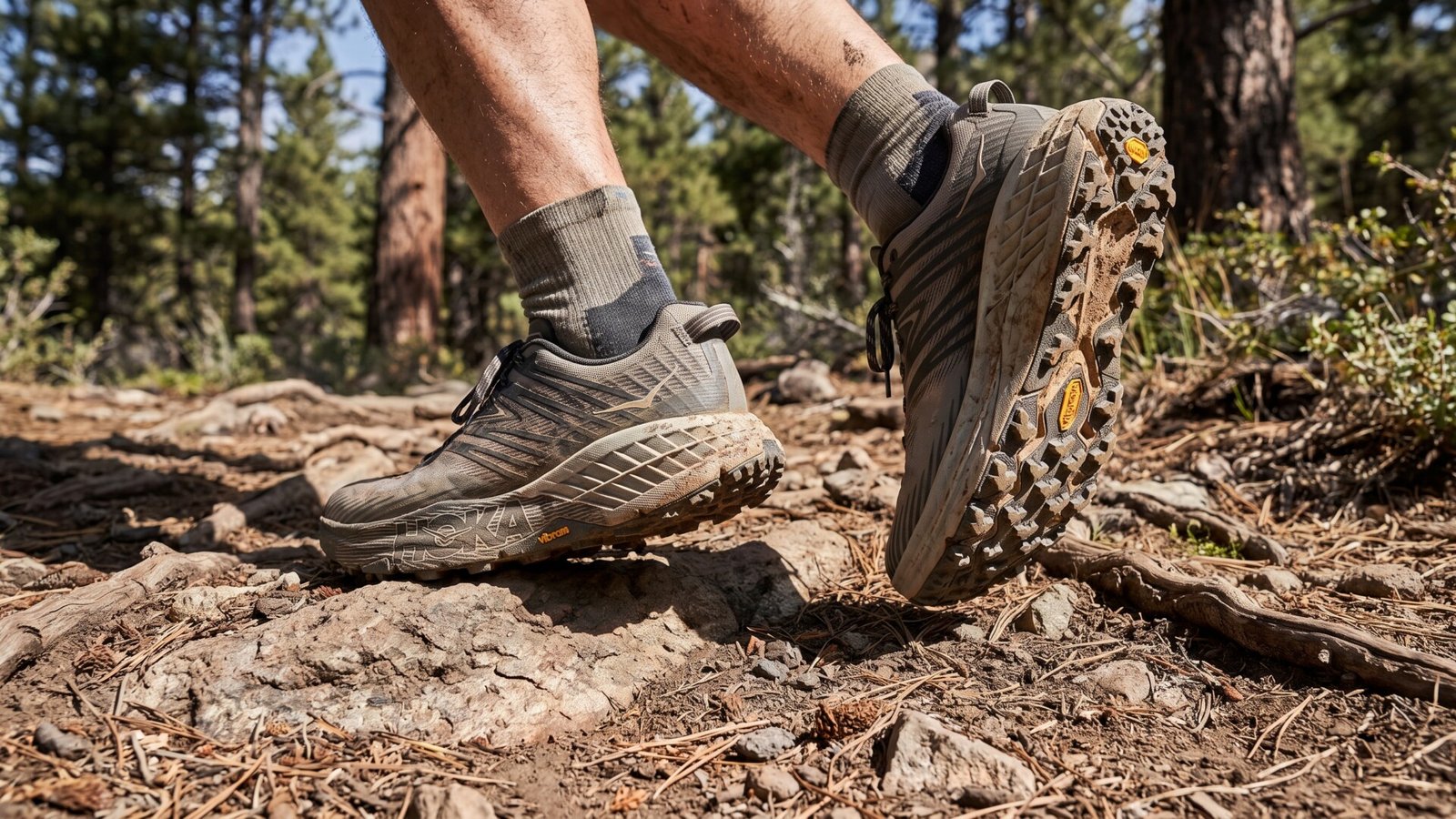
Hoka Speedgoat Review
You already know the Hoka Speedgoat story. It is the shoe every trail runner seems to own, the one with the exaggerated midsole and the grip that gets talked about like a cheat code. And for a lot of you, it genuinely is the right call. But it is not the right call for everyone, and pretending otherwise is how you end up with a $155 shoe that feels wrong on the terrain you actually cover. The Speedgoat is a technical trail shoe through and through – aggressive traction, serious cushioning, built for rocks, roots, and long descents. If your world is pavement, flat paths, or the occasional gravel towpath, this is probably not your shoe, and the Brooks Cascadia or Hoka Challenger ATR 7 deserves a harder look. Let’s figure out which camp you are in.
Hoka Speedgoat at a Glance
| Category | Verdict |
|---|---|
| Best for | Technical trails, rocky terrain, long trail days, hiking |
| Cushioning | Plush and protective, with a high-stack feel |
| Traction | Excellent on loose, wet, and uneven ground |
| Fit | Secure and performance-oriented; wide versions suit more foot shapes |
| Pavement use | Acceptable for short transitions, not the main strength |
| Durability | Good overall, with outsole wear depending on terrain and mileage |
| Value | Strong if used primarily on trails; less compelling as an everyday road shoe |
| Editor’s choice | Hoka Speedgoat 6 for buyers wanting the current all-around Speedgoat experience |
Quick recommendations before we go deep:
- Buy the Hoka Speedgoat 6 if: you want a cushioned trail shoe with dependable grip for technical terrain.
- Choose a wide version if: standard trail shoes usually pinch at the forefoot or your feet swell during long outings.
- Look elsewhere if: you mostly walk or run on pavement, prefer a low-to-the-ground feel, or want a lighter, faster shoe.
- Editor’s choice: Hoka Speedgoat 6, assuming the current version is available in your preferred width and price.
What the Hoka Speedgoat Is Designed to Do
Let’s clear up a confusion that shows up in every comment section: the Speedgoat is not a lifestyle sneaker with trail vibes. It is not the shoe you buy because it looks good with joggers. It is a purpose-built trail runner, named after ultrarunner Karl Meltzer – Speedgoat Karl, a guy who has won more hundred-mile races than almost anyone alive. That naming tells you everything about the design brief: this is a shoe for moving fast and staying protected over terrain that would punish a road shoe within a month.
The Speedgoat’s identity comes from two things. First, the stack of cushioning underfoot. Hoka built its name on maximum cushioning, and the Speedgoat carries that philosophy onto the trail. The midsole absorbs impact from rocks, roots, and hard landings, which matters more the longer you are out there. Second, the outsole. The Speedgoat uses Vibram Megagrip with aggressive lugs, and that combination is the real reason people trust this shoe on loose dirt, wet rock, and steep sections.
Here is the tradeoff that does not make it into the marketing. The same structure that protects you on technical trails – the tall platform, the substantial outsole, the rocker geometry – can feel bulky and less efficient on pavement. The shoe does not flex like a road trainer. It does not give you that snappy, close-to-the-ground feel. On smooth hardpack or asphalt, you are carrying trail equipment that is not working for you.
Within Hoka’s lineup, the Speedgoat sits at the aggressive end of the trail spectrum. The Challenger ATR 7 is the crossover option, designed to handle both road and easy trail without feeling awkward on either. The Tecton models are lighter, faster, carbon-plated race shoes for runners chasing times on smoother trail. The Speedgoat is the workhorse – the one you grab when the route is genuinely rough and you want to finish the day without your feet feeling like they went ten rounds.
Comfort and Performance on Real Trails
Cushioning and underfoot protection
Here is the thing people misunderstand about Hoka cushioning. Plush does not mean soft in the way a foam mattress is soft. The Speedgoat’s midsole is protective – it absorbs impact and spreads the load so your feet and legs do not take the full punishment of every rock and hard landing. That distinction matters because buyers sometimes expect a squishy, sink-in feel and then find the shoe firmer than they imagined. The Speedgoat is not a couch. It is a shock absorber with a rocker that keeps you moving forward.
What does that mean in practice? On rocky trails, the cushioning prevents the sharp edges of embedded stones from driving into the bottom of your foot. On long descents, it absorbs the repeated impact that would otherwise hammer your knees and lower back. On a full day of hiking with a pack, it delays the fatigue that comes from feeling every step in your joints.
The downside is real, though. Runners who want ground feel – who want to know exactly what is under their foot – will find the Speedgoat’s platform too tall and too isolated. If you are used to minimal shoes or low-profile trail trainers, the transition can feel like running on stilts. The shoe does not flex much through the forefoot, and that takes adjustment. This is not a criticism of the Speedgoat. It is a warning about matching the shoe to the runner.
Traction and technical terrain
The Vibram Megagrip outsole is where the Speedgoat earns its reputation. The rubber compound grips wet rock and slick surfaces far better than the standard blown rubber you find on cheaper trail shoes. The lugs are aggressive – deep enough to bite into loose dirt and mud, spaced to shed debris rather than pack up and turn into slick platforms.
Why does this matter more than the cushioning? Because traction is the difference between finishing a route confident and spending the whole day walking like you are on ice. On steep climbs, the lugs dig in and give you purchase. On descents over loose gravel, they find grip where a road shoe would slide. On wet rock – the kind that ends trail days early – Megagrip gives you a fighting chance.
But let’s be straight about limits. No outsole eliminates the need for careful foot placement. On smooth, wet rock, even Megagrip can struggle, especially if the surface has a film of mud or algae over it. In deep, slick mud, aggressive lugs help but they do not make you invincible. The Speedgoat gives you a serious grip advantage. It does not give you permission to stop paying attention.
Walking, hiking, and standing
The Speedgoat pulls double duty as a hiking shoe for a lot of owners, and honestly, it is a strong option there. The cushioning protects on rocky trails, the grip handles loose and uneven ground, and the rocker helps keep you moving on long days. For day hikes, travel where you know there will be uneven paths, or any outing that mixes trail and rough ground, the Speedgoat is a legitimate choice.
Where it gets overbuilt is the urban environment. If your version of "hiking" is a paved park path or a few miles of sidewalk, the Speedgoat is more shoe than you need. The aggressive outsole lugs wear faster on concrete, and the tall, rockered platform feels less natural when you are just walking to the store or standing around. For that use, the Hoka Clifton 9 – the road cousin – is lighter, smoother, and cheaper. Or the Challenger ATR 7 if you want the option of easy trail without sacrificing pavement comfort.
Fit, Sizing, and Width
Sizing the Speedgoat starts with a simple rule: begin with your usual running-shoe size. Most buyers find the Speedgoat runs true to length, but there are two adjustments worth making before you commit.
First, think about what happens on a long trail day. Your feet swell. They also slide forward on descents, and if your toes are already at the front of the shoe, you will end the day with bruised nails. Give yourself a thumb’s width of space between your longest toe and the end of the shoe. That is not room to swim in – it is room to move without punishment.
Second, pay attention to heel security and midfoot lockdown. A roomy toe box is only useful if your foot is not sliding around inside the shoe. The Speedgoat’s upper is designed to hold the midfoot securely, and the heel collar does its job, but you need to test that for yourself. Lace the shoe properly – not loose, not death-grip tight – and walk on an incline if you can. If your heel lifts or your foot shifts sideways when the terrain gets uneven, the fit is wrong regardless of what the size chart says.
The wide version deserves serious consideration if standard trail shoes tend to pinch your forefoot, if you have bunions, or if your feet swell noticeably on long outings. Hoka’s wide sizing gives the forefoot more room without turning the shoe into a boat. The catch is that a wide shoe still needs to hold your heel and midfoot. If you need wide in the toe but your heel is narrow, try the wide version with a runner’s lock lacing technique before you give up on it.
Two practical notes. Test the Speedgoat with the socks you actually plan to wear – thick trail socks change the fit completely. And because sizing can vary between versions and even between colorways of the same version, check the retailer’s return policy before you take the shoes outside. Walk around the house on carpet, test them on stairs, and make sure the fit works before the shoes touch dirt.
Durability and Long-Term Ownership
The Speedgoat is built to take a beating, but it wears exactly where you would expect. The outsole lugs are the first thing to show wear, especially if you spend time on abrasive surfaces. On mixed trail use – dirt, rock, roots – the Vibram compound holds up well, and owners routinely get several hundred miles out of a pair. On asphalt, those same aggressive lugs wear down faster, and once they go, the grip advantage goes with them.
The exposed midsole foam is worth watching. The Speedgoat’s cushioning is visible along the sides, and if you regularly brush against rocks or kick curbs, the foam will show scuffs and nicks. That is cosmetic damage for the most part, not structural failure. The upper, usually a breathable mesh, holds up fine for trail use but can develop creasing where it flexes. The heel lining is another wear point, particularly if you tend to slip your shoes on without loosening the laces.
Here is the hidden cost nobody mentions. Using the Speedgoat as an everyday road sneaker means you are paying trail-shoe prices for performance you are not using, and wearing out the outsole faster than a road shoe would wear its own. The math is simple: a $155 trail shoe that lasts 400 miles on trails is good value. The same shoe that lasts 250 miles on pavement because the lugs are grinding against concrete is a worse deal than a $130 road shoe that lasts 400 miles on the same surface.
Maintenance is straightforward. Knock the dirt off after muddy outings before it dries and cakes into the outsole. Air the shoes out naturally – never throw them on a radiator or in a dryer. If you are using the Speedgoat several times a week, rotate them with another pair so the midsole foam has time to recover between uses.
The cost-per-wear framework matters here. A trail shoe that prevents discomfort, gives you confidence on rough terrain, and stays useful across years of long outings is better value than a cheaper shoe that fails you on the first rocky descent. But that value only materializes if you actually use the shoe for what it is built to do.
What Most Buyers Get Wrong About the Speedgoat
The biggest misconception is that more cushioning automatically means more comfort for everyone. It does not. Comfort is subjective and situational. Some runners need stability. Some need flexibility. Some need a close-to-the-ground feel so they can read the terrain through their feet. The Speedgoat’s cushioning is a specific tool for a specific job – protecting you on rough, uneven ground over long distances. If that is not your job, the cushioning is not making you more comfortable. It is just making the shoe heavier and less responsive.
The second misconception is that the Speedgoat’s appeal is the Hoka branding or the chunky aesthetic. It is not. The value is the combination of protection and traction on demanding terrain. That combination is what makes the shoe worth its price. Buy it for the looks and you are paying for performance you will never use.
The third is about versatility. The Speedgoat can handle short road transitions – a mile or two to reach the trailhead, a stretch of pavement between trail sections. But if the majority of your mileage is on roads and sidewalks, the Speedgoat is the wrong tool. The Challenger ATR 7 transitions to pavement far more smoothly. The Clifton 9 is the better road shoe entirely.
On trend and ownership relevance: the Speedgoat is likely to stay useful longer than most sneakers because technical trail performance does not age the way fashion does. A shoe that grips well and protects your feet on a rocky trail is valuable whether it is this season’s model or three years old. But that longevity only matters if you bought it for your terrain rather than its popularity. Buy the shoe for the route, not the hype.
Hoka Speedgoat Compared With Alternatives
| Shoe | Best for | Main advantage | Main drawback | Better choice when |
|---|---|---|---|---|
| Hoka Speedgoat 6 | Technical trails and hiking | Grip, cushioning, protection | Less natural on pavement | The route is rocky, loose, steep, or long |
| Hoka Challenger ATR 7 | Trail-road crossover | Smoother road transitions | Less aggressive trail traction | You split time between pavement and easy trails |
| Hoka Clifton 9 | Road walking and running | Lighter, smoother daily comfort | Not built for technical trails | Most mileage is on streets and sidewalks |
| Brooks Cascadia | Stable all-around trail use | Balanced protection and control | Less plush than the Speedgoat | You prefer a more traditional trail feel |
| Salomon Speedcross 6 | Muddy and steep terrain | Aggressive grip and secure foothold | Narrower, more specialized feel | Mud and steep loose terrain dominate the route |
The comparison is not about which shoe is objectively better. It is about which shoe matches your use.
The Challenger ATR 7 is the Speedgoat’s closest cousin, and the decision between them comes down to terrain. If your routes mix pavement and easy trail – fire roads, smooth singletrack, gravel paths – the Challenger’s less aggressive outsole and smoother ride make it the better daily option. If the terrain gets rocky, loose, steep, or genuinely technical, the Speedgoat’s grip and protection justify the extra aggression.
The Brooks Cascadia is the choice for runners who want a more traditional trail feel. It is stable, well-balanced, and gives you more ground feedback than the Speedgoat. It is not as plush, and it does not have the same maximalist cushioning, but some runners prefer that grounded sensation, especially on technical terrain where they want to feel the trail.
The Clifton 9 is not a trail shoe at all, but it is the right answer for a huge number of buyers who are considering the Speedgoat because they like how Hokas look. If your actual daily use is road walking, commuting, or everyday wear, the Clifton is lighter, smoother, and better suited to pavement.
The Salomon Speedcross 6 is the specialist’s choice. Its grip is even more aggressive than the Speedgoat’s, and its foothold is extremely secure. But it is narrower, more specialized, and less versatile. Buy it only when mud and steep, loose terrain dominate your routes and you are willing to accept a shoe that is not great anywhere else.
Who Should Buy the Hoka Speedgoat?
The Speedgoat is for a specific kind of buyer, and knowing whether you are that buyer saves you money and disappointment.
Buy it if you are a trail runner who regularly encounters rocks, roots, loose dirt, steep climbs, or uneven descents. The grip and cushioning are not luxuries on those routes – they are the difference between a good day and a miserable one.
Buy it if you are a hiker who wants more cushioning and protection than a lightweight road shoe provides. The Speedgoat handles rocky trails and long days with a pack better than most dedicated hiking shoes, and it does it without the break-in period of stiff leather boots.
Buy it if you prefer a substantial, protective platform and do not need strong pavement performance. If your world is trails and you never think about running on roads, the Speedgoat’s single-mindedness is a feature, not a bug.
Buy it if you need a wide option and can confirm the fit gives you enough forefoot room without sacrificing heel security. The wide version opens up the Speedgoat to foot shapes that standard trail shoes punish.
Buy it if you are willing to maintain and rotate the shoe rather than use it as a universal sneaker for every surface. The Speedgoat rewards owners who treat it as the specialized tool it is.
Who Should Skip the Hoka Speedgoat?
Now the other list, and it is just as important.
Skip it if you are a road runner, commuter, or walker whose daily surfaces are mostly concrete or asphalt. You are paying for trail performance you will never use, and the shoe will wear faster on pavement than a road shoe would.
Skip it if you prefer minimal shoes, strong ground feedback, or a flexible, low-profile platform. The Speedgoat’s tall, rockered design is the opposite of what you want, and no amount of cushioning will make up for the disconnect.
Skip it if you need a genuinely fast, lightweight race shoe. The Speedgoat is protective and capable, but it is not light, and it is not built for speed on smooth surfaces. Look at the Tecton line or a lighter trail shoe if racing is the goal.
Skip it if your feet move excessively inside highly cushioned shoes and you cannot achieve a secure fit through sizing or lacing. If your foot slides inside the Speedgoat on uneven terrain, the cushioning stops being protective and starts being a liability.
Skip it if you are buying it mainly because Hoka is fashionable rather than because you need trail-specific grip and protection. There are cheaper, better shoes for pavement, and buying the Speedgoat for the look is how you end up with an expensive shoe that does not fit your life.
Final Verdict
The Hoka Speedgoat 6 wins for technical trail versatility. If your routes are rocky, loose, steep, or long, the combination of Vibram Megagrip traction, protective cushioning, and a stable platform makes it one of the strongest choices you can buy. It is the shoe you grab when the terrain is the problem and you need the shoe to solve it.
But the value equation depends entirely on how you use it. On trails, the Speedgoat earns its price with every mile. As a casual pavement shoe, it is overbuilt, overpriced, and wearing out faster than it should. The Hoka Challenger ATR 7 is the better buy for mixed road and easy-trail use. The Hoka Clifton 9 is the smarter purchase for mostly urban walking and running.
Here is the buyer rule that settles it: buy the Speedgoat when the terrain is the problem you need the shoe to solve, not simply because you want a comfortable-looking Hoka. If you are hitting technical trails, hiking rocky routes, or spending long days on uneven ground, this is your shoe. If you are mostly on pavement, save your money and buy the shoe that matches the road you actually walk.
Frequently Asked Questions About Hoka Speedgoat
Is the Hoka Speedgoat good for everyday walking?
It can be comfortable for outdoor walking and uneven paths, but it may feel too substantial for daily pavement walking. The tall, rockered platform and aggressive outsole are built for trails, not sidewalks. If most of your routes are urban, the Clifton 9 is lighter and smoother, and the Challenger ATR 7 handles the occasional easy trail without sacrificing pavement comfort.
Is the Hoka Speedgoat true to size?
Most buyers can start with their usual running-shoe size, but allow extra toe room for downhill movement and foot swelling on long trail days. Sock thickness changes the fit, and sizing can vary between versions and colorways. Test the shoe with the socks you plan to wear, and check the return policy before taking it outdoors.
Is the Hoka Speedgoat good for wide feet?
The wide version is the safer starting point for broad forefeet or feet that swell during long outings. It gives the forefoot more room without turning the shoe into a boat. Just remember that a wide shoe still needs to hold your heel and midfoot securely – if your foot slides inside, the fit is wrong regardless of the width.
Can you wear the Hoka Speedgoat on pavement?
Short pavement sections are fine – a mile or two to reach the trailhead is not going to hurt anything. But frequent asphalt use will wear the aggressive trail outsole faster and make the shoe feel less efficient than a road model. If most of your mileage is on pavement, you are better off with the Clifton 9 or Challenger ATR 7.
Is the Hoka Speedgoat good for hiking?
Yes, for most day hikes and even longer outings on uneven terrain. The traction handles rocks, roots, and loose dirt, and the cushioning protects your feet over long miles with a pack. Pack weight, terrain, ankle support needs, and personal fit still matter – the Speedgoat is not a replacement for a high-top boot if you need ankle support.
How does the Hoka Speedgoat compare with the Brooks Cascadia?
The Speedgoat suits buyers who want more cushioning and protection, especially on rocky or technical terrain. The Cascadia is better for those who prefer a more grounded, stable, traditional trail feel. Both are solid shoes – the choice comes down to whether you want maximum protection or more direct feedback from the trail.
Is the Hoka Speedgoat worth the price?
Yes, if you are a regular trail user who will actually use its grip and protection. The traction on wet rock and loose terrain, combined with the cushioning on long descents, justifies the cost for trail runners and hikers. No, if you mostly need an urban walking or running shoe – you are paying for trail performance you will never use.