Puma Palermo vs. Adidas Samba: Which Retro Sneaker Is Better?
Most people buying their first pair of terrace sneakers assume the Samba is the safe choice and the Palermo is the compromise. Flip that. The Samba is the sharper shoe and the more versatile one, and it is also the one more likely to squeeze your foot by hour four. The Palermo gives up a little silhouette precision and picks up room, color, and the fact that not everyone on the train is wearing your shoes. That is the whole tradeoff in one sentence, and the rest of this comes down to which half of it you can live with.
Both of these are low-profile, suede-heavy, football-descended shoes with gum-style soles and a shared cultural address. That is why they end up in the same browser tab. But the Puma Palermo vs Adidas Samba question is not a coin flip dressed up as a comparison. Fit, shape, branding, and the way each one finishes an outfit are genuinely different, and product photos flatten all of it.
Early answer: Adidas Samba if you want the strongest classic silhouette and the easiest styling. Puma Palermo if you want a less ubiquitous shoe, a more relaxed feel, or actual color in your rotation.
At a Glance: Puma Palermo vs. Adidas Samba
| Category | Puma Palermo | Adidas Samba |
|---|---|---|
| Typical retail price | Usually around $90 to $110 | Usually around $100 to $120 |
| Best for | Color, casual styling, less common alternative | Classic terrace styling, slim outfits, trend recognition |
| Comfort | Moderate; firm and relatively flat | Moderate; firm, flat, and structured |
| Walking | Fine for errands and short commutes | Fine for casual walking, rough for long days |
| Fit | Often more forgiving, but version-dependent | Often narrow through midfoot and toe |
| Durability | Good in casual rotation with suede care | Upper holds up; outsole wear depends on use |
| Style versatility | Denim, shorts, relaxed streetwear | Denim, trousers, skirts, minimalist fits |
| Value | Better below retail or in versatile colorways | Better when shape and recognition matter |
Quick recommendations
- Choose the Adidas Samba for the most recognizable terrace sneaker, a slimmer profile, and maximum styling range with tailored trousers, jeans, skirts, and clean minimalist outfits.
- Choose the Puma Palermo for a more relaxed visual balance, stronger color-blocking, and a sneaker that does not feel overexposed.
- Choose neither for all-day standing if you need real cushioning, arch support, or a genuinely wide fit. Neither shoe is built for that job.
- Editor’s choice: Adidas Samba for pure silhouette and versatility. Puma Palermo for differentiation and casual value.
If you are still mapping the wider category before committing, our [Internal: best retro sneakers buying guide] is the place to start, and the [Internal: Adidas Samba hub] covers the model’s many versions in more depth.
The Core Difference: Classic Recognition vs. Fresh Retro Appeal
The Samba has become the default reference point for the entire terrace sneaker trend. That is a real advantage and a real cost. You get instant cultural recognition, a shape that has been photographed in every possible outfit, and zero explaining required. You also get a shoe that half your office, your group chat, and the person ahead of you in line already own.
The Palermo sits on the same historical ground without sitting on the same shelf. It is a Puma terrace model with a city name, a low-profile build, and the same football-culture lineage, but it reads as a choice rather than a default. That matters more than spec sheets suggest, because most people are not buying a sneaker in isolation. They are buying how it makes an outfit feel.
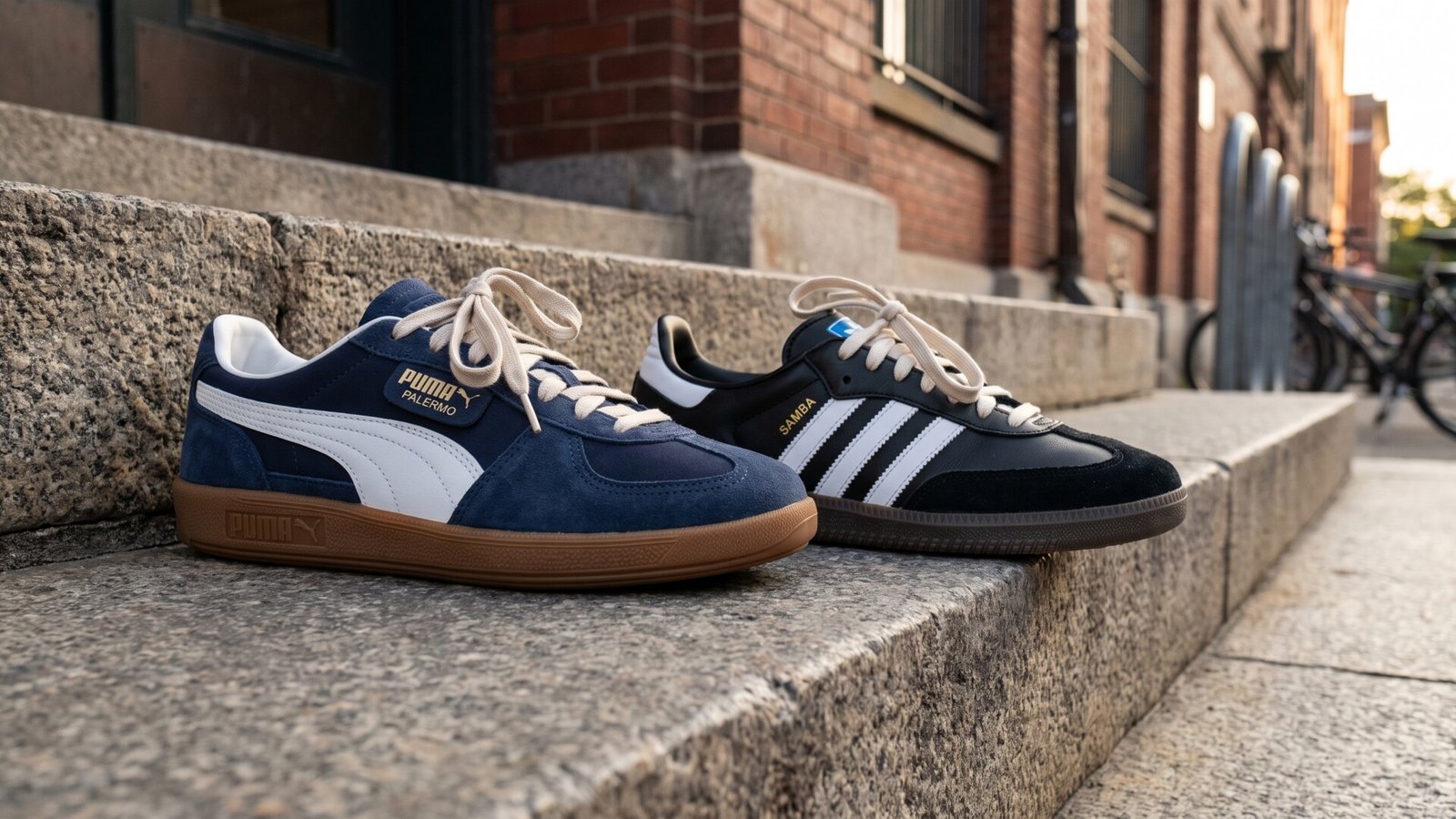
Look at the visual effect side by side. The Samba is narrower, sharper, and more streamlined. The Palermo is slightly broader, more colorful, and more relaxed. Neither is better in the abstract. The Samba tightens an outfit. The Palermo loosens it.
Here is the decision framework we would actually use:
- Buy the Samba if the goal is silhouette and styling precision, and you want one shoe that works with almost everything.
- Buy the Palermo if the goal is individuality, color, and a purchase that does not feel like joining a queue.
That framing holds up better than any comfort comparison, because comfort on both of these is a matter of your foot, not the logo. More on that below.
Design, History, and Cultural Positioning
Why the Adidas Samba still carries more recognition
The Samba started life as a football training and indoor sport shoe, then moved into terrace culture, then into everyday fashion. That path is why it works so well now. It was never designed to be a fashion object, which is exactly what makes it function as one. The slim toe, the contrasting three stripes, the T-toe overlay, the low gum outsole, the restrained branding – it is a simple design that survived because it does not need updating.
Its recent popularity is not really about performance history. It is about the way the shoe acts as a visual bridge. It sits comfortably between sportswear, minimalist fashion, and casual streetwear, which means it can finish an outfit without dominating it. That is rare and it is the actual reason people keep buying it.
The tradeoff is obvious once you name it. The Samba is easy to style and hard to make feel distinctive. When everyone has the answer, the answer stops being interesting.
Why the Puma Palermo feels like the alternative
The Palermo draws on Puma’s broader terrace and football-inspired history, with the city name doing a lot of the storytelling. The construction is classic: low profile, suede-heavy upper, T-toe treatment, gum sole. The formstrip and the more prominent branding give it a different visual identity from the Samba’s three stripes.
That difference is the point. The Palermo benefits from the same retro sneaker cycle while staying less saturated in everyday settings. Walk through a mall and count Sambas. Then count Palermos. That gap is the Palermo’s entire pitch.
One thing to be clear about: the Palermo is not a cheaper Samba. Its proportions, branding, color blocking, and overall attitude are genuinely different. If you buy it expecting a Samba substitute, you will notice the difference and probably misread it as a flaw.
What the current trend says about both sneakers
Low-profile sneakers are getting attention again because a lot of buyers are moving away from heavily cushioned, oversized silhouettes for certain outfits. Chunkier shoes still have a place, but they fight with tailored trousers, slim denim, and anything that wants a clean line at the ankle. Terrace shoes solve that problem.
The trend-longevity question matters here. Both models have real historical foundations, so neither is dependent on a single collaboration or a novelty colorway. That makes both safer than most trend purchases.
The trend risk is not equal, though. The Samba is more exposed to fatigue because it has become a widespread fashion uniform. The Palermo may hold its freshness longer for buyers who dislike overexposure. Neither shoe is going to embarrass you in three years. One is just more likely to feel repetitive.
Design and Styling Comparison
Silhouette and visual proportions
The Samba is slim and elongated. The Palermo is slightly more substantial and relaxed. Put them next to each other and the Samba looks like it was drawn with a finer pen.
That shape changes how an outfit reads. The Samba suits cropped or tailored trousers and narrow hems because it keeps the line clean from knee to floor. The Palermo works naturally with straight-leg jeans, relaxed denim, and shorts because its slightly broader profile balances a looser leg.
The toe box matters too. The Samba’s narrower toe is part of why it looks sharp and part of why it can feel tight. The Palermo’s toe box reads a little more generous, and in most versions it is.
Colorway changes everything. A neutral Samba and a bold Palermo communicate more differently than the base models do. If you are comparing a black Samba to a bright color-blocked Palermo, you are not really comparing the same decision anymore.
Outfit versatility
Adidas Samba: strongest with straight-leg jeans, tailored trousers, track pants, pleated skirts, casual suiting, and simple neutral outfits. It is the easier shoe to use as a quiet finishing piece.
Puma Palermo: strongest with denim, cargo pants, relaxed trousers, shorts, track-inspired outfits, and color-coordinated casual looks. It contributes more visible color and branding, which is either the appeal or the problem depending on how you dress.
If you want one pair to cover work-casual, weekend, travel, and streetwear, the Samba is the safer single-shoe bet. The Palermo can do all of that too, but it does it with more personality and slightly less neutrality.
Branding and fashion signaling
The three stripes and the Samba name carry a lot of recognition. The formstrip and the Palermo’s retro branding are more noticeable in a different way – louder on the shoe, less loaded in the culture.
Buyer psychology runs straight through this. The Samba signals that you know what is current in terrace footwear. The Palermo signals the same awareness with a less common choice. Neither signal is better. They just say different things about how much you want to blend in.
If you want a clean, logo-light look, pick the colorways where branding blends into the upper rather than high-contrast versions. That advice applies to both shoes and it is the single biggest lever you have over how loud they read.
Comfort, Fit, and Sizing
Cushioning and everyday comfort
Set expectations now: neither of these is a modern max-cushion walking sneaker. Both are relatively flat, structured retro shoes with limited underfoot foam. The Samba feels firm, low, and secure. The Palermo feels similarly grounded but often a touch more forgiving depending on the version and materials.
That makes both fine for errands, commuting with breaks, casual outings, and moderate walking. Neither should be your default for long standing shifts or high-mileage travel. If that is your actual need, you want a different category entirely – our [Internal: best sneakers for wide feet] guide covers the fit side, and a proper walking shoe covers the rest.
Practical comfort upgrades work. Cushioned socks help. A supportive aftermarket insole helps more, but it eats interior volume, so it can turn a snug shoe into an unwearable one. Try the insole with the shoe before you commit to the combo.
Fit and width guidance
Samba sizing runs narrow through the midfoot and forefoot for a lot of people. If you have wide feet or you hate a close fit, that is the first thing you will notice and the last thing you will stop noticing.
Palermo fit varies by version and foot shape, but its overall interior feel tends to suit buyers who want a little more room than the Samba gives them. That is a tendency, not a guarantee. Materials and regional releases differ.
Try your usual size first, then check the specific retailer’s exchange policy, because gendered versions and material runs can shift the fit. And do not size up automatically if you have wide feet. Extra length does not fix a narrow forefoot, and it creates heel slip that makes the shoe worse, not better.
Best choice for common foot and use cases
| Buyer profile | Better starting point | Reason |
|---|---|---|
| Narrow or average-width foot | Adidas Samba | The close, streamlined shape is easier to control |
| Average width, relaxed look | Puma Palermo | Less severe profile, works casually |
| Wide forefoot | Puma Palermo, verify the version | More likely forgiving, but neither is a true wide fit |
| All-day standing | Neither as a first choice | Both are flat with limited cushioning |
| Travel with moderate walking | Palermo for comfort, Samba for styling | Depends on fit and outfit priorities |
Materials, Durability, and Ownership Experience
What will hold up well
Both shoes lean on suede and leather paneling, rubber outsoles, and stitched overlays. That construction is durable for casual use because there is not much to break. Fewer bulky foam components means fewer things to compress and fail.
Suede ages well when you maintain it. It also shows water, oil, and dark scuffs more readily than smooth leather. A light suede shoe that gets caught in the rain will look older faster than a dark mixed-material version, regardless of which logo is on the side.
Colorway affects perceived longevity more than most buyers expect. Darker or mixed-material versions stay presentable longer. Very light suede looks great in month one and tired by month eight if you actually wear it.
What tends to show wear first
Toe creasing comes first on both. Then the suede nap goes shiny or flattened where you flex. Gum soles get dirty and stay dirty. Heel lining wears through on the inside, especially if you slip the shoes on without unlacing them.
Flat rubber soles also compress over time, which is why a shoe that felt fine in month one can feel thin in month twelve if it is your only daily pair. Rotate either sneaker with another pair to cut moisture buildup and slow interior and outsole wear.
The accessories are not upsells here, they are maintenance: a suede-safe cleaning kit, a soft brush, and shoe trees or structured inserts. Our [Internal: sneaker cleaning kit guide] covers what actually works on suede versus what ruins it.
Which one is the better long-term purchase?
Compare by use, not by assuming one model is universally tougher. They are close.
The Samba is the better long-term buy if you want one highly versatile neutral sneaker and you will wear it across many outfits. Its versatility means more wears, which means better cost per wear even at a slightly higher price.
The Palermo is the better long-term buy if you want rotation value, stronger color options, and a sneaker less likely to feel visually repetitive. If you already own a neutral low-profile shoe, the Palermo adds more to a closet than a second Samba would.
On resale: classic Samba colorways have stronger recognition and a larger secondhand audience. That does not make ordinary pairs an investment. Buy either one to wear, not to flip.
What Most Buyers Get Wrong
Assuming the more famous sneaker is more comfortable. Popularity reflects styling and cultural reach, not foot-shaped engineering. The Samba is famous because it looks right, not because it cradles your arch.
Choosing from product photos alone. A slim low-profile shoe can look perfect and feel restrictive after several hours. Wide-foot buyers get burned by this constantly, then blame the shoe instead of the fit.
Treating all colorways as interchangeable. The same model swings from minimalist to sporty to loud depending on contrast, material, and branding. A black-on-black Samba and a white-and-green Samba are almost different shoes in outfit terms.
Ignoring saturation. The Samba is the safer fashion purchase and the less individual one. If you care about not looking like everyone else, that is a real cost and it belongs in the decision.
Which Sneaker Still Makes Sense in Three Years?
Both have better staying power than a short-lived chunky trend because both are built on established terrace silhouettes with decades of cultural reference behind them. That is the floor. Neither is going to look like a costume.
Adidas Samba outlook: likely to remain wearable because the shape is simple and historically recognizable. Its current peak visibility will probably soften, which means the purchase may feel less fashion-forward in a couple of years while remaining completely usable. That is a fine outcome for a $100 shoe.
Puma Palermo outlook: likely to remain a credible retro sneaker with more room for personal styling, especially in a versatile colorway rather than a trend-dependent collaboration. Its lower saturation is an advantage over a longer horizon.
Run the cost-per-wear math before you buy either. A $100 sneaker worn twice a week for two years costs less per wear than a cheaper pair that only works with a few outfits and lives in the closet. The better purchase is the one you reach for, not the one that photographs best.
Buy the colorway that solves your wardrobe problem, not the one most visible in your feed. That single rule will save you more money than any comparison table.
Who Should Buy the Puma Palermo?
- Buyers who want a terrace-style sneaker without owning the most common current option.
- Shoppers who prefer a slightly more relaxed, colorful, or sportier appearance.
- People who regularly wear straight-leg denim, relaxed trousers, shorts, or casual streetwear.
- Buyers with average-to-slightly-wide feet who find the Samba too restrictive, provided the specific Palermo version fits comfortably.
- Anyone who finds the Palermo at a meaningful discount and likes the colorway, since its value improves when it lands below the Samba.
If that sounds like you, [Affiliate: check current Puma Palermo colorways and prices] before you commit to a specific version.
Who Should Buy the Adidas Samba?
- Buyers who want the most recognizable version of the classic terrace sneaker look.
- Shoppers who need one low-profile sneaker to work with jeans, trousers, skirts, casual tailoring, and minimalist outfits.
- People with narrow or average-width feet who prefer a close, streamlined fit.
- Buyers who value a larger resale and secondhand market, while understanding that ordinary pairs are not investments.
- Anyone who prefers understated branding and the Samba’s sharper silhouette.
For that reader, [Affiliate: compare Adidas Samba colorways and pricing] and pick a neutral you will actually wear.
Final Verdict: Adidas Samba Wins, but the Palermo Is the Better Alternative for Some Buyers
The Adidas Samba takes it. More versatile silhouette, stronger fashion recognition, easier integration into both casual and slightly dressed-up outfits. If you want one retro sneaker that works with everything you own, that is the answer and it is not close.
The limitation is real, though. The Samba does not win on comfort for every foot, and its popularity makes it less distinctive. If either of those matters to you, the verdict changes.
The Puma Palermo is the better pick for buyers who prioritize individuality, stronger color-blocking, a more relaxed visual character, or a potentially more forgiving fit. It is not the runner-up prize. It is the right shoe for a different person.
The decisive rule:
- Buy the Samba if the main goal is one classic, highly versatile retro sneaker.
- Buy the Palermo if the main goal is a less predictable daily sneaker with more visible personality.
Either way, buy the best-fitting neutral colorway at the better current price. Do not pay extra for a trend label.
Frequently Asked Questions About Puma Palermo Vs Adidas Samba
Is the Puma Palermo more comfortable than the Adidas Samba?
Comfort depends heavily on foot shape and the specific version, but neither is a highly cushioned walking shoe. The Palermo may feel more forgiving to some wearers, while the Samba can feel more secure and streamlined on narrower feet. If you have wide feet, the Palermo is the better starting point, but try it on.
Are Puma Palermo and Adidas Samba true to size?
Both are commonly bought in your usual sneaker size, but fit varies by release, materials, and foot shape. If you are between sizes or have wide feet, prioritize the retailer’s exchange policy and do not assume extra length fixes forefoot tightness.
Which is better for wide feet, Puma Palermo or Adidas Samba?
The Palermo gets the better starting position for many wide-foot shoppers, but neither is a dedicated wide-fit model. The exact upper, lacing, and version matter more than the logo. Check the specific pair before you buy.
Can you wear either sneaker for walking all day?
Both work for casual walking but are not ideal for long standing, high-mileage travel, or demanding work shifts. If that is your daily reality, look at a more supportive walking sneaker instead.
Which sneaker is easier to style?
The Samba has the edge for maximum outfit range, especially with tailored trousers, skirts, and minimalist outfits. The Palermo is highly versatile but reads more visibly sporty and colorful.
Is the Adidas Samba worth the higher price?
The premium is justified when you value its silhouette, recognition, and wardrobe flexibility. It is not automatically better value if it fits poorly or you will only wear it with a narrow set of outfits.
Which sneaker will stay in style longer?
Both have durable cultural foundations, but the Palermo may feel fresher as Samba visibility becomes more common. The safest long-term choice is the model and colorway that fits your existing wardrobe, not the current trend cycle.
Should I buy the Puma Palermo or the Adidas Samba as my first terrace sneaker?
If you want the safest single-shoe bet, the Samba. If you want to avoid the most common option and you like color, the Palermo. Neither is a mistake if the fit is right. The one caveat worth carrying into the shop: the Samba wins this comparison on paper and in most closets, but it only wins for you if it fits.
If the Samba pinches across the forefoot or you find yourself reaching for the Palermo every morning because it is the pair that does not require planning, then the “better” shoe is the one on your feet. Fit and actual wear beat reputation every time. Buy the pair you will still be lacing up in two years, and let the trend argument settle itself.