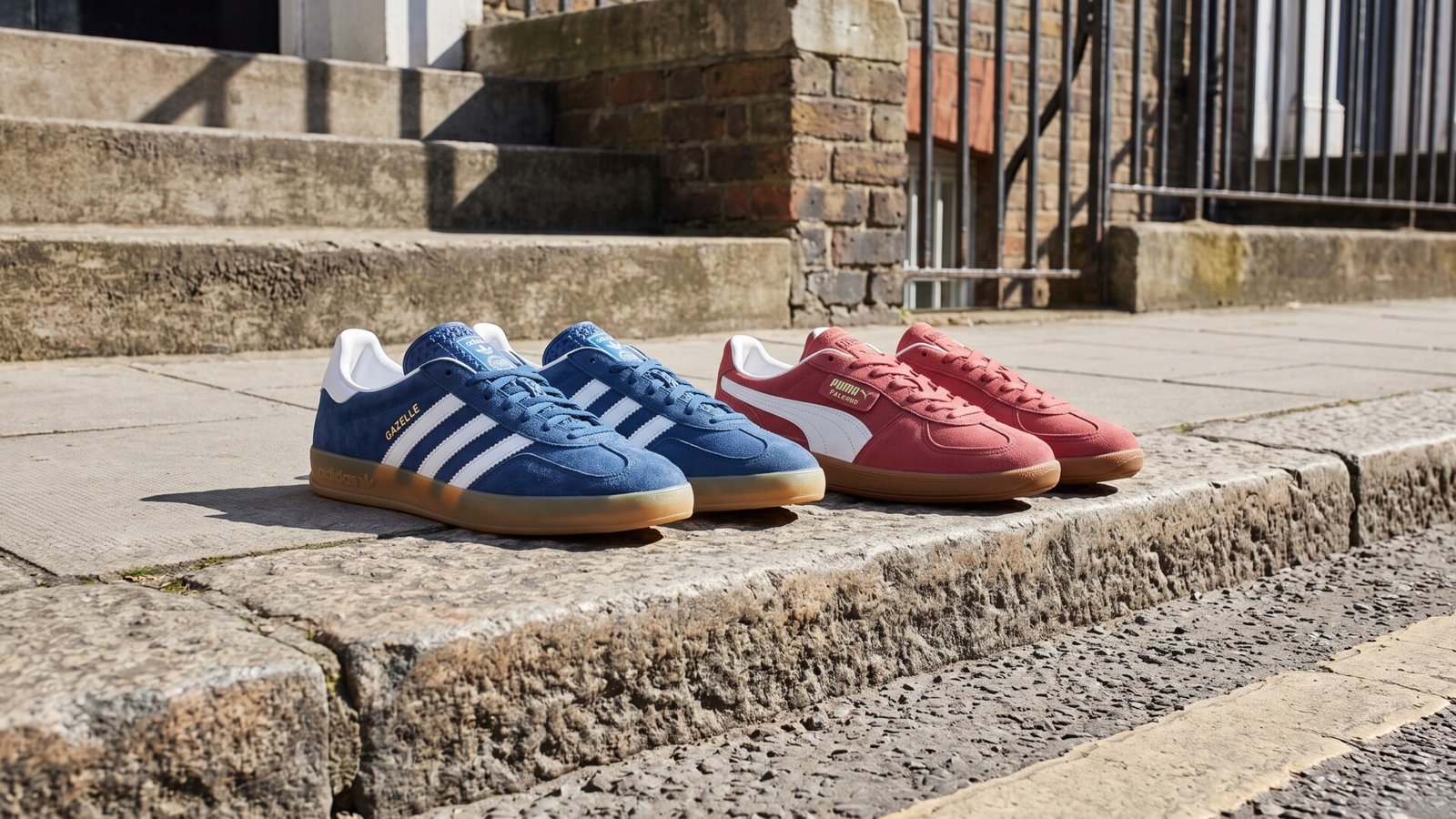
Puma Palermo vs. Adidas Gazelle: Which Retro Sneaker Should You Buy?
Two years from now, one of these pairs will be sitting by the door getting worn three times a week. The other will be in the back of the closet, and you will not be able to say exactly why you stopped reaching for it. That is the real stakes in the Puma Palermo vs. Adidas Gazelle decision. Both are low-profile terrace sneakers with suede uppers, gum-style outsoles, and football-inspired DNA. Both cost about the same. Both look good in photos. The difference is what happens after the honeymoon: the Gazelle stays easy because its silhouette and color range slot into almost any outfit, while the Palermo asks a little more from your wardrobe and gives back a little more character. Pick the Gazelle for maximum versatility. Pick the Palermo if you want a shoe that does not look like everyone else’s.
At a Glance: Puma Palermo vs. Adidas Gazelle
Here is the short version before we get into the details.
| Category | Winner | Why it matters |
|---|---|---|
| Everyday versatility | Adidas Gazelle | Easier to pair with casual and smart-casual outfits |
| Distinctive style | Puma Palermo | More noticeable terrace-inspired design details |
| Comfort for casual walking | Tie, with fit caveats | Both are everyday casual wear, not long-distance walkers |
| Fit flexibility | Adidas Gazelle | More familiar fit profile and broader sizing availability |
| Durability value | Slight edge to Puma Palermo | Strong visual structure and practical casual construction |
| Trend longevity | Adidas Gazelle | More established as a long-running wardrobe staple |
| Best overall buy | Adidas Gazelle | Safer choice for most buyers |
| Best alternative pick | Puma Palermo | Better for buyers who want a less common look |
Quick recommendations
- Buy the Adidas Gazelle if: you want one retro sneaker that works with jeans, trousers, shorts, and everyday streetwear.
- Buy the Puma Palermo if: you prefer a more distinctive silhouette, bolder color blocking, and a terrace look that feels less ubiquitous.
- Editor’s choice: Adidas Gazelle, because its styling versatility and long-term wardrobe usefulness outweigh the Palermo’s stronger visual personality for most buyers.
The Background: Two Terrace Sneakers With Different Cultural Weight
The Gazelle has been around since the 1960s, originally as a lightweight training shoe. It found its way onto the football terraces in the 1980s, then into music venues, then into streetwear, and it has never really left. That is the key point for a buyer. The Gazelle’s current popularity is not a trend cycle. It is decades of recognition compounding into a shoe that almost everyone can place.
The Palermo comes from a different lineage. Puma has a long history in terrace and city-focused footwear, and the Palermo sits within that design language rather than emerging from a single sports discipline. It has a more specific identity: a terrace sneaker revived for people who want the look without wearing the most obvious version of it.
That history shapes how each shoe reads on foot today. The Gazelle reads as a broadly recognized lifestyle classic. The Palermo reads as a fashion-conscious revival of terrace footwear. Neither label is better, but they attract different buyers.
Both are accessible alternatives to more expensive designer or limited-edition terrace sneakers. The Gazelle has stronger mainstream visibility and resale familiarity. The Palermo has the appeal of being slightly less expected. If you are building a rotation around [Internal: See our retro sneaker buying guide], the Gazelle is the safer anchor and the Palermo is the more interesting second pair.
Design and Aesthetic Comparison
Shape, proportions, and visual character
Both shoes use low-profile construction, elongated toe shapes, suede panels, side branding, and gum-style outsole treatment. The difference is in how those elements are arranged.
The Gazelle’s proportions tend to look cleaner and more understated. The three stripes are familiar enough that they fade into the overall shape. The toe box is slim, the side profile is flat, and the shoe does not demand attention. That is a compliment. It is why people wear Gazelles with everything from straight-leg jeans to relaxed trousers to shorts without thinking about it.
The Palermo is more graphic. The branding and panel layout create more visual noise, and the color blocking on many releases makes the shoe feel bolder. It can be a stronger focal point, but it may require more deliberate color coordination. A loud Palermo with a busy outfit can look like two competing ideas. A restrained Palermo with a simple outfit looks sharp.
On foot, both work with wide-leg denim, straight-leg jeans, track pants, cargos, shorts, and relaxed trousers. The tradeoff is repetition. The Gazelle is easier to wear repeatedly without dominating an outfit. The Palermo can make a statement, but you may find yourself planning outfits around it rather than the other way around.
Colorways and trend positioning
Colorway matters more than the logo in this comparison. A muted Palermo can be more versatile than a loud Gazelle, and a classic Gazelle can be more timeless than an unusual Palermo.
For maximum wardrobe utility, look at the Gazelle in black with white details, navy with white details, and green with white details. These are the colorways that have stayed relevant through multiple style cycles and will not look dated in three years. [Affiliate: Check current Gazelle colorways at Adidas]
For the Palermo, black and white, white with colored Formstrip details, and gum-soled colorways give you the most recognizable Puma look without going so bold that styling becomes a chore. [Affiliate: Check current Palermo colorways at Puma]
Both benefit from the continuing popularity of terrace sneakers. But the Gazelle has more evidence of staying power because it has already moved through multiple style cycles. It was cool in the 80s, it was cool in the 90s, it came back in the 2010s, and it is still here. The Palermo’s revival is newer, which means it has less track record. That does not make it a bad buy, but it does mean the Gazelle is the lower-risk choice for trend longevity.
Comfort, Walking, and Everyday Wear
Neither of these is a dedicated walking sneaker. That is the first thing to understand. Both are low-profile retro sneakers with flat, relatively structured soles and minimal underfoot cushioning. They feel stable and close to the ground, which is part of the appeal, but they do not offer the plush ride of a modern performance shoe.
If you are used to something like the New Balance 530, New Balance 2002R, or Adidas Ultraboost, these will feel firm by comparison. That is not a defect. It is the tradeoff for the slim profile and heritage look.
For short commutes and daily errands, either pair works if the fit is correct. The suede uppers break in gradually and mold to your foot, but they do not stretch dramatically. The structured soles provide decent stability for casual city walking.
For all-day sightseeing, consider a cushioned alternative or add supportive insoles only if the shoe has enough internal volume. Low-profile sneakers often do not have room for a thick insole, and cramming one in can make the fit worse. If you need serious cushioning, look at [Internal: See our best walking sneakers guide] instead.
For standing at work, neither is the obvious choice. If you are on your feet for eight hours, you want substantial underfoot cushioning and support. These are not that.
For casual social wear, both perform well because their slim profile works with a broad range of outfits. That is where they shine.
Fit and Sizing: Which Pair Is Easier to Get Right?
Sizing can vary by foot shape, materials, and specific release. Check the current retailer’s size chart and return policy rather than assuming every colorway fits identically.
Adidas Gazelle: The general expectation is a fairly secure, low-profile fit. Buyers with average or narrow feet may prefer their regular size. Wide-footed buyers should pay close attention to forefoot pressure and consider sizing up only when the retailer permits easy returns. The Gazelle has a familiar fit profile and broad sizing availability, which makes it easier to get right.
Puma Palermo: The fit is similarly low-profile, but the structured terrace shape can feel more restrictive for broad forefeet. If you dislike a snug toe box, prioritize trying them on or buying from a retailer with free returns. The Palermo’s sizing is less widely documented than the Gazelle’s, which adds a little risk to the purchase.
A practical fit checklist:
- Leave adequate space in front of the toes.
- Check whether the little toe presses against the sidewall.
- Wear the socks you intend to use regularly when trying them on.
- Do not size up so far that the heel slips.
If you have wide feet, neither is a guaranteed option. Both use relatively slim retro profiles. Check our [Internal: See our best sneakers for wide feet guide] before committing. For general sizing advice, see our [Internal: See our sneaker sizing guide].
Durability, Materials, and Ownership Experience
Both shoes use suede and synthetic or leather panel construction, though exact materials can vary by colorway and edition. The suede is the part that shows wear first.
Where wear usually becomes visible:
- Toe creasing from normal walking.
- Suede nap changes where the shoe flexes.
- Outsole wear at the heel.
- Dirt around the lighter midsole or gum areas.
Maintenance is straightforward if you stay on top of it. Use a suede brush and appropriate cleaner for suede panels. Avoid soaking the shoes or using harsh household detergents. Rotate them with another pair to reduce repeated compression and moisture buildup. Use a shoe tree or paper stuffing when storing them if creasing is a concern.
A suede cleaning kit is worth the small investment. [Affiliate: Check suede cleaning kits on Amazon] will keep both pairs looking better for longer.
Long-term ownership value favors the Gazelle slightly because it is easier to replace in the same style. Broad availability means you can find a similar colorway if yours wears out. The Palermo may feel more distinctive, but it can be harder to match if a preferred colorway sells out.
Resale is not a reason to buy either. Standard pairs are not reliable investment products. Condition, colorway, collaboration status, and availability matter more than the base model’s name. Buy these to wear, not to flip.
What Most Buyers Get Wrong About This Comparison
The most common mistake is assuming the more recognizable sneaker is automatically the better fashion choice. The Gazelle’s visibility is useful for styling confidence, but it also means the shoe is less distinctive in crowded streetwear settings. If everyone has one, yours does not say much.
Choosing by logo alone misses the main issue. The outsole feel, toe-box shape, colorway, and intended wardrobe matter more than whether you prefer Adidas or Puma. A great colorway in the "wrong" brand beats a boring colorway in the "right" one.
Another common mistake: assuming a retro sneaker is automatically a comfortable walking shoe. It is not. The appeal comes from the slim profile and heritage look, which can conflict with the cushioning needed for long days.
Here is a repeatable decision framework:
- Choose the Gazelle for wardrobe coverage and low-risk styling.
- Choose the Palermo for visual identity and a less common alternative.
- Choose neither if your priority is long-distance walking comfort, wide-foot accommodation, or high-performance cushioning.
Which Option Still Makes Sense in Three Years?
Both models commonly sit in the accessible lifestyle sneaker category, typically around $90 to $120 at retail, though sales can change the value calculation substantially. Do not treat prices as permanently fixed.
Cost per wear is the useful framework here. A $100 pair worn twice a week for two years costs roughly $0.96 per wear before maintenance. A cheaper sale pair that rarely leaves the closet is worse value than a full-price pair worn consistently. A versatile neutral colorway generally has a better cost-per-wear profile than a seasonal or difficult-to-style colorway.
The hidden cost of choosing the wrong silhouette is real. If you buy the Palermo and find it does not work with half your wardrobe, you may need additional sneakers to cover outfits or occasions the first pair cannot handle. That is money you did not plan to spend.
Three-year outlook:
- Gazelle: stronger choice if you want a dependable staple likely to remain recognizable and easy to style.
- Palermo: stronger choice if you value personality and expect to keep wearing terrace-inspired footwear even if the current trend cools.
Both are more likely to age well when bought in restrained colorways and maintained properly.
Who Should Buy the Puma Palermo?
The Palermo is for shoppers who want a terrace sneaker with more visual presence and a slightly less obvious choice than the Gazelle. It suits people whose wardrobe already includes simple jeans, cargos, track pants, and neutral trousers that can support a stronger sneaker detail.
It also suits people who care about cultural and stylistic distinction more than maximum mainstream recognition. If you like explaining what your shoes are, the Palermo gives you something to talk about.
Do not buy it if you have notably wide feet, need serious walking comfort, or want the safest possible one-sneaker wardrobe. Those buyers should look at the Gazelle or a cushioned alternative.
Who Should Buy the Adidas Gazelle?
The Gazelle is for buyers who want the lowest-risk purchase and a sneaker that can move between casual streetwear, everyday errands, and relaxed smart-casual outfits. Classic colorways are the right starting point for anyone building a first retro sneaker rotation.
It is the better choice for buyers who value trend longevity, easy outfit matching, and broad retailer availability. You can find Gazelles almost anywhere, which means replacements and alternate colorways are easy to track down.
Do not buy it if you dislike owning a widely seen sneaker or want substantial cushioning and support for long days on your feet. If you want something less common, the Palermo is the move.
Final Verdict: Adidas Gazelle Wins for Most Buyers
The Adidas Gazelle is the winner for most people. It combines recognizable terrace styling, broad outfit versatility, strong trend longevity, and a lower-risk buying decision. That is not based on superior athletic performance. Both are lifestyle sneakers, and neither replaces a purpose-built walking or performance shoe.
The exception is clear: choose the Puma Palermo if your priority is a more distinctive look, stronger visual character, or a terrace sneaker that feels less familiar than the Gazelle.
By colorway, go with the Gazelle in black, navy, or green with contrasting details for maximum versatility. If you choose the Palermo, pick a restrained neutral or classic color-blocked version that gives you personality without making the shoe difficult to style.
Frequently Asked Questions About Puma Palermo Vs. Adidas Gazelle
Is the Puma Palermo better than the Adidas Gazelle?
For most buyers, no. The Gazelle is easier to style and more established as an everyday staple. The Palermo is better for shoppers who prefer a more distinctive terrace look.
Are Puma Palermo and Adidas Gazelle true to size?
Both generally run close to standard lifestyle sneaker sizing, but their low-profile shapes can feel snug in the forefoot. Buyers with wide feet should verify the specific retailer’s fit guidance and return policy.
Which is more comfortable, the Puma Palermo or Adidas Gazelle?
Comfort depends heavily on foot shape and the exact version, but neither is designed as a heavily cushioned walking sneaker. Both are better for casual daily wear than prolonged sightseeing or standing.
Which sneaker is better for wide feet?
Neither is a guaranteed wide-foot option because both use relatively slim retro profiles. Buyers with broad forefeet should try them on where possible and avoid relying on aggressive sizing up, which can create heel slip.
Which sneaker is easier to style with jeans?
Both work with jeans, but the Gazelle is generally easier to match because its silhouette and color range are more familiar. The Palermo works especially well with straight-leg and relaxed denim when the colorway is coordinated.
Do Puma Palermo or Adidas Gazelle sneakers hold their value?
Standard pairs are not reliable investment products. Resale depends on condition, colorway, limited availability, and collaborations, so buyers should choose based on wearability rather than expected profit.
Are these good sneakers for travel?
They can work for light travel and casual city use, but travelers expecting extensive walking should consider a more cushioned sneaker or pack a second pair.
Should I size up in the Puma Palermo?
Only if you have a broad forefoot and the retailer offers easy returns. Sizing up too far can cause heel slip, which is worse than a snug toe box for most people.
Which is the better first retro sneaker?
The Adidas Gazelle. It is the safer entry point because it pairs with more outfits and has broader availability, which makes it easier to replace or add colorways later.