Adidas Indoor Super vs. Handball Spezial: Which Retro Sneaker Is Right for You?
You searched for the Indoor Super vs. Handball Spezial because you want one retro Adidas sneaker and you cannot tell from the product photos whether these are basically the same shoe in two different colorways. They are not. The Handball Spezial is the softer, more familiar, easier-to-wear one, and the Indoor Super is the more structured, sportier, less common one – and which you should buy depends entirely on whether this is your only terrace pair or your fourth. That is the whole tradeoff in one sentence. The rest is just working out which side of it you are on.
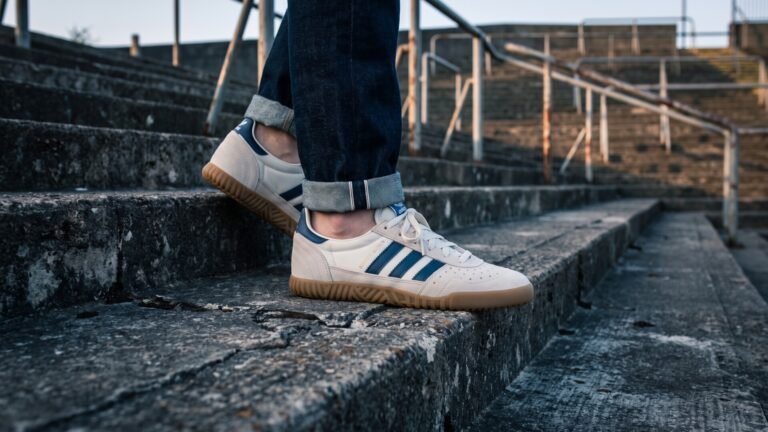
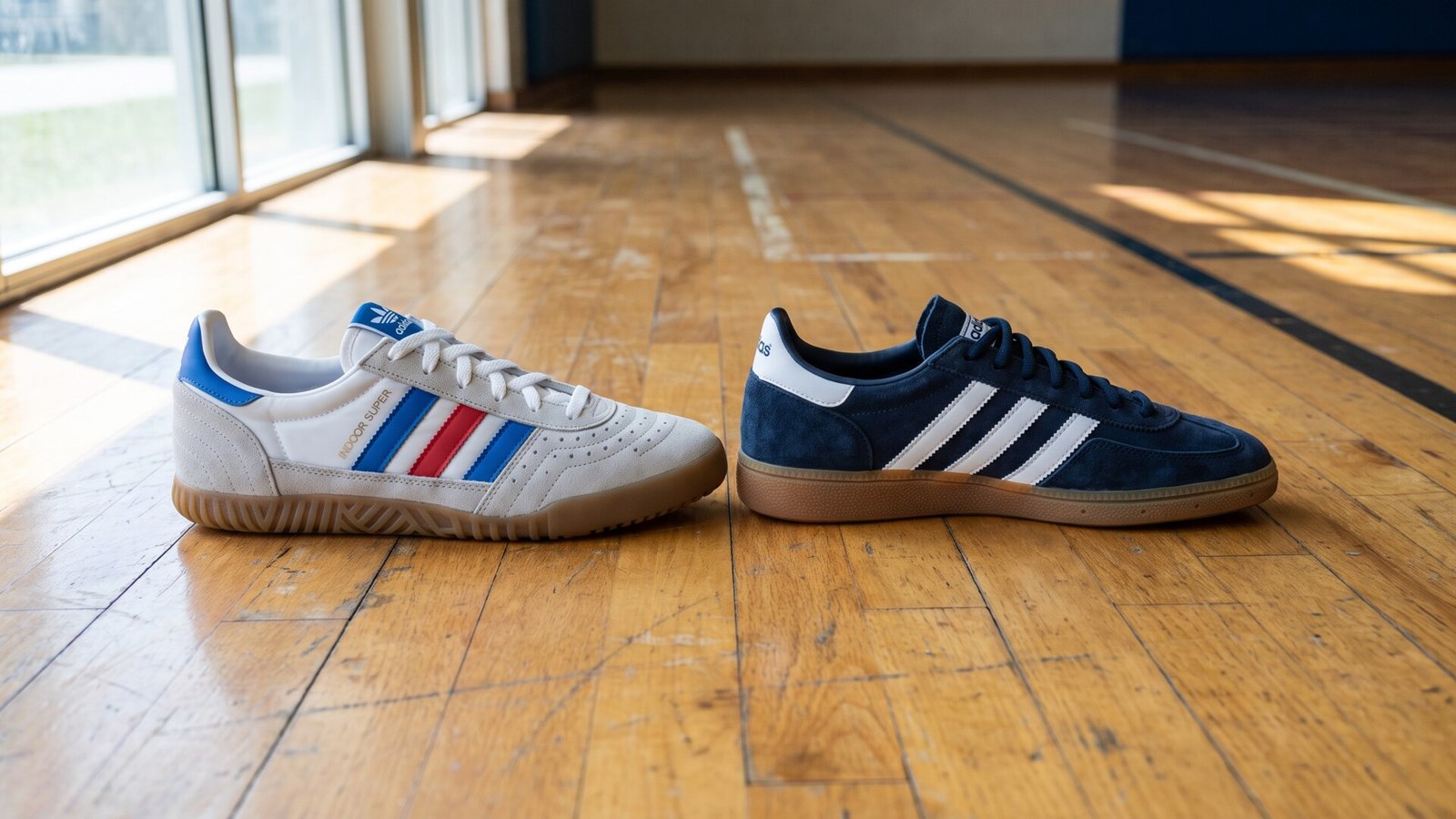
Both shoes sit in the same Adidas indoor-sport family tree. Low profile, suede-heavy, gum-style soles, contrasting three stripes, retro court DNA. Walk into any sneaker shop and they will be sitting two feet apart on the same shelf, and the colorways will be close enough that you could mistake one for the other if you were not paying attention. But the toe shape, the panel layout, and the overall visual balance are different, and those small differences decide how the shoe actually wears with your clothes.
Here is the quick answer before we get into the details. Most people should buy the Handball Spezial. It is the safer, more versatile, more recognizable choice. The Indoor Super is the better buy for anyone who already owns a versatile terrace sneaker and wants something with a bit more indoor-football character and a lot less overlap with what everyone else is wearing.
At a Glance: Indoor Super vs. Handball Spezial
| Category | Adidas Indoor Super | Adidas Handball Spezial | Winner |
|---|---|---|---|
| Price positioning | Usually similar, sometimes slightly higher | Usually similar, wide sale availability | Handball Spezial (easier to find discounted) |
| Comfort | Structured, firmer court feel | Softer, more flexible out of the box | Handball Spezial |
| Fit | Slightly more locked-in | More forgiving, easier break-in | Handball Spezial |
| Style versatility | Strong with sportswear, narrower with smart-casual | Works with almost anything casual | Handball Spezial |
| Durability | Holds up well, similar wear pattern | Holds up well, similar wear pattern | Tie |
| Walking use | Fine for casual days, not a walking shoe | Fine for casual days, not a walking shoe | Tie |
| Overall value | Good if you want the look | Good all-rounder | Handball Spezial |
A few quick recommendations to orient yourself:
- Best for everyday styling: Handball Spezial.
- Best for a more distinctive retro-sport look: Indoor Super.
- Best for broad wardrobe compatibility: Handball Spezial.
- Best for buyers bored with the usual terrace releases: Indoor Super.
Early verdict: the Handball Spezial wins overall for most shoppers, but the Indoor Super is the more interesting choice for buyers who prioritize individuality. Neither is a bad shoe. They are just answering different questions.
What Separates the Two Adidas Terrace Sneakers?
The shared DNA is real. Both are low-profile court-inspired sneakers with indoor-sport roots – the Handball Spezial comes out of handball, the Indoor Super out of indoor football. Both use suede overlays with synthetic or leather detailing depending on the colorway, both have stitched side stripes, both sit on a gum or gum-look rubber outsole, and both have that flat, grounded feel that makes terrace sneakers so easy to wear.
Where they split is in the visual character.
The Handball Spezial is softer and more understated. The toe box is rounder, the paneling is cleaner, and the shoe reads as a lifestyle sneaker first and a sports shoe second. That is exactly why it has become one of the defining silhouettes of the current terrace-sneaker moment. It looks like it belongs with everything.
The Indoor Super is more structured and more sport-focused. The indoor-football reference is stronger, the paneling is busier, and the shoe has a slightly more technical visual balance. It looks like it came off a court in the 1970s and never quite left. That is a compliment if you like the look, and a limitation if you do not.
Why does that difference matter in practice? Because a small change in toe shape, panel layout, or sole height can flip a sneaker from casual to sporty to fashion-led. The Handball Spezial reads casual. The Indoor Super reads sporty. If you wear a lot of relaxed tailoring and straight-leg trousers, the Handball Spezial will slot in without effort. If you wear track pants, wide denim, and sportswear-led outfits, the Indoor Super will feel more at home.
A simple decision rule: choose based on the role the sneaker needs to play in your wardrobe, not on which colorway looks best on the product page. A beautiful photo of a loud Indoor Super can sell you a shoe that does not fit a single outfit you own.
Design, Styling, and Trend Positioning
The Handball Spezial look
The Handball Spezial is the easier styling option, full stop. It works with jeans, straight-leg trousers, cargos, track pants, and relaxed tailoring. It is the kind of shoe you can put on without thinking and it will not fight anything you are wearing. That is not a small thing – most sneakers fail because they demand a specific outfit, and the Handball Spezial rarely does.
That current popularity cuts both ways. It makes the shoe feel versatile because you see it everywhere and it clearly works for everyone. It also makes it feel less distinctive. If three people in your group chat own a pair, the shoe stops feeling like a personal choice and starts feeling like a uniform.
Color choice matters more than most buyers think. Brown, navy, black, and muted green are the everyday options – they work across seasons, they hide scuffs better than pale suede, and they stay wearable for years. Bright contrast colorways make a stronger statement but are harder to wear repeatedly, which quietly pushes them to the back of the rotation.
The trend risk is real. The silhouette is culturally relevant and highly visible right now, which means buyers who jump in at peak visibility may eventually feel like they own a common trend rather than an unusual retro sneaker. That is not a reason to avoid it. It is a reason to buy a colorway you actually like rather than the one that is trending hardest.
The Indoor Super look
The Indoor Super is the better option for buyers who want a more authentic indoor-court mood and a slightly less obvious alternative to the Handball Spezial. It has the same terrace DNA but wears it differently – more sport, less lifestyle.
Its strengths show up with football-inspired outfits, track pants, wide denim, workwear trousers, and other sportswear-led styling. Pair it with a straight-leg track pant and a plain sweatshirt and it looks intentional. Pair it with slim chinos and a blazer and it looks like you grabbed the wrong shoe in the dark.
That is the tradeoff. The more distinctive shape or paneling can make it feel less neutral with slim trousers or polished outfits. It is not a shoe that disappears into an outfit. It is a shoe that announces itself, which is exactly what some buyers want and exactly what others do not.
Trend longevity is where the Indoor Super has a quiet advantage. It benefits from the continued terrace and indoor-football trend without being as closely associated with the most saturated part of it. If the Handball Spezial cools off, the Indoor Super keeps its own smaller audience. If the whole trend cools off, both shoes fall back to being what they always were – solid retro sneakers – but the Indoor Super has less hype baggage to shed.
Which one looks more expensive?
Neither wins this outright. Perceived value comes down to suede quality, color blocking, stitching, and finish – not the model name on the box. Both models can look premium in one release and ordinary in another, and both can look cheap if the colorway is doing too much.
Judge the exact pair in front of you. Run your hand across the suede. Check whether the panels sit flat and the stitching is even. Look at how the color blocking reads from a few feet away, because that is how people will actually see the shoe. A well-finished Handball Spezial in a muted colorway will look more expensive than a busy Indoor Super with mismatched panels, and vice versa.
One thing worth saying plainly: scarcity does not equal quality. A less common Indoor Super is not automatically better made than a Handball Spezial you can find in five shops. It is just harder to find. Do not let low availability talk you into a shoe that does not fit your wardrobe.
Comfort, Walking, and Everyday Wear
Neither of these is a comfort shoe. They are low-profile retro sneakers with flat, grounded soles and flexible uppers, and that is the whole story. If you are coming from a modern running-inspired sneaker, both will feel firmer and less forgiving underfoot.
The Handball Spezial should suit casual daily wear, errands, commuting, and moderate walking. The upper is soft, the break-in is short, and the shoe feels easy from the first wear. Most people can put it on and forget about it for a normal day.
The Indoor Super may appeal to buyers who prefer a more structured court-shoe feel. The upper is a little more locked-in, the ride is a little firmer, and the shoe feels more like a piece of sports equipment than a lifestyle sneaker. Some people love that. Others find it stiff compared to the Spezial.
Be honest about standing and long walking. Neither should be framed as a specialist all-day comfort shoe for demanding work shifts, extended travel, or high-mileage walking. You can wear either for a normal day out. You should not buy either expecting them to carry you through a twelve-hour shift on concrete.
The underfoot tradeoff is worth understanding. Flexible retro uppers become comfortable with wear but offer less immediate support than modern running-inspired sneakers. Gum-style soles feel stable and grounded but do not provide the cushioning of models like the Adidas Ultraboost or Adidas Supernova Rise. That is not a flaw – it is the design. But it means these are casual shoes, not performance shoes.
If you need more comfort for travel or long city days, consider cushioned socks or a supportive insole – provided the replacement insole fits securely and does not crowd the toe box. A thick insole in a low-profile shoe can make the fit worse, not better. Try it before you commit. For more on this, see our guide to [Internal: the best sneakers for walking and travel].
Fit and Sizing: Which Is Easier to Get Right?
Start with true to size for most average-width feet. That is the honest starting point for both models. But Adidas lasts vary between releases and individual colorways can fit differently, so treat that as a starting point rather than a guarantee.
Foot shape is where the two shoes start to separate.
- Narrow or average feet are the safer match for both models. Neither shoe is built around a wide last.
- Wide feet may experience pressure through the forefoot, especially if the upper has limited stretch or the wearer sizes down for a close fit. Neither shoe should be treated as a guaranteed wide-foot option.
- High insteps should check the tongue, lace pressure, and return policy before committing. A shoe that fits everywhere except across the top of the foot is still a shoe that does not fit.
The sizing strategy is simple. Do not size down solely because the shoes look narrow or sleek. If you are between sizes, prioritize toe room and compare the retailer’s measured size chart rather than guessing. And do not use extra length as a substitute for width – a longer shoe does not fix a narrow toe box, it just gives you a different problem.
Try both with the socks you actually intend to wear. Check heel slip, toe clearance, and forefoot pressure indoors before you remove the return tags. A five-minute test in the house saves a two-week return headache. If you are weighing these against other Adidas options, our [Internal: Adidas Samba vs. Handball Spezial comparison] covers the sizing quirks of the wider terrace family.
Materials, Durability, and Ownership Experience
Both shoes are built from similar materials: suede or suede-like overlays, textile or synthetic panels depending on the version, stitched side stripes, padded collars, and rubber outsoles. Neither is a fragile shoe, and neither is a tank. They are retro sneakers built to a price, and they wear like it.
What tends to go first, in rough order:
- Toe-box creasing and scuffing. Inevitable with any suede toe box. Creasing is normal; scuffing is what makes a shoe look tired.
- Suede darkening or flattening. Rain, dirt, and repeated brushing all change the nap over time.
- Gum outsole discoloration. Gum soles yellow and darken with age. Some people like the patina; some do not.
- Heel lining wear from repeated slip-on behavior. If you never untie your laces, the heel lining pays for it.
Maintenance is not complicated. Use a suede brush and an appropriate protector before regular wear. Avoid soaking suede-heavy uppers – spot clean instead. Use shoe trees or clean paper to help the shape recover after wet commutes. A basic [Affiliate: suede cleaning kit] and a [Affiliate: water and stain protector] will cover most of what these shoes need. For a fuller routine, see our [Internal: terrace sneaker buying guide].
Long-term value is where buyers get unrealistic. Neither model should be purchased as an investment. Popular Handball Spezial colorways may be easier to resell because more shoppers recognize them, and an unusual Indoor Super colorway may appeal to a smaller audience but stand out more in a wardrobe. That is the whole resale picture. Neither shoe is going to fund anything.
The hidden cost of choosing poorly is the one nobody talks about. A slightly cheaper sale pair is not good value if its color, width, or styling role means it stays unworn in the box. The best-value sneaker is the one you actually wear.
What Most Buyers Get Wrong About These Sneakers
The biggest mistake is assuming the more popular model is automatically the better buy. The Handball Spezial offers easier styling, but its visibility can make it feel less personal. If you want a sneaker that feels like yours, popularity is a cost, not a benefit.
The second mistake is assuming a gum sole makes either shoe suitable for serious indoor sport. It does not. Modern performance requirements, traction, fit, and court-specific construction are separate questions, and neither of these is a modern court shoe. They are retro sneakers that look like court shoes. If you need actual indoor-sport footwear, buy actual indoor-sport footwear.
The third mistake is assuming retro sneakers are automatically comfortable for full-day walking because they have a flat, stable feel. Flat and stable is not the same as cushioned and supportive. A shoe can feel great for an hour and brutal by hour eight.
The fourth, and most expensive, mistake is underestimating how much colorway matters relative to model. A neutral Indoor Super may be more versatile than a loud Handball Spezial. A simple Handball Spezial may be a better cost-per-wear purchase than a rare-looking Indoor Super that only works with a few outfits. The model sets the ceiling; the colorway decides how often you actually reach for the shoe.
Before you buy, run a wardrobe test. Identify at least three trousers and two jackets you already own that work with the selected pair. If you cannot name them, the shoe is a want, not a need – and that is fine, as long as you are honest about it.
Which Option Still Makes Sense in Three Years?
Trend longevity is the question that separates a good purchase from a regret.
The Handball Spezial has strong current recognition and will likely remain a reliable terrace staple. It has been around long enough and is visible enough that it is not going to vanish. But its broad visibility creates greater trend-saturation risk. If the terrace moment cools, the Spezial is the shoe most people will associate with it – which means it carries the most trend baggage.
The Indoor Super has a more specific indoor-football identity and may age better for buyers who genuinely like that look rather than buying it only because it is less common. Its audience is smaller, but that audience is more likely to still want the shoe in three years.
Here is a buyer framework that cuts through it:
- Buy the Handball Spezial if the priority is one pair for regular outfits, easy resale, and broad social recognition.
- Buy the Indoor Super if the priority is a more distinctive silhouette, stronger sports authenticity, and less overlap with friends’ wardrobes.
- Avoid both if the actual need is maximum cushioning, wide-foot comfort, or demanding work footwear. Neither shoe is built for that, and buying one anyway is how people end up disappointed.
Cost per wear is the honest way to think about value. A $100-$140 pair worn twice weekly over two years can become a low-cost-per-wear purchase – but only if it fits the buyer’s real wardrobe. The same shoe worn once a month because it clashes with everything is expensive no matter what you paid.
To improve longevity: rotate pairs, clean the suede early, protect the heel lining, and avoid wearing them in heavy rain or on abrasive surfaces. Most sneaker wear is not caused by bad materials. It is caused by wearing one pair every single day.
Who Should Buy the Handball Spezial?
The Handball Spezial is for buyers who want:
- The safer overall purchase for everyday casual outfits.
- A recognizable Adidas terrace sneaker with strong current cultural relevance.
- Easy pairing with jeans, cargos, track pants, and relaxed trousers.
- A model with a larger secondhand audience if resale becomes necessary.
The tradeoffs are real. It may feel too common for buyers seeking a distinctive sneaker. Some colorways – especially pale suede – may show dirt and suede wear quickly. And it is not the strongest choice for serious all-day walking or wide-foot comfort.
If that sounds like you, look at the Adidas Handball Spezial in brown, navy, black, or muted green colorways, subject to current availability. Those are the versions that hold up best over time and work with the most outfits. [Affiliate: Check current Handball Spezial prices and colorways]. If you are also considering the Samba, our [Internal: Adidas Samba vs. Handball Spezial comparison] will save you a lot of back and forth.
Who Should Buy the Indoor Super?
The Indoor Super is for buyers who want:
- A less predictable alternative to the Handball Spezial.
- A stronger indoor-football or court-sport visual identity.
- A sneaker that works with sportswear, wide-leg denim, and relaxed streetwear.
- A more distinctive option within the Adidas terrace category.
The tradeoffs are equally real. Its styling may be less universally easy than the Handball Spezial. Availability and colorway selection may be less consistent, which means you may have to wait for the right pair rather than picking from a full shelf. And it may not satisfy buyers who want the most recognizable current Adidas terrace model.
The Adidas Indoor Super is worth hunting in neutral and contrast colorways – the neutrals for versatility, the contrast versions for character. [Affiliate: Check current Indoor Super prices and availability]. If neither shoe quite fits, the [Internal: Adidas Gazelle Indoor] and [Internal: Adidas Samba OG] are the obvious next places to look, and our [Internal: Adidas sneakers hub] covers the whole family.
Final Verdict: Handball Spezial Wins for Most Buyers
The Adidas Handball Spezial is the overall winner because it combines easier styling, stronger mainstream recognition, broader outfit compatibility, and a more straightforward resale path. For most people buying one retro Adidas sneaker, it is the right call.
The Adidas Indoor Super gets a clear secondary recommendation for buyers who value individuality, indoor-football character, and a less saturated alternative. It is not the compromise pick – it is the more interesting pick, for the right person.
The purchase rule is simple:
- Buy the Handball Spezial if this is the only retro Adidas sneaker in your rotation.
- Buy the Indoor Super if your wardrobe already has a versatile terrace pair and the next purchase should add personality.
And a final reminder that applies to both: neither model should be chosen for serious athletic performance, maximum cushioning, or guaranteed wide-foot comfort. They are retro sneakers. Buy them because you like how they look and how they fit your clothes.
Frequently Asked Questions About Adidas Indoor Super Vs. Handball Spezial
Is the Adidas Indoor Super the same as the Handball Spezial?
No. They share Adidas terrace and indoor-sport design language – low profile, suede-heavy, gum-style sole – but they are separate models with different shape, paneling, visual balance, and styling effect. The Handball Spezial is softer and more lifestyle-oriented; the Indoor Super is more structured and sport-focused. They are cousins, not twins.
Which is more comfortable, the Indoor Super or Handball Spezial?
Comfort depends on foot shape and colorway, but both are low-profile retro sneakers rather than heavily cushioned walking shoes. The Handball Spezial is the safer general daily-wear recommendation because its upper is softer and breaks in faster. The Indoor Super may suit buyers who prefer a more structured court feel. Neither is a specialist comfort shoe.
Do Adidas Indoor Super and Handball Spezial fit true to size?
Many average-width feet can begin with their usual Adidas size, but width, instep height, socks, and the exact release all matter. Check the retailer’s size chart and return policy before committing, and try both with the socks you actually wear.
Are either of these sneakers good for wide feet?
Neither should be treated as a guaranteed wide-foot option. Wide-foot buyers should prioritize forefoot room, avoid sizing down, and consider models with a roomier last if pressure appears across the toes. If you know you need width, these are not the safest starting point.
Which sneaker is better for walking all day?
Both are suitable for casual walking, but neither is the best specialist choice for long-distance walking, travel days, or standing shifts. If you need more cushioning, look at a modern walking or running-inspired Adidas model instead – the Ultraboost and Supernova Rise are the obvious places to start.
Which one is easier to style?
The Handball Spezial has the advantage for most wardrobes because its shape and current styling language work across more casual outfits. The Indoor Super can be equally versatile for buyers with a sportswear or streetwear-heavy wardrobe – it just has a narrower sweet spot.
Do the Handball Spezial or Indoor Super hold resale value?
Neither should be bought primarily as an investment. The Handball Spezial may have a broader resale audience because more shoppers recognize it, while a desirable Indoor Super colorway may attract a smaller but more targeted group of buyers. Buy them to wear, not to flip. Most people reading this do not need to spend more than the standard retail on either shoe. The Handball Spezial at its normal price in a neutral colorway is enough sneaker for the vast majority of wardrobes, and the Indoor Super is worth the same money only if you actually want the sportier look. The buyers who genuinely need to spend more are the ones who need real cushioning or real width – and those buyers should not be shopping this category at all. Buy the pair that fits the clothes you already own, wear it, clean it, and stop researching.