Common Projects Sizing Guide: Do They Run Large?
The guy in the queue at the counter has the Achilles Low in one hand and his phone in the other, and he is losing it a little. He wears a 42 in Adidas. The retailer’s chart says 41. A forum thread says size down two. Someone else says true to size or you will wreck your toes. He has been standing there long enough that the staff have started reorganizing the shelf behind him.
We have watched this exact scene play out in group chats, in store queues, and in the DMs of anyone who has owned a pair long enough to be treated as an authority. The confusion is not stupidity. It is that nobody separates length from width from heel volume, and those three things behave differently on this shoe.
Here is the short answer. Common Projects Achilles Low generally fits close to true to size in length. But the leather is smooth, the shape is low-volume, and the heel is not padded like a running shoe, so a normal size can feel loose on some feet. That gap is where the entire sizing debate lives.
Order your usual Common Projects size for a relaxed fit. Consider going down one European size only if the heel slips noticeably or there is obvious space in front of your toes. And if your foot is genuinely wide, sizing down is not a fix – it is a different problem.
One thing that clears up a lot of the noise: Common Projects only sells shoes in European (Italian) sizes, and “your usual Common Projects size” means the EU number on the brand’s own conversion, not the EU number on your Nike box. On that basis, Mytheresa labels the Original Achilles true to size, and Nordstrom reports that its customers say the same. Most of the “size down” advice online comes from people converting from a different brand’s EU chart, which we explain in the conversion section below.
Common Projects Sizing at a Glance
Start here. This table is the whole article compressed into something you can screenshot before you hit checkout.
| Buyer situation | Recommended starting point | Main reason |
|---|---|---|
| Average-width feet, relaxed fit | Usual Common Projects size | Keeps toe room and stops you over-tightening |
| Average-width feet, close fit | Consider one size down | Cuts excess length and heel movement |
| Wide forefoot | Usual size if width allows | Sizing down squeezes the toes |
| Narrow heel | One size down or a heel grip | Achilles Low can feel loose at the rear |
| Between sizes | Usually the larger size | Roomy is easier to manage than short |
| Thick socks or an insole | Usual size | You need the extra volume |
Our recommendation: start with your usual Common Projects size unless you already know you like a close, low-volume fit. Going too small is usually the harder mistake to live with, because leather softens over time but never gets longer.
One caveat before we go further. Almost all of this guidance is about the Original Achilles Low, the shoe that built the brand. Other Common Projects models – the Achilles Mid, the Retro Low, the BBall, the Tournament – have different shapes and padding and can fit differently. If you are looking at something other than the classic Low, treat this as a starting point and check the model-by-model notes further down.
Common Projects Size Chart: EU to US Conversion
Common Projects labels every pair with a single European number (the brand calls it Italian sizing) and does not make half sizes. The men’s conversion used by US department-store stockists is a clean one-to-one step: the Common Projects size guide published on Neiman Marcus maps EU 39 to US 6 and EU 47 to US 14, with every whole size in between. Mytheresa lists the same 39-47 / US 6-14 range.
| Common Projects size (IT/EU) | US men | Notes |
|---|---|---|
| 39 | 6 | |
| 40 | 7 | |
| 41 | 8 | |
| 42 | 9 | The most common reference point in forum threads |
| 43 | 10 | |
| 44 | 11 | |
| 45 | 12 | |
| 46 | 13 | |
| 47 | 14 | Not every colorway or retailer stocks 47 |
Note what that chart implies. Common Projects treats EU 42 as a US 9 and EU 43 as a US 10. Plenty of sportswear brands use a different scale – Nike’s men’s chart, for example, puts US 9 at EU 42.5 and US 10 at EU 44. So if you wear a US 10 in Nike and grab the EU number from that box (44), you will land a full size larger than Common Projects’ own chart suggests (43). That gap is very likely where a lot of the “Common Projects run big, size down” advice comes from: the shoe is not necessarily long, the conversion is.
Why European retailers often say “size down”
This also explains why advice splits by region. Paris stockist Graduate Store, which compares against your usual European size in other brands, recommends going one size below your usual size in the Original Achilles and the BBall Low (for example, 41 to 40), while noting it depends on foot shape. Stockists that convert from your US size using the Common Projects chart – Mytheresa and Theory, plus Nordstrom’s customer reviews – describe the same shoe as true to size. Both can be right at the same time. The practical rule: if you are converting from your US size with the Common Projects chart, start true to size. If you are starting from the EU size you wear in Nike, Adidas or New Balance, expect to go down.
Half sizes: which way to round
Because Common Projects only comes in whole EU sizes, half-size wearers have to round. Mytheresa’s fit note says half sizes should take the next size up, which matches the “roomy is easier to manage than short” logic in the table above. The exception is a narrow, low-volume foot: if you are a US 9.5 with a slim heel, the EU 42 (US 9) is often the better bet as long as your toes are not touching the front. Try both if you can, or order from a retailer with free returns.
Women’s Common Projects sizing
Women’s styles are sold under the Woman by Common Projects line, typically in EU 35 to around 42 depending on retailer and colorway. Here the conversions genuinely disagree between shops, which is worth knowing before you order:
| IT/EU size | US women (END., BDGA, Simon) | US women (Theory) |
|---|---|---|
| 35 | 5 | 4.5 |
| 36 | 6 | 5.5 |
| 37 | 7 | 6.5 |
| 38 | 8 | 7.5 |
| 39 | 9 | 8.5 |
| 40 | 10 | 9.5 |
| 41 | 11 | 10.5 |
END. Clothing, BDGA and the Simon-hosted Common Projects chart map EU 36 to US 6, while Theory maps EU 36 to US 5.5 and says to choose your normal size. Those half-size differences are exactly why we keep repeating the same advice: check the chart on the specific site you are buying from, and if you know your foot length, go by that rather than the US label.
Sizes and conversions checked on retailer pages in November 2026. Retailers update charts, so confirm on the product page before you buy.
How Common Projects Achilles Low Fits
Length, width, and overall shape
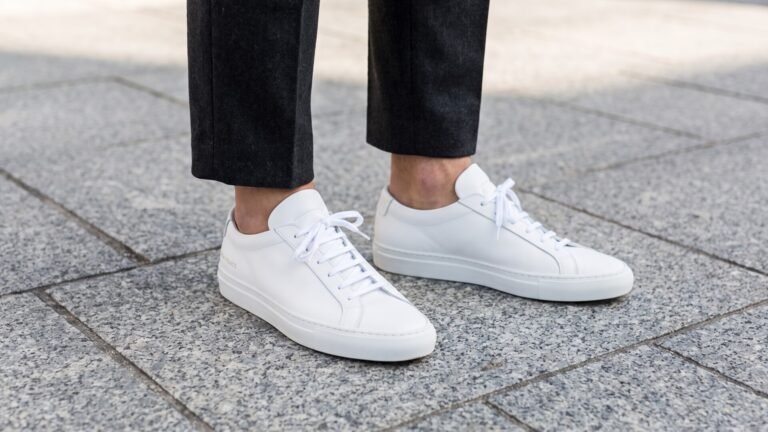
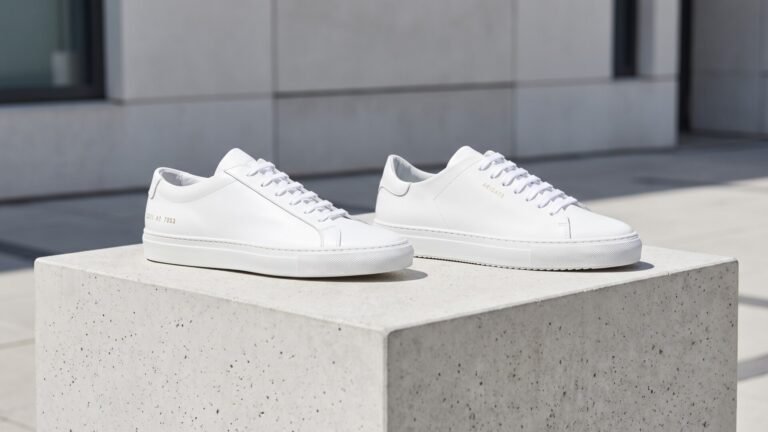
The Achilles Low can feel slightly long because of its clean, low-volume profile. It is not a padded athletic shoe. There is no thick collar, no structured heel counter bulging with foam, no chunky tongue. The upper is smooth leather over a slim rubber sole, made in Italy according to retailers such as Nordstrom and Mytheresa.
That minimal construction is why length feels more noticeable than it does in a Nike or a New Balance. On a running shoe, padding fills the gaps and holds your foot in place. On the Achilles Low, nothing fills the gaps. If there is space, you feel it.
Width is where buyers need to be honest with themselves. The shoe accommodates average-width feet fine. It is not a naturally wide sneaker. There is not much extra room across a broad forefoot, and the leather does not have the give of a knit or a mesh upper. If your little toe is already pressing against the side of most leather sneakers, this one will not be the exception.
The distinction that matters: a shoe can feel spacious without being too large. Spacious in the toe box is fine. Too large in the heel is not.
Heel hold and break-in
Heel movement is the number one reason people conclude Common Projects run large. And they are half right. The heel area is minimal, the leather starts stiff, and the shape does not clamp your ankle the way a sportier shoe does.
What happens next matters. The smooth leather gradually softens and conforms to your foot. But here is the honest part: a heel that lifts dramatically on day one is unlikely to lock down completely by month three. Some improvement, yes. A total transformation, no.
Practical signals to read:
- Mild movement when you walk is manageable and often settles.
- The heel should not lift like a flip-flop with every step.
- If you have to pull the laces uncomfortably tight to keep the heel down, the size is wrong, not the lacing.
Small fixes exist. Thinner socks, a low-profile insole, or a stick-in heel grip can all tighten things up without changing how the shoe looks. What does not work is stuffing a bulky insert into a shoe that is fundamentally a size too big. That just makes a loose shoe into a loose shoe with a lump in it.
What changes after wear
The leather gets more flexible. A shoe that feels snug across the forefoot on day one will usually feel better after a few weeks. That is real, and it is why people say to buy tight.
But length does not change. The shoe will not get shorter. Extra space in front of your toes stays extra space in front of your toes, forever.
This is the hidden mistake. Someone tries on a pair, feels the stiffness, assumes it will “break in” everywhere, and buys a size that is already loose. Six weeks later the leather has softened and the shoe is sloppier than ever. Stiff is not the same as small.
Can you stretch Common Projects?
A little, and only in one direction. If a pair is fractionally tight across the widest part of your forefoot, a few weeks of normal wear usually takes the edge off, and a two-way shoe stretcher (or a cobbler) can coax a small amount of extra width out of the leather. Keep the leather conditioned so it flexes rather than cracks, and stretch gradually.
What stretching cannot do is add length or fix a toe that is pressing against the front. It also cannot fix a heel that slips – leather only gets softer, so a loose heel tends to get looser. If you are relying on a stretcher to make a brand-new pair wearable, that is a strong signal to exchange for the next size instead.
Socks and insoles
Because the Achilles Low has so little padding, sock thickness moves the fit more than it would in a cushioned runner. Most people wear them with no-show or thin ankle socks for the clean look, and that is the sock you should try them on in. A thick athletic crew sock can take up roughly the space of a half size, which is why a pair that felt perfect in the shop can feel tight at home, or vice versa.
- No-show or thin cotton socks: the default for a close, minimalist fit. If your heel slips in these, the size is likely too big.
- Medium crew socks: fine with your normal size if you have average-width feet, but expect a snugger forefoot.
- Thick sport socks or orthotics: stay with your normal size, or go up if you are between sizes. Remove the existing footbed only if your orthotic is designed to replace it.
- Heel grips: a cheap stick-in fix for mild heel lift, not for a shoe that is a full size too long.
Model-by-Model Fit: Achilles Low vs. Mid vs. BBall vs. Retro
Most sizing threads are really about the Original Achilles Low, but people often buy a second pair in a different silhouette and assume the same number will work. Retailer notes suggest the core sneakers fit broadly alike, with a few differences in padding and shape. Here is what we could actually confirm, and where we could not.
| Model | Typical fit starting point | What we could verify |
|---|---|---|
| Original Achilles Low | True to size on the Common Projects chart; one down from your Nike/Adidas EU size | US stockists list it as true to size; Graduate Store advises one below your usual EU size |
| Original Achilles Mid / High | Same size as your Achilles Low | Graduate Store calls the Mid normally sized, though its own example still drops a size. Treat as unconfirmed |
| BBall Low / High | Same as Achilles, or one down from your other-brand EU size | Graduate Store advises one size smaller than usual |
| Retro Low | Same as Achilles; take the lower size if between | Graduate Store says it runs large and to choose the lower size if you are in between |
| Tournament | Check the retailer’s note for that colorway | No reliable model-specific fit guidance found |
| Chelsea Boot / Derby | Usually one down from your usual EU size | Graduate Store recommends a smaller size for both |
A few practical notes on the differences. The Achilles Mid and High add more leather around the ankle, so heel slip tends to be less of an issue than in the Low, which can make your normal size feel more secure. The BBall has a different, basketball-inspired shape, so it is worth trying rather than assuming. The Retro Low has a chunkier, vintage-inspired shape with a different sole, and Graduate Store specifically describes it as running large. None of this is guaranteed – Common Projects does not publish model-by-model fit notes that we could find – so if you own one model, use it as your reference and size the next one the same, then adjust after trying it on.
Should You Size Down in Common Projects?
No universal yes or no. Use the conditions below.
Size down if these apply
- You have average or narrow feet.
- You notice real space in front of your toes in your usual size.
- Your heel slips when you walk.
- You prefer a close, minimalist look and wear thin socks.
- You are between sizes and the larger one feels loose rather than comfortable.
Stay true to size if these apply
- You have a wider forefoot.
- You wear thicker socks or plan to add an insole.
- Your usual size has acceptable toe room and only minor heel movement.
- You are buying from a retailer with difficult returns and cannot assess the fit in person.
Do not size down if these apply
- Your toes touch the end of the shoe.
- The upper creases directly over your toes.
- Your forefoot already feels compressed.
- You have bunions or need extra width.
- The shoe feels narrow rather than long. A smaller size will not create width. It will create pain.
Buy this size: the smallest size that gives you clear toe clearance and a secure heel.
Avoid this size: anything that requires tight lacing to stay on, or anything where your toes are already brushing the front.
Common Projects Size Conversion and Brand Comparisons
Cross-brand conversion is where people get burned. Treat the table below as a starting reference, not gospel.
| Familiar shoe brand | How to use it as a reference | Important caution |
|---|---|---|
| Adidas Stan Smith | Useful length reference for many buyers | Different heel and upper feel |
| Nike Air Force 1 | Broad starting point only | Nike sizing varies a lot by model |
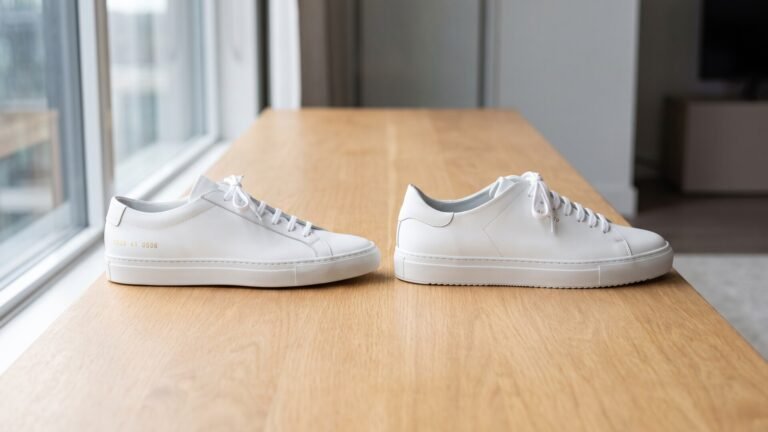
| Axel Arigato Clean 90 | Strong comparison for minimalist leather | Heel volume and toe shape can differ |
| Oliver Cabell Low 1 | Useful style and construction comparison | Do not assume identical EU sizing |
| New Balance | Weak as a direct conversion | Width options and athletic lasts change everything |
The smarter move is to ignore brand-to-brand rules and do two things. First, measure both feet – they are rarely identical – in the socks you actually plan to wear. Second, use the specific retailer’s Common Projects size chart, because US, UK, and EU labels do not line up perfectly across shops.
If you are weighing the Achilles Low against the Stan Smith, our Achilles Low vs. Stan Smith breakdown covers the fit and silhouette differences in detail. The Stan Smith is a genuinely useful length reference, but the two shoes do not share a last, and the padding around the collar is completely different. If the Air Force 1 is your other reference shoe, our Air Force 1 vs. Stan Smith comparison explains how those two everyday leather sneakers differ in bulk and padding, which helps you judge how much more snug the slimmer Achilles will feel.
How to Measure Your Feet Before Ordering Common Projects
Since you cannot rely on your size in another brand, a quick measurement is the most useful five minutes you can spend before paying for a sneaker in this price bracket.
- Measure in the evening, when your feet are at their largest, and wear the socks you plan to wear with the shoes.
- Stand on a sheet of paper against a wall, heel touching the wall, and mark the tip of your longest toe (not always the big toe).
- Measure from the wall to the mark in centimeters. Do both feet and use the longer one.
- Measure the widest part of your forefoot too. If it is broad relative to your length, read the wide-feet advice below before you pick a size.
- Compare your length with the size chart on the retailer page you are buying from. Where a chart gives foot length, trust that over the US label.
- Leave roughly a finger’s width (around 1 cm) of space in front of your longest toe when you try the shoes on. Less than that and the shoe is short; much more and you will likely get heel slip.
If you already own a pair of Common Projects, or a close cousin like the Axel Arigato Clean 90 or Oliver Cabell Low 1, the insole length of that shoe is an even better reference than your foot measurement. Pull the insole if it is removable and compare it against the retailer’s chart or your new pair.
Fit Advice for Different Foot Shapes and Use Cases
Narrow feet
You are the most likely to feel the shoe is too big. Less volume in your foot means more empty space in the shoe, especially at the heel.
Start with your usual size. If your toes still have clear room and the heel is lifting, go down one. A thin insole or a heel grip can help without changing the look. This is the one group where the size-down advice genuinely earns its reputation. If heel slip is a constant problem for you across brands, our guide to the best sneakers for narrow feet covers shoes with more lockdown at the rear.
Average-width feet
Easiest category. Your usual size is the safest bet. The choice between relaxed and close comes down to how you wear them – thin socks and cropped trousers push you toward a closer fit, thicker socks and a looser silhouette let you keep the room.
One thing to know: the minimalist design makes small fit differences visually obvious. A gap at the heel shows. Creasing shows. On a busier shoe, nobody notices. On a plain white Achilles Low, everything reads.
Wide feet
Your issue is almost certainly width, not length. Sizing down makes the width problem worse. You get toe pressure, faster creasing across the forefoot, and discomfort on any walk longer than a block.
Be honest about this early. If the Achilles Low pinches your forefoot in your usual size, the shoe is not for your foot, and no size will fix it. Look at roomier Common Projects models if you love the brand, or consider alternatives like the Oliver Cabell Low 1 or the Stan Smith, which tend to be more forgiving across the front. Our Common Projects alternatives guide covers the realistic options. Common Projects does not offer wide widths, so there is no wide version to fall back on. If you have bunions or foot pain, a podiatrist or a proper in-store fitting is a better guide than any sizing chart.
Want the more forgiving Stan Smith? See the Stan Smith – Men’s →Stan Smith – Women’s →
Travel, commuting, and all-day wear
A close fashion fit is great for standing in a photo. It is less great for hour eight of a travel day, when your feet have swollen and the shoe that felt sharp at 9am feels like a vice at 4pm.
Leave a little room for normal foot expansion. Not excess length – that causes its own problems – but enough that your toes are not jammed when your feet inevitably spread. For the broader picture on comfort over a full day, our Achilles Low review goes deeper on daily wear.
What Most Buyers Get Wrong About Common Projects Sizing
The single most common error is treating “size down” as a rule instead of a response.
People read it somewhere, apply it blindly, and end up with a shoe that is too short. The correct logic is simpler: size down when the shoe is long or loose, not because the leather feels stiff. Stiffness is a break-in issue. Length is a sizing issue. They are not the same thing, and confusing them is how people waste over $500.
The second mistake is believing leather stretches in every direction. It does not. The upper softens, molds, and becomes more comfortable across the forefoot. It does not reliably add useful width, and it absolutely does not get shorter. If the shoe is too short, it stays too short. If it is too narrow, it stays too narrow. Break-in fixes feel, not geometry.
Third is the premium-image trap. Because the shoe is expensive and the leather is firm, buyers assume a long, painful break-in is part of the deal. It is not. A shoe that needs a month of suffering to feel okay is usually the wrong size, not a rite of passage. You are allowed to expect a sneaker at this price to fit on day one.
Fourth, and this one costs real money: people obsess over a theoretical half-size difference and ignore the return policy. A retailer with free returns and a 30-day window is worth more than a perfect forum consensus. Order the size your foot actually needs, from somewhere you can send it back.
The Hidden Cost of Choosing the Wrong Size
Too large has a specific failure pattern. The heel slips, so you walk differently. The shoe creases more heavily because your foot moves inside it. Friction builds up. You end up depending on inserts to make a shoe work that never fit. And you have paid premium money for a minimalist sneaker that no longer looks minimal because it is folding in the wrong places.
Too small is worse in a different way. Toe compression limits how far you can walk. The upper creases hard right over the toes. The forefoot takes damage faster because it is under constant pressure. And leather will not solve a length problem – it will just make the too-short shoe slightly softer while it is still too short.
Then there is resale. A clean pair in a common size moves faster than a heavily creased pair that has been stretched out with bulky inserts. That is a real consideration if you rotate shoes often. But do not buy a size for resale. Buy the size that fits your foot. A shoe that fits is worth more to you than a shoe that sells.
If you are ordering online, run this check the moment the box arrives, indoors, on carpet:
- Heel hold – walk ten steps. Does the heel stay put?
- Toe clearance – is there clear space without your toes touching?
- Creasing position – flex your foot. Does it crease over the toes or behind them?
- Width pressure – any pinching at the sides?
- Condition – check the outsole and upper for wear before you commit.
Do all of that before you wear them outside. Most return policies require it.
Where to Buy and What Common Projects Cost Right Now
Price matters to sizing because an exchange on a $500-plus shoe is not something you want to do twice. In November 2026, the men’s Original Achilles Low was listed at about $565 at Nordstrom, Mr Porter, Kith and Mytheresa, and the women’s Original Achilles at about $565 at Theory. Some smaller stockists still show older stock closer to $480, and seasonal sales can go lower, so a realistic range for a full-price pair is about $480-$565. Prices change often; check the product page before you buy.
For sizing, the retailer matters almost as much as the shoe:
- Choose a store with free or cheap returns and exchanges. It lets you order two sizes if you are genuinely unsure, then return one unworn.
- Read the size chart on that specific product page. As the women’s table above shows, two reputable shops can map the same EU size to different US numbers.
- Check the fit note. Some stockists add “true to size” or “half sizes take the next size up” on the product page. That is more useful than a generic forum rule.
- Keep everything pristine until you decide. Try them indoors, keep the box and tissue, and do not wear them outside until you are sure.
If you are still deciding whether a premium minimalist sneaker is right for you at all, our minimalist white sneakers buying guide and our round-up of the best luxury sneakers for everyday wear put the Achilles Low in context with its rivals.
Which Common Projects Size Still Makes Sense in Three Years?
The best long-term fit is slightly secure, not dramatically snug. Leather relaxes. A shoe that starts tight becomes comfortable. A shoe that starts perfect can become loose.
Think about how you will actually wear them. Occasional rotation, a couple of times a week, supports a closer fashion fit. Daily commuting and regular travel want a bit more functional room, because your feet will swell and you will be walking further than you planned.
Fit also affects how long the shoe stays useful in your wardrobe. A properly fitted white Achilles Low works with denim, tailored trousers, and casual workwear for years. A pair that only looks right when you are standing still – because it slips when you walk or pinches when you move – gets relegated to the back of the closet fast.
For the bigger question of whether the brand and construction justify the price at all, our complete Common Projects brand guide covers positioning, model history, and what you are actually paying for. Sizing is the last mile. The first mile is deciding whether this is the right shoe. And if you want to see how Common Projects fits into the wider designer and sportswear landscape, start at our sneaker brands hub.
Who Should Buy the Common Projects Achilles Low?
Buy it if you want a clean, understated leather sneaker and you are willing to check the fit properly instead of guessing. Average-width and narrow-footed buyers who like a close silhouette and can buy from a retailer with a real return policy are the sweet spot.
It also suits anyone who wants one versatile sneaker for smart-casual outfits, travel, and lighter daily wear. If your priorities are minimalist styling, premium positioning, and long-term wardrobe versatility, the Achilles Low delivers.
Who Should Consider an Alternative?
Skip it if you have a wide forefoot and feel pressure even in your usual size. Skip it if you need serious cushioning, support, or a shoe for standing all day. Skip it if you want the minimalist look at a lower price and are not sure about sizing.
The Oliver Cabell Low 1 and the Adidas Stan Smith are the two most sensible places to look first. Both are covered in our best Common Projects alternatives roundup. If you are deciding between premium minimalists, our Common Projects vs. Axel Arigato and Achilles Low vs. Clean 90 pieces break down whether the Arigato offers a more forgiving fit or better value. And for a direct head-to-head on construction and sizing, see our Achilles Low vs. Oliver Cabell Low 1 comparison.
Final Verdict: Do Common Projects Run Large?
Not really – but they can feel large.
The Achilles Low fits close to true to size in length when you convert from your US size using Common Projects’ own chart (EU 42 = US 9 for men). Where it feels big is in heel volume and that low-volume, unpadded shape, which leaves more empty space than a sportier sneaker would. Narrow-footed buyers notice this most.
Start with your usual Common Projects size if your feet are average width. Go down one only when you have clear excess length or real heel movement. And if your foot is wide, do not size down to fix width – look at a different model or a different brand.
The buying rule: choose the smallest size that gives clear toe clearance without pressure, holds your heel securely, and leaves room for the socks and use case you actually have planned.
Frequently Asked Questions About Common Projects Sizing
Do Common Projects run large?
The Achilles Low is usually close to true to size when you convert from your US size with the Common Projects chart (EU 42 = US 9 for men). Its low heel volume makes some buyers prefer one size down, and anyone starting from their Nike or Adidas EU size will often end up a size large. For most people it is a feel and conversion issue more than a length issue.
What Common Projects size is a US 10?
On the men’s Common Projects chart used by US stockists such as Neiman Marcus and Mytheresa, a US 10 is an EU 43, a US 9 is an EU 42 and a US 11 is an EU 44. Always confirm against the chart on the product page you are buying from.
Do Common Projects come in half sizes?
No. Common Projects is sold in whole European sizes only. Mytheresa advises half sizes to take the next size up; if you have a narrow foot and a slim heel, the size below can work as long as your toes have clear room.
Should you size down in Common Projects Achilles Low?
Yes, if you have narrow or average-width feet with excess length or heel slip. No, if the shoe already feels tight across the toes. Sizing down is a response to looseness, not a default move.
Are Common Projects good for wide feet?
The Achilles Low is not a naturally wide sneaker. If you have a broad forefoot, prioritize width and comfort over the brand name, and do not assume sizing down will help. It usually makes things worse.
Do Common Projects stretch?
The leather softens and conforms with wear, so a snug forefoot usually improves. But do not expect the shoe to get meaningfully shorter or to solve serious width pressure. Break-in fixes feel, not fit.
How should Common Projects Achilles Low fit?
The heel should feel secure, your toes should have clear space without touching the front, and the forefoot should not feel compressed when you walk.
Do Common Projects fit like Adidas Stan Smith?
They can be a useful broad reference for length, but the upper construction, padding, and shape are different enough that the sizes should not be treated as interchangeable. Check the retailer’s chart.
Are Common Projects comfortable for walking all day?
They can handle normal daily wear, but the minimalist construction is not built for people who need pronounced cushioning or support over long distances. If you are on your feet ten hours a day, this is not your shoe.
How do women’s Common Projects sizes convert?
Woman by Common Projects is also sold in EU sizes, roughly 35 to 42. Retailers disagree slightly: END. Clothing and BDGA map EU 36 to US 6, while Theory maps EU 36 to US 5.5. Use the chart on the site you are ordering from, or go by foot length.
Do the Common Projects BBall and Retro Low fit like the Achilles?
Broadly similar, but not identical. Paris stockist Graduate Store advises going one size below your usual EU size in the BBall Low and says the Retro Low runs large. If you already own an Achilles Low that fits, that size is the best starting point for other models.
The guy at the counter eventually put the phone away and did the only thing that actually works. He tried the 42 and the 41, walked a few steps in each, and checked whether his heel stayed down and his toes had room. The 42 had a little slip. The 41 pressed his toes. He went with the 42, swapped to thinner socks, and stopped reading forums. That is the whole method. Try the size your foot asks for, not the size a thread told you to buy. The Achilles Low rewards buyers who check the fit in the real world – and punishes the ones who size down because someone on the internet said so.