Common Projects: The Complete Brand Guide
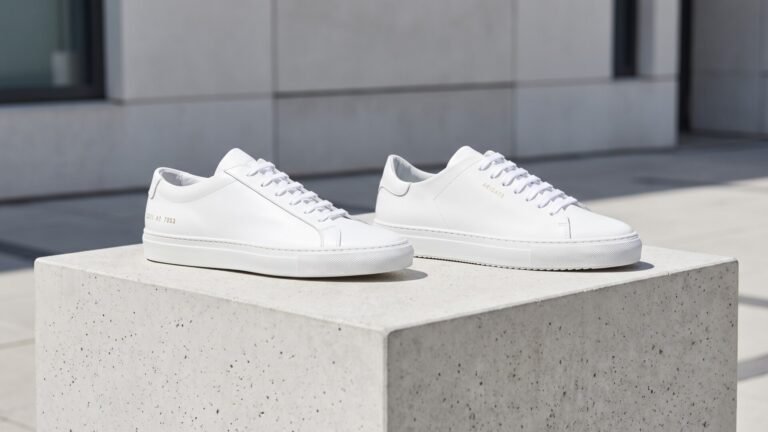
Common Projects is not a scam, but it is one of the great sleight-of-hand tricks in modern footwear. The brand took a plain leather sneaker, made it in Italy, stamped a row of gold numbers on the heel, and charged luxury money for it. And it worked. Honestly, there is no cushioning technology in an Achilles Low that justifies the price. No carbon plate, no proprietary foam, no engineered knit. What you are paying for is proportion, leather finishing, and a design language so controlled that it has stayed relevant since the brand launched in 2004 – more than two decades now.
So here is the answer up front. Common Projects is worth it if you want one polished, low-profile sneaker that moves between denim and tailoring and you will actually wear it three or four times a week. It is not worth it if you want maximum comfort, a wide fit, or the best possible white leather sneaker per dollar. Those buyers have better options, and we will name them.
This page is our hub for everything Common Projects on Street Sneakers Vault: the brand story, the full model lineup, prices, sizing, care, and where each of our deeper reviews and comparisons fits in. If you want the bigger picture first, it sits inside our wider guide to sneaker brands.
Common Projects at a Glance
| Category | Summary |
|---|---|
| Founded | 2004, by Prathan Poopat and Flavio Girolami |
| Brand identity | Italian-made minimalist footwear with a luxury-fashion position |
| Where it is made | Italy (retailer listings for the Original Achilles state Made in Italy; check the label on any specific item) |
| Best-known model | Common Projects Original Achilles Low (style number 1528) |
| Signature detail | Gold-foil numbers on the heel giving the style number, color code, and size – not a unique serial number |
| Typical price | About $480-$565 for the Original Achilles Low at full US retail; $565 at several major US retailers as of November 2026 |
| Best for | Minimalist wardrobes, smart-casual outfits, frequent everyday wear |
| Main drawback | High price relative to comfort technology and competing alternatives |
| Editor’s choice | Achilles Low for the cleanest expression of the brand |
Quick recommendations before we get into the weeds:
- Best overall: Common Projects Achilles Low – the one that built the reputation.
- Best for a more distinctive silhouette: Track 80 or another current technical or retro-inspired model, subject to season and availability. These come and go, so check what is actually in stock.
- Best for value-conscious buyers: Compare the Achilles Low with the Oliver Cabell Low 1, Axel Arigato Clean 90, and similar before you commit. We break those down below.
- Best for buyers uncertain about fit: Read our Common Projects sizing guide first. These are not cheap enough to guess on sizing.
Comparing it with the Clean 90? See the Clean 90 – Women’s →
One thing to keep in mind: Common Projects changes colors, materials, and model availability by season. Construction details and leather finishes can shift between releases too. Verify current specs and the retailer’s return policy before you order, especially on sale pairs.
What Common Projects Is Known For
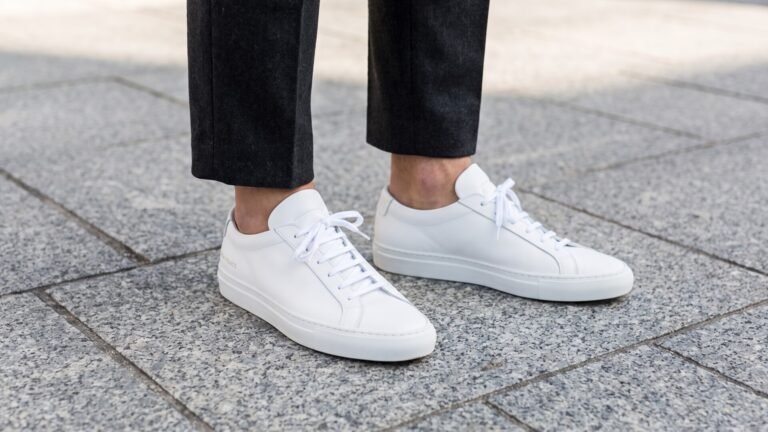
The design language is the whole point. Clean uppers. Simple paneling. Almost no visible branding except that heel stamp. The silhouette is low, slim, and controlled, and it is built to sit under a wool trouser hem as easily as it is to poke out under dark denim. That is rarer than it sounds. Most sneakers fight your outfit for attention. These do not.
The Achilles Low is the model everyone means when they say Common Projects. It is the reference point for the entire luxury minimalist sneaker category, and a lot of brands have spent fifteen years trying to copy it. Some got close on looks. Fewer got close on the leather finishing and the proportions.
Those gold numbers on the heel are worth understanding properly. They are a design signature, not a performance feature. The stamp carries style and size information, and it doubles as the brand’s most recognizable branding – which is a neat trick. Common Projects made a logo out of something that looks like a serial number, so the branding reads as industrial detail rather than a logo. That is the entire brand in one sentence.
What the numbers actually say: a four-digit style number, a four-digit color code, and the European size. On a white Original Achilles Low, for example, you will see 1528 (the Original Achilles Low style) and 0506 (white) – the same codes retailers use, such as Kith listing the white pair as CP1528-0506. Because every pair of the same model, color, and size carries the same digits, the stamp is not a unique serial number and does not prove authenticity on its own. It is still handy when shopping secondhand: if the numbers on the heel do not match the model, color, and size in the listing, ask questions.
Position-wise, Common Projects sits between traditional luxury fashion and premium contemporary footwear. It is more understated than logo-heavy designer sneakers like the ones in our Gucci sneakers guide, and more expensive than standard leather lifestyle shoes. If you want the deeper ownership assessment, our Achilles Low review covers how they actually hold up.
Common Projects History and Cultural Impact
Common Projects launched in 2004. It was founded by Prathan Poopat (sometimes credited as Peter Poopat), a former art director at V Magazine, and Flavio Girolami, a brand consultant. Kith’s brand history notes the two met in New York’s East Village in the mid-1990s, and the Achilles sneaker was their first shared project. The shoes have been produced in Italy, and retailer listings for the Original Achilles today still state Made in Italy. That Italian manufacturing connection matters. It gave the shoes a craft story that sportswear brands could not claim, and it justified a price point that would have looked absurd on a canvas sneaker.
What Common Projects really did was help popularize an idea: a sneaker could be deliberately plain, fashion-oriented, and priced like a luxury accessory. Before this, plain white leather sneakers existed. They were just cheap, or they were performance tennis shoes, or they were somewhere in between and nobody cared.
The Achilles Low rode the late-2000s and 2010s shift toward minimalist white sneakers, especially among buyers moving between streetwear, tailoring, and contemporary menswear. That crossover is the key. The same shoe worked with a hoodie and with an unstructured blazer, and that flexibility made it a wardrobe staple for a generation of guys who did not want to own ten pairs of shoes.
The cultural influence is bigger than the shoe. Common Projects made subtle branding aspirational. It proved that restraint, construction, and recognition through small details could carry a luxury price. Every minimalist leather sneaker since – and there are dozens – is working from that playbook. If you want the wider context for how designer footwear got here, our piece on the rise of luxury sneakers covers it, and our rundown of Italian sneaker brands shows where Italian manufacturing fits in.
The Common Projects Model Lineup
You will encounter a lot of seasonal noise. Here are the models that actually matter for a buying decision.
| Model | Silhouette | What sets it apart | Best for | Our coverage |
|---|---|---|---|---|
| Original Achilles Low (1528) | Low-top | The original: smooth leather upper, slim rubber cupsole, gold-foil heel stamp | Daily smart-casual wear, one-pair wardrobes | Achilles Low review |
| Achilles Mid (1529) | Mid-top | Raised, padded collar; same clean upper | Denim, relaxed trousers, cooler months | Covered below |
| Achilles High | High-top | Full high-top version of the Achilles | Streetwear and cold-weather outfits | Covered below |
| Achilles Retro Low | Low-top | Vintage-inspired take on the Achilles; details vary by season | Buyers who want the Achilles with a little more character | Covered below |
| BBall Low / BBall High | Low and high | Basketball-inspired paneling, padded collar, perforated toe box on recent pairs, often suede overlays | Buyers who find the Achilles too plain | Covered below |
| Tournament Low / High | Low and high | Court and tennis-inspired shape; the gold-foil numbers sit on the side panel | A sportier minimalist look | Covered below |
| Track 80 | Low-top runner | Vintage running-inspired, mixed suede, mesh, and leather on many versions | Retro-runner fans who want a quieter brand | Covered below |
Model names, style numbers, and materials change by season, so treat this as a map of the core families rather than a stock list. Beyond sneakers, Common Projects also makes Chelsea boots, loafers, derbies, and small leather goods, but this guide sticks to the sneakers.
Original Achilles Low
Low-profile leather upper, simple cupsole, minimal paneling, heel stamp. That is it. The Achilles Low is the most versatile Common Projects sneaker for denim, chinos, wool trousers, and casual tailoring. It is also the least trend-dependent. Retailer listings for the white pair describe a calf leather upper and lining, flat cotton laces, a slightly padded collar, and a rubber sole of about 2.5 cm.
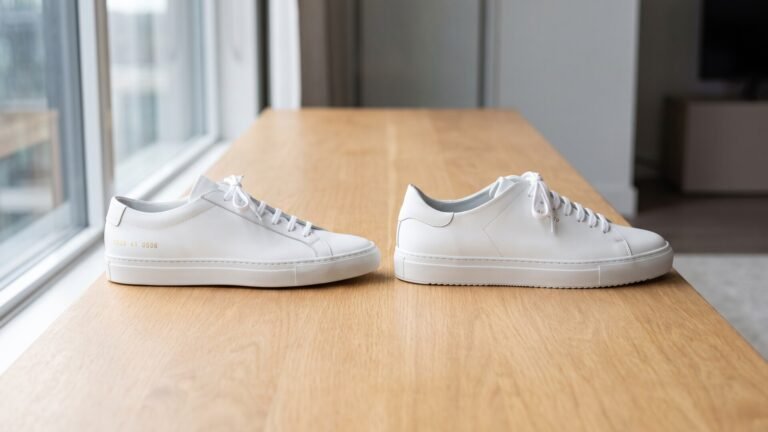
The tradeoff is real though. Its simplicity creates versatility, but it also makes scuffs, creasing, and proportion more visible. There is nowhere to hide on a plain white leather toe box. If you want the full breakdown, our full Achilles Low review goes deeper, and we have head-to-heads against the Adidas Stan Smith, the Oliver Cabell Low 1, and the Axel Arigato Clean 90.
Achilles Mid and Achilles High
The taller versions change the styling balance. The Mid adds a raised, padded collar; the High is a full high-top. They give you a more noticeable fashion silhouette, and they work better with denim, relaxed pants, and colder-weather outfits. The extra height makes them less versatile with tailored trousers, though – a high-top under a slim wool hem looks off unless you know exactly what you are doing.
Do not assume the higher versions deliver performance benefits comparable to a basketball or outdoor shoe. They do not. They are fashion silhouettes with more leather, not support systems.
BBall, Tournament, and Other Court-Inspired Models
These add more visible paneling, sport references, or a chunkier shape while keeping the restrained branding. The BBall (low and high) borrows from vintage basketball shoes, with extra panels, a padded collar, and on recent pairs a perforated toe box and suede overlays. The Tournament leans toward tennis and court shoes, and moves the gold-foil numbers to the side panel. They are for buyers who like the brand’s materials and finish but find the Achilles Low too plain.
The question worth asking: does the higher price make sense when the design is less uniquely associated with Common Projects? A court-inspired sneaker is a crowded field. You are paying Common Projects money for a shape that many brands do well. Buy it because you love the specific model, not because it says Common Projects.
Track 80, Achilles Retro, and Other Retro-Inspired Models
Here you get layered uppers, mixed materials, and more substantial soles. The Track 80 is the clearest example: a low runner inspired by vintage running shoes, usually mixing suede, mesh, and leather. The Achilles Retro Low sits closer to home, giving the Achilles shape a more vintage character. These are the brand’s more contemporary designs, and they are more trend-sensitive than the Achilles Low. That means less reliable as a long-term wardrobe purchase.
Evaluate the specific release rather than assuming every Common Projects model has the same quality or styling value. Some seasonal technical models are excellent. Some are just a trend with a heel stamp.
Seasonal and Limited Models
Colors, materials, and collaborations change constantly. Unusual suede, textile, or color-blocked versions may carry different maintenance demands – suede and rain are not friends, and textile uppers clean differently than leather.
Do not pay a premium simply because a colorway is scarce unless you already like the design and expect to wear it often. Prioritize fit, material quality, and intended use over limited-release appeal. A rare colorway you wear twice a year is a bad purchase at any price.
Design, Materials, and Build Quality
Why does a Common Projects look more expensive than a typical white sneaker? Controlled branding, clean proportions, leather finishing, tonal construction, and the absence of visual clutter. The stitching is tidy, the panels line up, and the leather has a finish that reads as polished rather than plasticky.
In ownership terms, the leather upper is the part that matters. Good leather creases in a way that looks intentional over time, and it takes conditioner and cleaning without going patchy. The lining, stitching, outsole bonding, and heel construction all affect how the shoe holds together, but the upper is what you look at every day.
Here is the key limitation, and it is the thing most reviews skip. The upper can age attractively, but creasing, toe-box marks, dirt, and heel wear are highly visible because there are few decorative elements to disguise them. A busy sneaker with panels and overlays hides a scuff. A plain white Achilles Low shows everything.
That is the contrarian point worth sitting with: the Achilles Low‘s plainness is both its strongest selling point and its biggest durability illusion. It can look refined for years, but it does not hide wear better than a more detailed sneaker. It hides wear worse.
Compared with cheaper lifestyle sneakers, the value is not that Common Projects is indestructible. It is that the design can remain useful across dress codes if maintained. That is a different claim, and an honest one.
Comfort, Fit, and Everyday Wear
The comfort profile is supportive enough for normal daily use, but this is not a walking, running, or standing-all-day performance shoe. The sole is a simple cupsole. There is no cushioning tech to speak of.
Expect a break-in period. The leather starts stiff and molds to your foot over the first couple of weeks. The low-profile shape feels different from a cushioned athletic sneaker – flatter, firmer, more connected to the ground. Some people love that. Some people’s feet do not.
Fit guidance without replacing the dedicated sizing article: check the specific model, consider your foot width and instep height, and use retailer-specific conversion charts. Common Projects has a reputation for running large, but the more accurate version is that the Achilles Low tends to feel roomy rather than measure long – we cover that in the sizing section below. Our sizing guide has the full detail.
Use cases, honestly:
- Commuting: fine for ordinary city walking. Less ideal than a cushioned walking sneaker for long distances.
- Travel: versatile and easy to style, but white leather requires maintenance and these are not the best choice for high-mileage sightseeing.
- Work: strong for smart-casual offices, provided the workplace does not require formal footwear.
- Standing all day: acceptable for some wearers, but not the safest recommendation if maximum cushioning is your priority.
If you are on your feet ten hours a day, this is probably not your shoe. That is not a knock. It is just the wrong tool. For a broader look at that trade-off, see our guide to luxury sneakers vs. performance sneakers.
Do Common Projects Run Large? Sizing in Brief
This is the question that stalls most first-time buyers, so here is the short version. Our full Common Projects sizing guide goes much deeper on foot shapes and edge cases.
- Sizes are European. Common Projects sizes its sneakers in EU sizes, and the size is part of the gold stamp on the heel. US conversions vary by retailer, so use the chart on the site you are buying from.
- Length is close to true to size. The Original Achilles Low is low-volume and has little padding, so a normal size can feel loose, especially at the heel. That roominess is why the “runs large” reputation exists.
- Some retailers suggest sizing down. A few stores advise one size down on the Achilles Low. That works best for narrow or average feet with real heel slip or clear space at the toes, and is a bad idea for wide feet.
- Other models can fit differently. The BBall, Tournament, Retro, and Track 80 do not necessarily share the Achilles fit, so check the specific model.
- Leather softens but does not shrink. Break-in eases stiffness across the forefoot. It will not fix a shoe that is too long or too narrow.
Treat all of this as a starting point. Feet vary, and leather sneakers at this price are worth trying in two sizes if a store or a free-returns retailer makes that possible.
Styling Common Projects
The Achilles Low works with slim, straight, and moderately relaxed trousers. It can look unbalanced with extremely wide or heavily stacked pants depending on the sole and outfit proportions – the low profile gets swallowed by a big hem. If wide-leg trousers are your thing, our guide to the best sneakers to wear with wide-leg trousers has better-proportioned picks.
Practical pairings that work:
- Dark denim and casual shirts or overshirts
- Chinos and knitwear
- Wool trousers and unstructured tailoring (see our ranking of luxury leather sneakers for the office)
- Neutral streetwear with restrained branding
White is the most versatile and the highest maintenance. Black is easier to live with and reads sharper in cold weather. Gray sits in between and hides light dirt better than white. Seasonal colors are fun but narrower – buy them because you love the color, not because you think they will be versatile.
The style signal is worth naming. Common Projects communicates taste through recognition among fashion-aware buyers rather than through large logos. That is part of its appeal, and it is also why non-sneaker enthusiasts may see little difference from cheaper white sneakers. You are buying a signal that only some people can read. Be honest with yourself about whether that matters to you.
What Most Buyers Get Wrong About Common Projects
This is where the money gets wasted, so pay attention.
Mistake: assuming the price guarantees superior comfort. The brand’s appeal is primarily design, finish, and positioning, not athletic cushioning. A $90 cushioned sneaker will out-comfort an Achilles Low on a long walk. That is not a flaw. It is a different product for a different job.
Mistake: treating the gold numbers as proof of quality. The stamp is a signature detail. Fit, leather behavior, construction, and maintenance determine ownership satisfaction. The numbers do not make the leather better.
Mistake: buying the whitest pair for every outfit. Off-white, gray, or black can be easier to maintain and more practical, especially if you live somewhere with weather. White is the icon. It is also the most work.
Mistake: assuming minimalist means maintenance-free. White leather exposes dirt and creasing. Cleaning supplies and careful rotation affect the cost and lifespan. Budget for a leather sneaker cleaner and a soft cleaning brush from day one, and use neutral shoe trees between wears.
How to Care for Common Projects
Because there is nothing on the upper to hide wear, care matters more on a Common Projects than on most sneakers. The good news is that the routine is simple. It is mostly about doing small things often rather than big rescues later.
Smooth leather (Original Achilles, most BBall and Tournament pairs)
- Wipe after wear. A soft dry cloth or brush removes dust before it settles into the grain and the sole edge.
- Spot clean gently. Use a cleaner made for smooth leather and a barely damp cloth. Avoid soaking the shoe, washing machines, and harsh household chemicals, which can dry out leather and loosen sole bonding.
- Condition occasionally. A neutral leather conditioner every so often helps the upper crease softly instead of cracking. Test any product on a hidden spot first, especially on white.
- Mind the heel stamp. Do not scrub the gold numbers with abrasive pads or erasers. Clean around them gently.
- Use shoe trees and rotate. Cedar or neutral shoe trees help the toe keep its shape and let the leather dry out between wears.
- Swap laces when they gray. Fresh white flat laces make a worn pair look newer for very little money.
Suede, mesh, and mixed-material pairs
Suede versions of the Achilles and many Track 80 pairs need a different approach: a suede brush and eraser for dry dirt, a protective spray before first wear, and no wet cleaning on suede panels. Let wet pairs dry naturally at room temperature, away from radiators and direct heat. Mesh panels on runners can take a gentle brush with a mild cleaner, but keep water away from neighboring suede.
Caring for a suede pair? Get a suede brush and eraser →Crep Protect spray →
For step-by-step cleaning methods on white leather, our guide to all-white sneakers that stay clean (and how to wash them) covers the basics, and our white sneaker cleaning guide walks through a similar leather routine on Adidas pairs.
Are Common Projects Worth It?
Frame this around buyer type, not a vague yes or no.
When the price makes sense
- You want one premium sneaker that moves between casual and smart-casual outfits.
- The Achilles Low will be worn frequently enough to bring the cost per wear down.
- You value understated design, Italian production, and the brand’s cultural position.
- You understand the purchase is about aesthetic consistency and wardrobe versatility, not technical performance.
When the price does not make sense
- You want maximum cushioning, wide-foot comfort, gym performance, or long-distance walking support.
- You will wear them only occasionally, because the price will create anxiety around scuffs and bad weather. A sneaker you are scared to wear is a sneaker you wasted money on.
- You mainly want a clean white leather sneaker and do not care about the Common Projects design signature.
- A lower-priced alternative offers the same fit and styling for your wardrobe.
Cost-per-wear and long-term value
Do the rough math yourself. A full-price pair at about $565 worn three times a week for two years (around 310 wears) lands near $1.80 a wear. Worn once a month for the same period, it is closer to $24 a wear. Same shoe, wildly different value. The premium only pays off with frequency.
Hidden costs add up too: cleaning products, replacement insoles if needed, shipping, return fees, and the opportunity cost of choosing a sneaker that is less comfortable for long walks. None of these are dealbreakers. They are just part of the real number.
Resale is worth a mention but not a sales pitch. Common Projects has recognizable demand, but condition, size, color, box, and current market interest influence resale more than the original retail price. Do not buy these as an investment. Buy them to wear.
For the closest brand-level comparison, see our Common Projects vs. Axel Arigato comparison and the model-level Achilles Low vs. Clean 90 breakdown.
Which Common Projects Should You Buy?
A clear decision framework:
- Buy the Achilles Low if you want the most versatile, iconic, and least trend-dependent model.
- Buy an Achilles Mid or High if you prefer a taller silhouette and regularly wear denim or relaxed trousers.
- Buy a BBall, Tournament, or other court-inspired model if you want more visual structure than the Achilles Low provides.
- Buy a Track 80 or technical model if you prefer a more substantial, contemporary sneaker and accept lower styling longevity.
- Wait or choose an alternative if you need superior walking comfort, a wider fit, lower maintenance, or better price-to-performance value.
Buy new or buy on sale
Check authorized retailers and seasonal sales, because discounts change the value calculation significantly. A pair at 30 percent off is a much easier recommendation than one at full retail. Just verify authenticity, return conditions, size availability, and product condition when shopping through resale marketplaces. And do not treat resale as guaranteed profit.
Common Projects Prices and Where to Buy
Prices have climbed over the years, so older articles quoting around $400 are out of date. Here is where things stood when we checked US retailers in November 2026:
| Model | Full-price range (USD) | Notes |
|---|---|---|
| Original Achilles Low, white leather | About $480-$565 | $565 at Kith, Revolve, and By George; some stores still list older stock at about $480 |
| Achilles in suede and premium leathers | About $515-$575 | For example, Achilles Sport in suede at $515 (Mr Porter) and Achilles Premium at $575 (Boyds); varies by leather and retailer |
| Achilles Mid / High, BBall, Tournament, Track 80 | Varies by season | Check the retailer; these move to sale more often than the white Achilles Low |
Prices change with seasons, currencies, and retailer, so check the live price before you buy. Two patterns are worth knowing. First, the white Original Achilles Low is the core product and rarely gets deep discounts. Second, seasonal colors, suede versions, and the less famous models often show up at end-of-season sales at multi-brand retailers, sometimes at around half price. If you are flexible on color or model, that is where the value is.
Where to buy: Common Projects sells through its own website and through established fashion retailers such as Kith, Mr Porter, SSENSE, END., and Revolve, plus independent menswear boutiques. Buying from an established retailer gets you a clear return policy, which matters a lot when sizing is the main risk.
On resale and secondhand platforms, ask for clear photos of the heel stamp, insole, sole, and box label, and check that the style number, color code, and size line up with the listing. That does not guarantee authenticity on its own, but mismatches are an easy red flag. Use platforms with buyer protection or authentication services where you can.
Common Projects Compared With Alternatives
| Option | Style | Comfort focus | Price/value position | Best for |
|---|---|---|---|---|
| Common Projects Achilles Low | Most minimalist and fashion-oriented | Moderate everyday comfort | Premium, weakest on specs alone | Buyers who value the original design language |
| Axel Arigato Clean 90 | More contemporary branding and detail | Moderate everyday comfort | Often easier to justify on sale | Buyers wanting a similar premium look with more visual identity |
| Oliver Cabell Low 1 | Clean and understated | Everyday casual wear | Lower entry price | Buyers prioritizing value |
| Adidas Stan Smith | Classic, recognizable sportswear style | Familiar casual comfort | Usually much lower | Buyers who want a versatile white sneaker without luxury pricing |
The short version of each. The Axel Arigato Clean 90 gives you a similar premium look with more visual identity and is often easier to justify on sale – our Achilles Low vs. Clean 90 comparison covers it properly. The Oliver Cabell Low 1 is the value play for buyers who want the look without the full price, detailed in our Achilles Low vs. Oliver Cabell comparison. The Stan Smith is the sportswear classic for anyone who wants a versatile white sneaker without luxury pricing – see our Achilles Low vs. Stan Smith comparison.
Want the white sneaker without luxury pricing? Find the Stan Smith – Men’s →Stan Smith – Women’s →
If you like the look but reject the price entirely, our roundup of the best Common Projects alternatives is exactly what you want. And if you are still weighing the two premium minimalist labels at brand level rather than model level, start with Common Projects vs. Axel Arigato.
Want to shop the wider category? Our minimalist white sneakers buying guide explains what to look for in leather, soles, and construction at any budget, the best white sneakers list covers picks for every price, and our best luxury sneakers for everyday wear puts Common Projects in context with other designer options.
Final Verdict: Who Common Projects Is For
Common Projects wins for buyers seeking a refined, low-branding sneaker that works across casual and smart-casual wardrobes. The Achilles Low is the best starting point because it carries the brand’s strongest identity and offers the broadest styling range. If you are buying one pair, that is the one.
But it is not the automatic winner for comfort, value, wide-foot accommodation, or heavy walking. If any of those are your priority, compare the alternatives before you pay for the logo, construction, and cultural cachet. The brand earns its reputation on design and finish. It does not earn it on specifications.
Frequently Asked Questions About Common Projects
Who founded Common Projects?
Common Projects was founded in 2004 by Prathan Poopat, a former art director at V Magazine, and Flavio Girolami, a brand consultant. The Achilles sneaker was their first shared project.
Are Common Projects made in Italy?
Yes. Common Projects sneakers are produced in Italy, and retailer listings for the Original Achilles state Made in Italy. As with any brand, check the label or product page for the specific item you are buying.
What do the gold numbers on Common Projects mean?
The gold-foil stamp shows the style number, the color code, and the European size. For example, 1528 is the Original Achilles Low and 0506 is white. It is not a unique serial number, so it does not prove a pair is authentic on its own.
Are Common Projects sneakers worth the money?
Worth it if you will wear them often and you specifically want the understated design. The value is strongest for frequent wearers who move between casual and smart-casual outfits. For occasional wear, the cost per wear gets ugly fast.
Why are Common Projects sneakers so expensive?
Italian manufacturing, materials, labor, design positioning, brand equity, and luxury-fashion pricing all play a part. The price is not explained by performance technology. There is no performance technology. As of November 2026, the white Original Achilles Low sells for about $480-$565 at US retailers.
How much do Common Projects cost?
The white Original Achilles Low costs about $480-$565 at full price in the US, with several major retailers at $565 as of November 2026. Suede and premium Achilles versions run roughly $515-$575, and seasonal models often turn up on sale.
Are Common Projects sneakers comfortable?
Suitable for ordinary daily wear, but not specialized walking or running shoes. Comfort depends on your foot shape, break-in expectations, and tolerance for a low-profile sole. If you need cushioning, look elsewhere.
Do Common Projects sneakers last?
They can provide years of use with sensible rotation and maintenance, but white leather, creasing, heel wear, and sole wear will determine how they age. No fixed lifespan applies; care and frequency matter more than the label.
Do Common Projects run large?
The Achilles Low is close to true to size in length but low-volume, so it can feel roomy, especially at the heel. Narrow or average feet sometimes go one size down; wide feet should not. See our Common Projects sizing guide for details.
What is the most popular Common Projects sneaker?
The Achilles Low, by a wide margin. It is the brand’s signature and most widely recognized model. Popularity does not make it ideal for every foot or wardrobe, though.
Are Common Projects good for walking all day?
Acceptable for normal city use, but not the first recommendation for long-distance walking or standing-heavy work. If that is your priority, compare cushioned walking shoes instead.
How should Common Projects sneakers be cleaned?
Gentle surface cleaning with suitable leather products. Avoid excessive water, harsh chemicals, and aggressive brushing. Use shoe trees or let pairs dry naturally, and check the care guidance for the exact material, since suede and textile versions need different treatment.
The one thing to remember before you buy: Common Projects is a design purchase, not a comfort purchase. Pay for the proportions and the leather finish if those matter to you, and buy the Achilles Low when you will wear it constantly. If you are shopping for cushioning, width, or value per dollar, put the money somewhere else and do not look back.