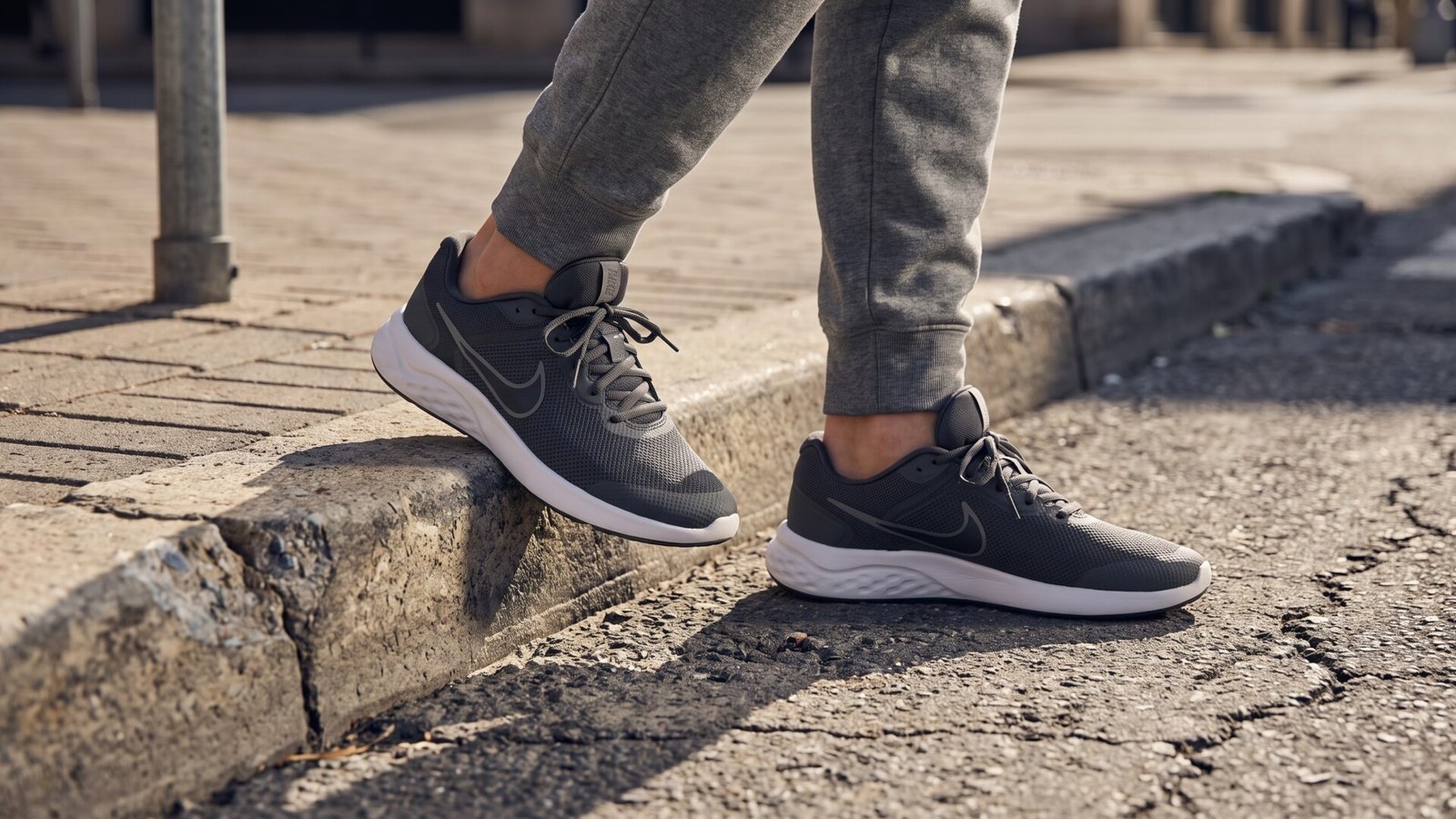
Nike Revolution 8 Review
If you are training for a half marathon, close this tab. The Nike Revolution 8 is not your shoe, and no amount of “it is a Nike running shoe” branding changes that. Real talk: this is a budget daily trainer that Nike positions at the bottom of its running lineup, and it behaves like one.
Here is the honest version. The Revolution 8 is a genuinely appealing buy for walking, errands, commuting, casual wear, and short easy runs. It is light, it looks like a running shoe, and when it is discounted it costs less than a decent dinner. That combination makes it look more versatile than it actually is. Buyers get stuck because the price and the swoosh suggest a shoe that can do everything. It cannot.
The tradeoff is simple. You get accessible pricing and easy everyday usability. You give up cushioning depth, premium materials, and long-run comfort. Buy it for casual mileage and daily errands. Look elsewhere if running comfort, standing all day, or long-term durability is the priority.
How this review was put together: it draws on Nike’s published specs, independent lab measurements and widely reported owner feedback. We have not run a multi-month wear test of our own, so treat the comfort and durability notes as informed guidance rather than personal mileage logs. Prices are US list prices in USD and sale prices vary.
At a Glance: Nike Revolution 8 Verdict
| Category | Verdict |
|---|---|
| Price | About $70 list in the US; often sold for roughly $50–$70 |
| Best for | Walking, casual wear, short easy runs, gym use |
| Comfort | Good for everyday use, less convincing on long runs |
| Fit | Reported to run slightly small with a narrow, tapered toe box; check width and toe-box preferences |
| Cushioning | Adequate for budget training, not especially plush |
| Durability | Reasonable for the price, with outsole wear depending on use |
| Value | Strong at sale prices; less compelling near full retail |
| Editor’s choice | Yes for a low-cost everyday Nike shoe, not for serious running |
Three quick calls, no hedging.
- Buy the Nike Revolution 8 if: you want an affordable, lightweight shoe for walking, commuting, errands, and the occasional short run. This is the Nike sneakers hub entry point, and it does that job well.
- Skip it if: you need maximum cushioning, a stable platform, a roomy fit, or a shoe for frequent long-distance training. The compromises show up fast under real load.
- Editor’s choice: the Revolution 8 is a value-focused everyday trainer, and the recommendation depends heavily on sale pricing. At full retail it competes with better shoes. At a discount it is one of the smarter cheap buys in the category.
Check current Nike Revolution 8 pricing and colorways: Men’s →Women’s →
Nike Revolution 8 Specs and Price
| Spec | What to know |
|---|---|
| List price | About $70 (USD) in the US |
| Weight | Around 9.3 oz (264 g) in independent lab measurements for a men’s sample |
| Heel-to-toe drop | Nike lists 10 mm; lab measurements came in slightly lower, near 9 mm |
| Midsole | A new EVA foam compound that replaced the older Phylon foam used in earlier Revolutions; testers describe it as on the firm side |
| Upper | Breathable mesh with a narrow, tapered toe box |
| Widths | Standard, with wide options in some markets and colorways |
| Versus Revolution 7 | Roughly 6% lighter in lab testing, with better grip and durability reported |
Lab figures vary slightly by size and sample, so check Nike’s listing for your size. The key takeaway is the firm, simple midsole and the narrow toe box: both explain a lot of how the shoe feels in real life.
What the Nike Revolution 8 Is Designed to Do
The Revolution line has always been Nike’s entry-level running shoe. Not a performance shoe with a budget price. A budget shoe that happens to be shaped like a running shoe. That distinction matters more than any spec sheet.
The Revolution 8 covers basic running, walking, training, and everyday use rather than specializing in any one of them. Nike builds it with a simple construction and a lightweight feel, which is exactly what makes it work for casual wear and exactly what limits it when you ask for premium comfort or advanced running performance.
The main selling point is accessibility. Familiar Nike styling, a conventional running silhouette, and a lower price than most dedicated daily trainers. For someone who wants one inexpensive pair that handles the school run, the grocery store, and a jog around the block, that is a real offer. If you are comparing Nike options by price, see our guide to the best Nike sneakers under $150.
Here is why it matters to you as a buyer. If you want one cheap pair that does a bit of everything, the Revolution 8 delivers useful versatility. If you expect the ride of a premium Nike running shoe because the box says Nike Running, you are going to be disappointed. The shoe is honest about what it is. The marketing around it is not.
Think of it as the base model. It gets you from A to B. It does not pretend to be the trim with the sport suspension.
Design, Comfort, and Ride Quality
Upper and everyday comfort
The upper is a breathable mesh with padded areas around the collar and tongue, and a practical lacing setup that locks the midfoot down without much fuss. For errands, commuting, and casual wear, that is all you need. The shoe disappears on your foot in the good way.
The compromise is structural. A lightweight upper means less bulk and less heat, but also less support for demanding movement. If you are cutting hard or moving laterally, you will feel the lack of structure. For straight-ahead walking and easy jogging, you will not.
Visually, the Revolution 8 is easy to wear. It pairs fine with joggers, jeans, shorts, and basic streetwear. What it does not have is a strong fashion identity. It is a conventional running shoe that happens to be wearable, not a statement piece. If you want a shoe that carries a fit, this is not that shoe. If you want a shoe that stays out of the way, it is.
Cushioning and walking comfort
The midsole is adequate for routine walking and short periods of standing. It is not plush. It is not highly protective. It is a budget foam doing a budget job, and that is fine for a lot of people.
The trap is assuming soft equals comfortable all day. Foam softness and all-day comfort are two different things. Prolonged standing, hard floors, body weight, and foot shape all expose the limits of a budget midsole. A shoe that feels bouncy in the store can feel flat by hour eight on a concrete floor.
If you are a frequent walker, a commuter covering several miles a day, or someone working long shifts on your feet, you are the buyer who will notice the ceiling here first. You are also the buyer who should probably be looking at a more cushioned shoe from the start. For that, start with our best budget sneakers for standing all day and best New Balance shoes for walking. The Revolution 8 will get you through a normal day. It will not carry you through a brutal one.
Running and gym performance
For short, easy runs and light training, the Revolution 8 does the job. It is best suited to exactly that. It is not built for speed work, long runs, or high-mileage plans, and pushing it there is how people end up sore and shopping again.
The ride is uncomplicated and flexible. That is the tradeoff against more responsive or protective shoes like the Nike Pegasus or the ASICS Gel-Cumulus line (check the current numbered version of each, since both are updated regularly). Those shoes cost more because they do more. The Pegasus gives you a more capable daily trainer with better long-run versatility. The Cumulus gives you a more cushioned, running-focused ride. For more ASICS options see our ASICS sneakers hub and our top ASICS sneakers for running in 2026. The Revolution 8 gives you a light, flexible shoe that handles easy miles and nothing more ambitious.
Gym users will appreciate the low weight and flexibility for general training. Just do not mistake it for a specialized lifting or cross-training shoe. It is not stable enough under heavy load for serious lifting, and it is not built for lateral work. It is a generalist that leans casual.
Fit, Sizing, and Foot Shape
Start with your usual Nike running-shoe size, but know that independent testers report the Revolution 8 runs slightly small, so if you are between sizes or like a little room, the larger size is the safer bet. Nike fit can vary between models, so check the retailer’s current fit guidance and return policy before you commit.
The toe box is where the decision gets made. It is narrow and tapered, with a fairly low toe-box height. Average and narrower feet are more likely to find the fit secure and comfortable. Wide-footed buyers should look for an available wide version or consider a naturally roomier alternative; our guides to the best running shoes for wide feet and best sneakers for wide feet are a good place to start. This is the single most common complaint about the shoe, and it is a fit problem, not a quality problem.
Watch for the usual warning signs. Toe pressure means the length or the toe box is wrong. Heel slipping means the collar and lacing are not locking you in. Forefoot numbness means the shoe is too narrow, and sizing up is not always the fix. If the shoe is narrow, a bigger size just gives you a longer narrow shoe that still squeezes your foot. That is the mistake people make over and over.
Try the shoes later in the day with normal running socks. Feet swell, and a shoe that fits at 8 a.m. can be a problem at 6 p.m. If you wear orthotics or have an unusual foot shape, confirm removable insole and volume compatibility before you buy. You do not want to find out the hard way that your insert does not fit. If you have persistent foot pain, a podiatrist is the right person to ask, not a shoe review.
| Fit issue | What it usually means | The fix |
|---|---|---|
| Toe pressure | Length or toe box too tight | Size up or switch to a roomier model |
| Heel slipping | Collar and lacing not locking | Adjust lacing or try a different model |
| Forefoot numbness | Shoe is too narrow | Look for a wide version, not a bigger size |
| Arch pressure | Insole volume mismatch | Check removable insole compatibility |
Durability and Long-Term Ownership
Nobody can give you a precise lifespan, and anyone who does is guessing. What you can count on is that the outsole, upper, foam, and heel padding will wear at different rates depending on your mileage, body weight, surfaces, rotation, and whether you are running or mostly walking.
The outsole traction in high-contact zones usually shows wear first. Then creasing in the upper, compression in the foam, and interior heel wear. The foam is the part that matters most, because a compressed midsole loses the cushioning you paid for even if the shoe still looks fine. Appearance is a terrible way to judge whether a running shoe is done. Independent lab testing found the Revolution 8’s outsole wear and toe-box and heel-padding durability to be respectable for the price, which fits the shoe’s budget-but-sturdy reputation.
The low price changes the durability math. Replacing a budget shoe is reasonable. Replacing it every few months because you are walking high mileage in it is not, and that is when a cheaper shoe stops being the cheap option. This is the hidden cost of choosing wrong, and it is the reason cost-per-wear matters more than sticker price. Our guides on whether budget sneakers are durable and the biggest mistakes people make buying cheap sneakers go deeper.
Care is simple. Rotate the Revolution 8 with another pair so the foam has time to recover. Let the shoes air out instead of leaving them in a hot car. Avoid machine washing unless the manufacturer permits it, and clean the upper gently to preserve its structure. A basic sneaker cleaning kit and a pair of shoe trees will keep them looking presentable longer than you would expect. More tips in our sneaker care and longevity guide.
What Most Buyers Get Wrong About the Nike Revolution 8
The biggest mistake is believing a Nike running label makes a shoe suitable for every kind of running. It does not. There is a real gap between occasional exercise and structured training, and the Revolution 8 lives firmly on the occasional side of that line. If you are following a training plan, this is not the tool.
The second mistake is assuming the lowest sale price is automatically the best value. It is not. A more expensive shoe can cost less per wear if it stays comfortable and useful for substantially longer. A $70 pair worn twice a week for a year beats a $45 pair that becomes uncomfortable after three months and gets replaced. The cheaper shoe was the expensive one.
The opposite mistake is just as common. People dismiss the Revolution 8 because it lacks premium materials, when for short walks, errands, travel backup use, and casual wear, simplicity is an advantage. You are not paying for technology you do not need. That is a feature, not a flaw.
Here is the decision rule. Choose the Revolution 8 when low upfront cost and general-purpose use matter most. Avoid it when cushioning, stability, fit customization, or high-mileage comfort are non-negotiable. Everything else is noise.
Real-World Use Cases
| Use case | Verdict | Reason |
|---|---|---|
| Casual daily wear | Recommended | Lightweight, familiar styling, easy to pair with casual clothing |
| Commuting | Recommended with limits | Works for moderate walking, but may feel under-cushioned for long routes |
| Short easy runs | Acceptable | Suitable for entry-level or occasional running |
| Long-distance running | Not recommended | Limited protection and comfort compared with dedicated daily trainers |
| Standing all day | Conditional | Fine for some users, but not the safest choice for long hard-floor shifts |
| Travel | Recommended as a budget option | Light and versatile, though not ideal for high-mileage sightseeing |
| Gym workouts | Recommended for general training | Flexible and light, but not specialized for every workout |
Two things this table does not capture.
First, the Revolution 8 is a genuinely good travel and backup pair even if it is not your best primary running shoe. It is light, it packs down, and it handles airport floors and city walking without asking for much. As a second pair you throw in a bag, it earns its place. For a full shortlist, see our best travel sneakers.
Second, standing work is where honesty matters most. Comfort depends on your foot shape, the surface, your socks, and your personal cushioning preference. If you work long shifts on hard floors and you already know you like substantial cushioning, do not talk yourself into the Revolution 8 because it is cheap. Prioritize a shoe designed around sustained walking and standing. Your feet will thank you by hour eight.
On styling, the Revolution 8 is functional rather than culturally significant. It is not going to become a fashion statement or a resale play. It will stay easy to wear as long as basic athletic footwear stays relevant, which is a safe bet for the foreseeable future. If style matters more to you than price, browse the Nike Dunk guide instead. Just do not buy the Revolution 8 expecting it to appreciate or turn heads.
Value, Alternatives, and Who Should Buy It
Is the Nike Revolution 8 good value?
At full retail of about $70, the Revolution 8 is a fair rather than amazing deal. At a common sale price, it becomes one of the better cheap buys in the category. The shoe’s value proposition lives and dies on the discount, so check current pricing before you decide.
Run the cost-per-wear math. A $70 pair worn twice a week for a year is better value than a $45 pair that becomes uncomfortable after a few months. A budget pair worn casually can still be the smarter purchase, because you are not asking it to do anything it cannot. The math only breaks when you ask a cheap shoe to do an expensive shoe’s job.
There is also the hidden cost of getting it wrong. Discomfort leads to buying insoles, then another pair, then a replacement sooner than expected. A [Affiliate: supportive insole] can help, but it is a patch, not a fix. If the shoe is fundamentally wrong for your feet, no insert saves it.
The conclusion is straightforward. The Revolution 8 is most compelling when discounted and used for moderate, mixed everyday wear. That is where it wins.
Alternatives worth considering
Nike Revolution 7: relevant if it is heavily discounted. The older budget model is a fine buy at a steep markdown, but independent testing found the Revolution 8 roughly 6% lighter with better grip, so if they cost the same, take the newer one.
Nike Pegasus: the pick for buyers who run more frequently and want a more capable daily trainer with better long-run versatility. You pay more, and you get more. If running is your priority, this is the upgrade that makes sense. Check Nike for the current numbered version, and see the wider Nike range in our Nike sneakers hub.
ASICS Gel-Cumulus: the pick for buyers who prioritize a more cushioned, running-focused daily trainer over Nike branding or the lowest purchase price. It is a different ride, and a better one for high-mileage comfort. Browse our ASICS sneakers hub for related models.
New Balance Fresh Foam 680: a budget running alternative, especially for buyers who prefer a softer everyday ride or need to investigate wide sizing options. If the Revolution 8’s toe box is your problem, this is worth a look. Our best New Balance sneakers under $150 guide lists other budget-friendly New Balance options.
| Shoe | Best for | Price tier | The tradeoff |
|---|---|---|---|
| Nike Revolution 8 | Budget mixed everyday use | $ | Limited cushioning and support |
| Nike Revolution 7 | Deep-discount budget buy | $ | Older model, check fit vs newer |
| Nike Pegasus | Frequent runners | $$$ | Higher price |
| ASICS Gel-Cumulus | Cushioned daily training | $$$ | Less brand familiarity for Nike loyalists |
| New Balance Fresh Foam 680 | Budget running, wide feet | $ | Softer ride, less structure |
Who should buy the Nike Revolution 8?
- Buyers seeking an affordable Nike shoe for walking, errands, travel, casual wear, and occasional short runs.
- Beginners who want a simple entry-level running shoe before committing to a more expensive training model.
- Buyers who prefer a lightweight, flexible shoe and do not require maximum cushioning or a highly structured platform.
- Shoppers purchasing during a strong sale, where the value proposition is substantially better than at full retail.
Who should skip the Nike Revolution 8?
- Runners training frequently, increasing mileage, or preparing for long races.
- People who need a wide, highly accommodating toe box or who routinely experience pressure in standard-width running shoes.
- Workers standing on hard floors for long shifts who already know they prefer substantial cushioning and support.
- Buyers willing to spend more for improved long-term running comfort, durability, or specialized fit.
Final Verdict: Should You Buy the Nike Revolution 8?
The Revolution 8 is a good buy as an affordable everyday trainer, especially at a sale price. That is the whole verdict. It is not the best choice for serious running, extended standing, or buyers who expect premium cushioning from a budget model.
The two-year question is the one that actually decides it. Used moderately and rotated with another pair, the Revolution 8 can stay useful for a long time. Used for heavy daily mileage, it will expose its compromises sooner than a more capable trainer, and you will be shopping again before you expected to.
So buy the Nike Revolution 8 for budget-conscious mixed use. Choose a Nike Pegasus, an ASICS Gel-Cumulus, or a New Balance Fresh Foam 680 when running comfort and long-term training value matter more than the lowest price.
Check current Nike Revolution 8 pricing on Amazon: Men’s →Women’s →
Frequently Asked Questions About Nike Revolution 8
Is the Nike Revolution 8 good for running?
For short, easy runs and beginners, yes. For high-mileage training, long runs, or runners who need substantial cushioning and support, no. It is an entry-level shoe, and it performs like one once you start asking for real mileage.
Is the Nike Revolution 8 good for walking?
It works well for everyday walking and errands. Frequent long-distance walkers are better served by a more cushioned walking or daily-training shoe, because the budget midsole runs out of comfort on long routes.
How much does the Nike Revolution 8 cost?
Nike lists it at about $70 in the US, and it is frequently discounted to roughly $50 to $70 at retailers.
Does the Nike Revolution 8 run true to size?
Most buyers can start with their usual Nike running-shoe size, but independent testers report it runs slightly small with a narrow toe box. Check the retailer’s return policy and size chart before you commit.
Is the Nike Revolution 8 good for wide feet?
Standard sizing may feel restrictive for some wide-footed buyers. Look for an available wide option, or choose a naturally roomier alternative like a New Balance Fresh Foam 680. Sizing up is not the fix for a narrow shoe.
Can you wear Nike Revolution 8 shoes all day?
They can work for casual all-day wear for some users. Standing on hard floors or walking long distances may require more cushioning and support than the Revolution 8 offers.
How long do Nike Revolution 8 shoes last?
There is no fixed number. Lifespan depends on mileage, surfaces, body weight, rotation, and care. Cushioning and outsole wear matter more than appearance, so judge the shoe by how it feels, not how it looks.
Is the Nike Revolution 8 better than the Nike Revolution 7?
When they are similarly priced, the newer model is the logical default: independent testing found it lighter, with better grip and durability. The Revolution 7 is worth it if it is significantly discounted and fits you better.
Do you need insoles with the Nike Revolution 8?
Not necessarily. If the shoe fits and feels fine, leave it alone. If you need more arch support or cushioning, a supportive insole can help, but it will not fix a shoe that is fundamentally the wrong size or width for your foot.
The Nike Revolution 8 wins for one specific buyer: the person who wants a cheap, light, good-looking Nike shoe for walking, errands, commuting, and the occasional easy jog, and who buys it on sale. For everyone else, the money is better spent on a shoe built for what you actually do. Keep exploring in our sneaker models guide.