Chuck 70 vs Regular Chuck Taylor
Two Converse high-tops wear the same star logo and look almost identical from across the room, yet they are built differently and cost noticeably different amounts. The Chuck 70 is the heavier, more structured, more detailed version. The Chuck Taylor All Star (the regular one most people mean when they say “Chucks”) is the lighter, cheaper original. This guide breaks down what actually separates them, so you can pick the right pair for your feet and your budget.
Short answer: buy the Chuck 70 if you want a sturdier canvas, a cushioned OrthoLite insole, and a more premium look, and you wear sneakers often enough to justify roughly $90 to $100. Buy the regular Chuck Taylor All Star if you want the classic lightweight feel at about $60 to $65, a wider range of colors, or a pair you do not mind beating up.
Chuck 70 vs Chuck Taylor All Star at a Glance
| Feature | Chuck 70 | Chuck Taylor All Star |
|---|---|---|
| Typical price (USD) | About $90 to $100 (high-top about $95 on Converse.com) | About $60 to $65 (high-top $65 on Converse.com; sale colors lower) |
| Canvas | Heavier canvas, commonly cited as 12 oz | Lighter, softer canvas |
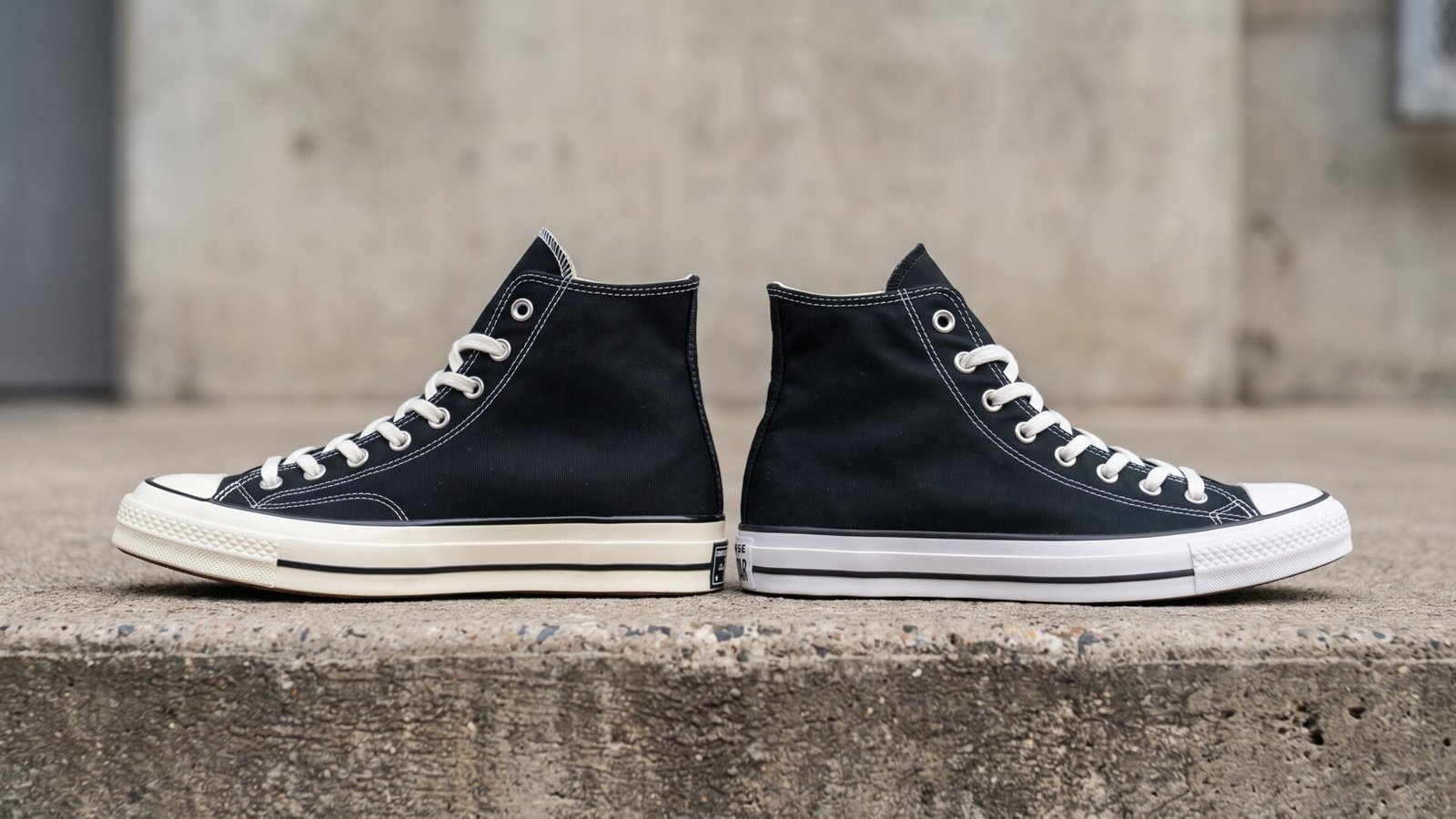
| Sole | Glossy off-white midsole, higher foxing | Matte white sole, larger toe cap |
| Insole | OrthoLite cushioning | OrthoLite cushioning on current Converse.com styles (older and some third-party pairs have flat insoles) |
| Heel patch | Leather ankle patch | Printed patch |
| Weight | Heavier (roughly 2.5 oz more per shoe, per one retailer) | Lighter |
| Sizing | Converse says: order half a size down | Converse says: order half a size down |
| Widths | Standard and Wide on the high-top | Standard and Wide on the high-top |
| Colors | Fewer, more muted | Huge range |
| Buy now | [Affiliate: Check the price on Amazon] | [Affiliate: Check the price on Amazon] |
Prices are USD and approximate; Converse and retailers discount regularly, so check the current number. The Chuck Taylor All Star dates to the 1920s, while the Chuck 70 launched in 2013 as a recreation of the shoe’s 1970s-era construction.
Design and Aesthetics
The Chuck 70 look
The Chuck 70 is designed to echo the 1970s Chuck. Several details show it:
- Canvas: A heavyweight canvas gives it a more structured shape that holds up better as it ages. Converse describes it as premium, heavyweight canvas.
- Sole: A varnished, off-white midsole and toe cap gives a vintage, slightly warm look instead of stark white. The foxing (the rubber strip around the base) sits higher, which gives the shoe a chunkier stance.
- Details: Extra stitching, thicker laces, and a leather Chuck Taylor ankle patch separate it from the standard version on close inspection.
The regular Chuck Taylor All Star look
The regular All Star is the shape most people picture: lighter canvas, a matte white sole, a larger toe cap, and a simple profile. It breaks in faster and feels lighter on foot, but it also creases and fades sooner. Its biggest advantage in design terms is range. It comes in nearly every color you can think of, which makes it the better canvas for self-expression or customizing.
Colorways and styling
The Chuck 70 tends to come in more muted, vintage-leaning tones, with premium material versions and collaborations. That makes it slightly easier to wear with chinos or a casual jacket. The regular All Star is the easy choice with jeans, shorts, and anything casual, and it is cheap enough to buy in a bright color you may only wear for a season. Both are low-key by design; see our top 10 iconic Converse sneakers for more of the lineup.
Comfort and Fit
Neither shoe is a running shoe or a walking shoe. Both are flat, vulcanized-style canvas sneakers, and neither offers modern midsole foam. The differences are in the details.
Cushioning and underfoot feel
The Chuck 70 uses an OrthoLite cushioning insole and a one-piece rubber sole, which most wearers find softer and more shock-absorbing than the older flat-insole All Star. Converse’s current product pages also list OrthoLite cushioning on the regular Chuck Taylor All Star, so the gap is smaller than it used to be, but the Chuck 70 is still the more substantial shoe underfoot, and it is also the heavier one. Retailers cite roughly 2.5 oz more per shoe. If you want light and nimble, the regular version wins; if you want a bit more cushioning and structure, the 70 does.
For long days on your feet, neither is ideal. Our top 10 most comfortable sneakers for standing all day covers better options, and the best budget sneakers for standing all day does the same at lower prices.
Sizing: both run large
Converse’s own product pages say both the Chuck 70 and the Chuck Taylor All Star run large and recommend ordering half a size down from your usual size. Customer reviews on those pages are mixed, and some reviewers say the regular All Star feels either small or big, so treat half a size down as a starting point and check the return policy. If you are between sizes or have a wider foot, stay at your usual size or look at the Wide option, which Converse offers on the high-top styles of both models.
Sizing differs for low-tops, platforms, and collaborations, so always check the exact product page. Our best sneakers for wide feet guide helps if neither fits comfortably.
Durability and Construction
The heavier canvas and higher foxing on the Chuck 70 generally mean it resists scuffs and abrasion better and keeps its shape longer. The regular All Star’s lighter canvas is more prone to creasing, fraying around the toe and eyelets, and fading, and its white sole can yellow with wear. How long either lasts depends on how often you wear it, the surfaces you walk on, and how you clean it, so avoid taking any fixed lifespan as a promise.
Care helps both. Brush off dry dirt first, clean the canvas with a soft brush and mild soap, use a gentle eraser on rubber scuffs, and always air dry away from direct heat. Our Converse All Star maintenance guide and the Sneaker Care and Longevity hub go step by step.
Cost per wear
A simple way to compare: at about $95, a Chuck 70 worn three times a week for a year (about 156 wears) works out to roughly 60 cents per wear. At about $65, a regular All Star worn the same amount comes to about 42 cents per wear, so the cheaper shoe wins on this math if it lasts the same time. The Chuck 70’s case rests on lasting longer and feeling better, not on being cheaper per wear by default. If you rotate pairs or wear them seldom, the cheaper All Star usually makes more sense.
Pricing and Value
- Chuck 70: About $90 to $100 for standard colorways (the high-top was $95 on Converse.com when we checked). Collabs and special materials go higher.
- Chuck Taylor All Star: About $60 to $65 (the black high-top was $65 on Converse.com), with limited-time colors from around $50 and frequent sales.
The roughly $30 gap pays for heavier canvas, the higher foxing and glossier midsole, extra stitching, and the leather patch. Whether that is worth it depends on how much you value the vintage look and sturdier build. Prices vary by color, style, and retailer, so check the live listing.
Use Cases and Lifestyle Fit
Who suits the Chuck 70
- Everyday and smart-casual wear: The cleaner proportions work with dark jeans, chinos, and relaxed office dress codes.
- Travel and walking days: More cushioning and structure than the old flat All Star, though still not a dedicated walking shoe.
- People who want one pair to last: The sturdier build is the main reason to pay more.
Who suits the regular Chuck Taylor All Star
- Budget buyers: The lowest-cost way into the icon.
- Concerts, festivals, and rough use: You will not worry about wrecking a $65 pair.
- Customizing and color: The color range and low price suit painting, lacing swaps, and experimenting.
- Purists: It is the original design, and many people prefer its lighter feel.
Resale and Trend Longevity
Standard colorways of either model are not resale plays. Both are mass-produced and widely available, and prices for any pair depend on condition, size, and demand. Limited collaborations (the Chuck 70 is the usual canvas for them) can trade above retail, but that is volatile and platform-dependent, so buy to wear rather than to flip. As for trends, the Chuck Taylor has been a staple for roughly a century, and neither shoe is likely to look dated soon.
Common Regrets When Choosing
The two most common sources of disappointment are predictable. Buyers who pick the Chuck 70 expecting the lightweight feel of the original sometimes find it heavier and stiffer than they wanted. Buyers who pick the regular All Star for the low price and then spend long days on hard surfaces in it find the flat sole tiring. Match the shoe to how you will actually wear it, not just to the price tag.
Other Options Worth Considering
If you like the canvas look but want a different shape, compare the Chuck Taylor with the Superga 2750 in our Superga 2750 vs Converse Chuck Taylor breakdown. For the wider Converse picture, read the Converse Chuck Taylor complete guide. If white sneakers are what you are after, our best white sneakers guide covers more styles, and the Sneaker Models hub lists every model we cover.
Final Verdict
If you will wear the shoes often and care about build and a more premium look, the Chuck 70 is the better pair at about $90 to $100. If you want the classic lightweight All Star, a huge color range, or a budget-friendly pair, the regular Chuck Taylor All Star at about $60 to $65 is still a solid pick. Both run large per Converse, so start half a size down and keep the return window in mind.
Who should buy the Chuck 70?
- You want a sturdier canvas and a more premium, vintage look.
- You want a more cushioned, structured feel than the classic flat shoe.
- You will wear them often enough to justify the higher price.
Who should buy the regular Chuck Taylor All Star?
- You are on a tighter budget.
- You prefer the lighter, original feel and a wider range of colors.
- You want a pair for rough use or customizing.
Frequently Asked Questions About Chuck 70 And Regular Chuck Taylor
What is the main difference between Chuck 70 and Regular Chuck Taylor?
The main difference is the build. The Chuck 70 uses a heavier canvas, a one-piece glossy off-white sole with higher foxing, extra stitching, and a leather ankle patch, along with OrthoLite cushioning. The regular Chuck Taylor All Star is the lighter, simpler original with a matte white sole and a printed patch.
Are Chuck 70s worth the extra money?
For many people, yes. At roughly $90 to $100 versus about $60 to $65, you get sturdier canvas, more structure, and a more premium look. If you wear sneakers occasionally or want a cheap pair for rough use, the regular All Star can be the smarter buy.
How do I know which size to buy for Chuck 70 vs Regular Chuck Taylor?
Converse product pages say both run large and recommend ordering half a size down. Reviews are mixed, so check the return policy and the exact style. If you have wider feet, consider the Wide option offered on the high-tops or stay at your usual size.
Can I wear Chuck 70s for long periods comfortably?
They are more cushioned than the traditional flat All Star, thanks to the OrthoLite insole, but they are still flat canvas sneakers. For all-day standing or long walks, a purpose-built comfort sneaker is a better choice.
What styles can I pair with each model?
The Chuck 70 works well with chinos, dark denim, and casual jackets. The regular Chuck Taylor All Star is easy with jeans, shorts, and streetwear. Both are casual sneakers, so neither replaces a dress shoe.
How do I clean and maintain my Chuck Taylor shoes?
Brush off dry dirt, then clean the canvas with a soft brush and mild soap. Use a gentle eraser on rubber scuffs and air dry away from direct heat, never in a dryer. See our Converse All Star maintenance guide at https://streetsneakersvault.com/converse-all-star-maintenance-guide/ for step-by-step tips.
When did the Chuck 70 come out?
Converse launched the Chuck 70 in 2013 as a recreation of its 1970s-era construction. The original Chuck Taylor All Star dates back to the 1920s.