Puma Tazon 6 Review
If you need an actual running shoe, close this tab. The Puma Tazon 6 is not it, and no amount of “training shoe” styling on the box changes that. Same goes if you’re on your feet ten hours a shift and need max cushioning – this is not your shoe, and we’ll point you at what is.
But here’s the thing. If you want a cheap, structured, decent-looking sneaker for jeans, errands, commuting, and the odd gym session, the Tazon 6 does a job that a lot of $120 sneakers don’t. It’s been sitting in Puma’s lineup for years for a reason: it looks like a real trainer, it costs about as much as a takeout order, and it holds up better than the price suggests.
Quick answer: buy it for casual wear and light gym use, especially on sale. Pass if you’re a runner or if you want a pillow under your foot. Wide feet? Read the sizing section first: Puma does make wide versions.
At a Glance: Puma Tazon 6 Verdict
| Category | Assessment |
|---|---|
| Typical price | Usually around $50–$80, depending on colorway and retailer |
| Comfort | Firm and supportive rather than soft |
| Best use | Casual wear, commuting, light walking, basic gym sessions |
| Fit | Generally true to size; wide-width versions exist (e.g., Tazon 6 FM Wide) |
| Weight | About 11 oz per shoe (men’s) |
| Durability | Good for the price, especially for ordinary daily wear |
| Style | Sporty, understated, easy with casual outfits |
| Main drawback | Can feel stiff and warm next to more breathable sneakers |
| Editor’s choice | Yes for budget casual use. No for running |
Three quick calls:
- Buy the Puma Tazon 6 if you want an affordable, structured sneaker for everyday wear.
- Look elsewhere if you need a highly breathable upper or soft cushioning for long walks.
- Best overall verdict: a sensible value purchase when discounted, less compelling at full retail when a newer or more comfortable alternative sits right next to it.
Check current pricing and colorways: Shop the Tazon 6 – Men’s →Women’s →
Puma Tazon 6 Specs and Features
Here’s what Puma’s own product pages list for the Tazon 6 FM, translated into plain English.
| Feature | What it is | What it does for you |
|---|---|---|
| Synthetic leather upper with perforations | Wipeable synthetic with small holes across the vamp | Easy to clean, some airflow, but warmer than mesh |
| Midfoot saddle | An overlay that wraps the middle of the foot | Locks your foot in and gives the shoe its classic trainer look |
| EVA midsole and EVA heel pod | Standard lightweight foam with an extra heel unit | Firm, stable cushioning and some shock absorption at heel strike |
| SoftFoam+ sockliner | Puma’s padded insole | Step-in softness; it’s removable if you want a supportive aftermarket insole |
| TPU shank | A plastic stabilizer under the midfoot | Keeps the shoe from twisting, which is why it feels “structured” |
| Rubber outsole | Full rubber tread | Grip on pavement and gym floors; the heel is the first wear point |
One naming tip: you’ll see “Tazon 6 FM,” “Tazon 6 Fracture FM” and wide variants. They share the same basic platform; the names mostly signal colorway and upper detailing, plus width. Always check the exact listing for materials before you buy.
What the Puma Tazon 6 Is Actually Designed For
Let’s clear this up first, because it’s where most buyers go wrong. The Tazon 6 is a sport-inspired lifestyle trainer. It’s built around a supportive, structured feel, not high-performance running tech. Some Puma regions even list it under running, and it looks the part, but “training shoe” here is a styling category more than a performance promise.
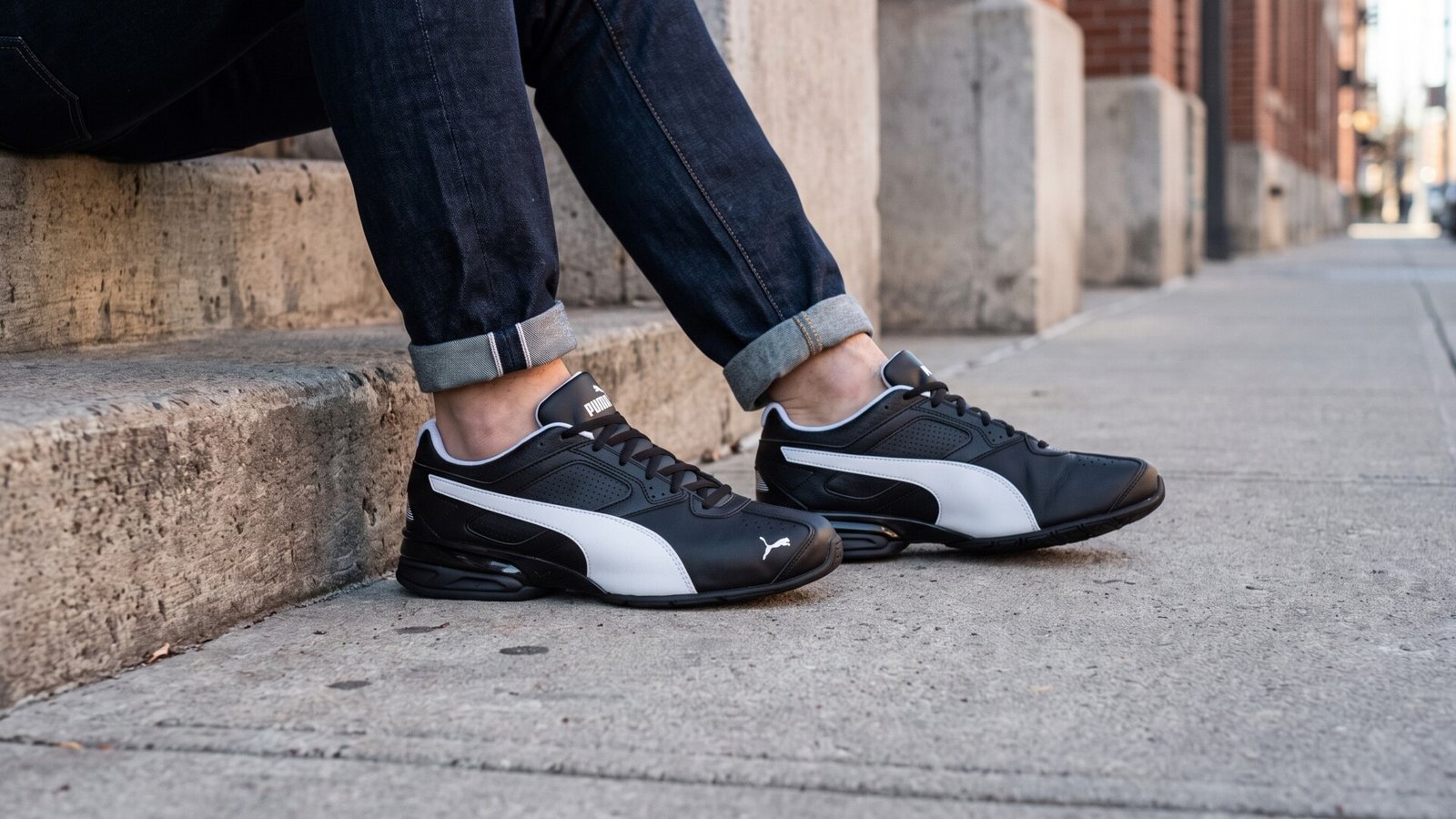
That styling matters more than people admit. The Tazon 6 looks like a traditional athletic trainer – layered upper, padded collar, chunky midsole – which makes it feel more substantial than the flat canvas and thin foam sneakers sitting at the same price. If you grew up around actual cross-trainers, this shape reads as familiar and dependable. That’s a big part of why it keeps selling.
What it is not: a running shoe, a court shoe, or a shoe for demanding workouts. It’ll handle light gym work and everyday movement fine. It should not be your daily distance runner, and it should not be your basketball shoe.
Within Puma’s range, it sits at the budget casual end. If you want softer everyday comfort, look at the Puma Softride Enzo line, and if running is a real priority, the Puma Electrify Nitro 5 (around $100 MSRP) is built for it. Both make more sense than trying to run in a Tazon 6. For the full brand picture, from the Suede to the Speedcat, see our Puma sneakers guide.
Design, Materials, and Everyday Style
The profile is classic athletic. Perforated synthetic leather upper, midfoot saddle, padded collar, substantial-looking midsole, traditional lacing. Nothing loud, nothing experimental. That’s the point.
Why it matters during ownership: this construction gives the shoe a more supportive appearance and feel than a flat canvas sneaker, and it holds its shape better over time. A cheap canvas shoe collapses and looks tired within months. The Tazon 6 keeps its silhouette longer because there’s actual structure in it.
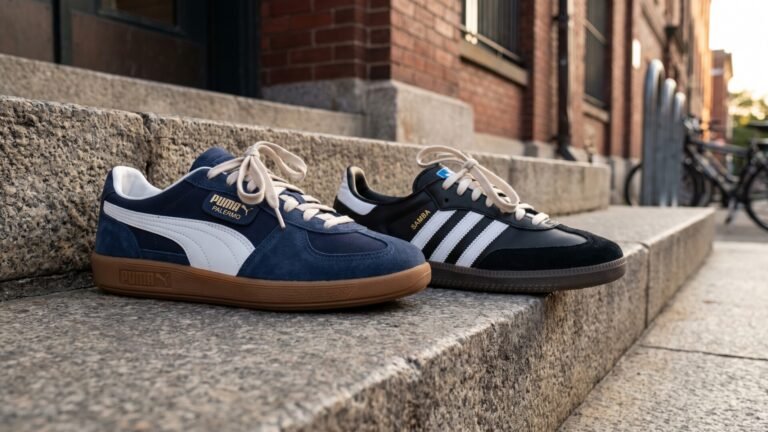
Styling-wise, it’s easy. Strongest with jeans, joggers, cargo pants, shorts, and casual athletic fits. Straight or relaxed jeans that sit on the tongue look better than skinny cuts, which make the chunky sole look even bigger. It’s less at home with minimal, slim, low-profile outfits – if your whole look is built around clean lines and a sleek silhouette, this shoe is too chunky and too busy to sit well in it. Know which lane you’re in. Want something sleeker from Puma? The Puma Palermo or Speedcat is the move.
Want something sleeker from Puma? Check out the Palermo – Men’s →Women’s →
Trend position is worth being honest about. This is not a hype sneaker. It’s not going to be the pair people ask you about. But that’s an advantage if you want a dependable everyday shoe without paying a scarcity tax or riding a trend that dies in eighteen months. The Tazon 6 will look the same in two years as it does now, and it’ll very likely still be available. There’s real value in that.
Material tradeoffs are practical. Synthetic leather is easier to wipe down and maintain than delicate real leather or suede, which is a plus for a beater-adjacent everyday shoe. The flip side: it retains heat, and it shows creasing and surface scuffing over time. Expect the toe box to crease early. That’s normal, not a defect.
Comfort and Real-World Wear
This is the section that decides it for most people, so let’s be specific about what wearing the Tazon 6 is actually like.
Cushioning and walking
The feel is firm, stable, and moderately cushioned. Not plush. Not springy. The SoftFoam+ sockliner gives a soft first step, but underneath it is a fairly firm EVA midsole. If you’re used to soft, sock-like sneakers, the Tazon 6 will feel stiff at first, and it stays fairly firm rather than breaking in to become soft.
Some wearers genuinely prefer that. A firmer platform feels more controlled for errands, commuting, and gym machines, and it doesn’t have that mushy, unstable quality cheap soft sneakers often have. Others find it tiring over long distances, because firm foam transfers more of the impact up rather than absorbing it.
The honest split: short-to-moderate daily use, fine. High-mileage walking, not ideal. At around 11 ounces, it’s not heavy for a trainer, but it’s not light either. If you’re logging several miles a day on foot, you want something lighter with more responsive cushioning. The Tazon 6 is a shoe for ordinary movement, not for walking as a hobby.
Standing and work
Here’s where we slow down, because someone working a long shift is not here for jokes.
The structured platform can feel reassuring at first. But firm does not automatically mean comfortable after eight hours. Standing all day is a different demand than walking – it’s sustained pressure with little variation, and a firm shoe with average breathability can start to wear on you by mid-shift.
If you work hospitality, retail, warehouse, or healthcare and you’re on your feet for full shifts, treat the Tazon 6 with caution. Try it indoors first if you can. And seriously consider a supportive insole – the stock sockliner is removable and basic, and a better insole changes the equation more than most people expect. Limited ventilation also gets more noticeable in warm workplaces. Note that it isn’t sold as a slip-resistant work shoe, so check your workplace’s requirements. If foot pain is a regular thing, see a podiatrist before you pick any shoe for long shifts.
For walking-first alternatives, see our New Balance 608v5 review and Skechers Go Walk 6 review.
See the Go Walk 6 – Men’s →Women’s →
Gym and casual training
For light strength training, machines, warm-ups, and general gym use, the Tazon 6 is reasonable. Stable base, TPU shank, secure upper, traditional trainer shape. It won’t embarrass you on the gym floor.
Set clear limits, though. Not the shoe for running, explosive training, long treadmill sessions, court sports, or anything where flexibility and fast transitions matter. If you’re doing real lifting or serious training, the Puma Fuse 3.0 ($120 on Puma US) is the better tool – wider last, grippy PUMAGRIP outsole, more stable under load. If running is the goal, the Puma Electrify Nitro 5 is the right lane. The Tazon 6 is the generalist you grab when you’re not sure and you’re not doing anything extreme.
Fit and Sizing: Is the Puma Tazon 6 True to Size?
Start with your usual Puma size. That’s the simplest advice and it holds for most people. But check the current retailer’s size chart anyway, because fit can shift between versions and colorways – budget models get revised quietly, and what fit last year may fit slightly differently now.
The shape is a conventional, secure athletic fit with a structured toe box and that midfoot saddle holding you in. Not a naturally roomy one. If you like a snug, held-in feel, you’ll be happy. If you like your toes to spread out, you won’t.
Wide feet, this is the part you need:
- Standard width: safest match. You’re the target foot.
- Moderately wide: look for the wide-width listings – Puma US sells versions such as the “Tazon 6 FM Wide” and “Tazon 6 Fracture FM Wide.” That’s a better fix than sizing up, which adds length rather than width.
- Very wide, bunions, or high-volume feet: even the wide version may not be enough. A shoe offered in extra-wide sizes, like the New Balance 608v5, is the safer bet.
Very wide feet? Find the 608v5 – Men’s →Women’s →
Socks change the fit more than people think. Thick athletic socks can make the upper feel tight across the top of the foot. Thin socks reduce friction but won’t create forefoot width that isn’t there. Match the sock to the fit you want.
And if you’re between sizes or you have high-volume feet, buy from a retailer with easy returns. Some sale colorways are marked final sale, so check before you check out. This is not the shoe to gamble on.
Durability, Maintenance, and the Hidden Cost of Choosing Cheap
Let’s talk about what actually wears out, because “it’s cheap” is not the same as “it’s good value.”
Likely wear points: outsole abrasion at the heel and forefoot, creasing across the toe, the sockliner compressing and flattening over time, and peeling or cracking on heavily flexed synthetic panels. None of that is unusual at this price – it’s just what happens. The outsole is the one to watch if you walk on pavement a lot.
Durability depends heavily on use. A pair rotated with another sneaker for commuting and casual wear should last considerably longer than one worn for daily running or long work shifts. Rotation is the single biggest thing you can do to extend any sneaker’s life, and it costs nothing.
Basic care goes a long way:
- Brush off dry dirt before it works into the material.
- Wipe the upper with mild soapy water and a soft cloth.
- Avoid soaking them or machine washing unless the manufacturer specifically allows it.
- Air-dry away from direct heat – radiators and dryers warp the midsole.
- Pull the sockliner out to dry separately after sweaty gym sessions.
Pick up a sneaker cleaning kit →
Now the cost-per-wear math, because this is where budget shoes get interesting. At roughly $60, wearing the Tazon 6 twice a week for a year (about 104 wears) works out to under 60 cents a wear. That’s a strong value. Pay full price, wear it for demanding daily mileage, and find the comfort doesn’t hold up – now the value looks worse, because you’re replacing it sooner than you planned.
Here’s the contrarian point, and it’s the one that matters most. The Tazon 6’s low price is not automatically a bargain if you actually need a running shoe or an all-day work shoe. Buying the wrong category doesn’t save money. It creates a second purchase. The cheapest shoe is the one you don’t have to replace because it was wrong.
If running on a budget is the real goal, our best budget tech runners under $120 and top 10 budget sneakers that outperform $200 pairs are better places to start.
What Most Buyers Get Wrong About the Puma Tazon 6
Four mistakes come up again and again. Here’s the buy-if / avoid-if framework that cuts through them.
Mistake one: treating it as a running shoe. The athletic look doesn’t make it a runner. If you plan to run regularly, this is the wrong purchase, full stop.
Mistake two: assuming a thick-looking sole means soft cushioning. It looks cushioned. It feels firm. Those two things are not the same, and buyers get burned by the gap constantly.
Mistake three: choosing it purely because it’s cheap. The hidden costs are real – poor fit, weak breathability, premature replacement. A $60 shoe that hurts is worse value than an $85 shoe that doesn’t.
Mistake four: expecting one sneaker to do everything. The Tazon 6 is a casual and light-activity trainer. It’s not a universal performance shoe. Buy it for what it is.
| If you are… | Buy the Tazon 6? | Why |
|---|---|---|
| Casual everyday wearer | Yes | Cheap, structured, looks decent |
| Commuter on foot, moderate distance | Yes | Firm support works for short trips |
| Light gym user | Yes | Stable enough for machines and basics |
| Regular runner | No | Wrong category entirely |
| Moderately wide feet | Yes, in the Wide version | Puma offers wide-width listings |
| Very wide feet | Probably not | Toe box stays conventional even in wide |
| All-day shift worker | Probably not | Firm feel and average breathability |
| Bargain hunter at full price | Maybe not | Better options sit close in price |
Puma Tazon 6 vs Practical Alternatives
| Shoe | Typical US price | Best for | Comfort character | Main advantage | Main limitation |
|---|---|---|---|---|---|
| Puma Tazon 6 | $50–$80 | Casual wear and light gym use | Firm and structured | Low price, supportive look, wide option | Not for running |
| Puma Softride Enzo | Varies by version* | Casual walking, softer everyday wear | Softer, more relaxed | More forgiving cushioning | Less traditional trainer structure |
| Puma Electrify Nitro 5 | $100 MSRP, often discounted | Entry-level running, daily training | Running-focused | Actually built for running | Costs more, overkill for casual use |
| Puma Fuse 3.0 | $120 | Strength and gym training | Stable and grounded | Better training platform, wider last | Less versatile as a casual sneaker |
| New Balance 608v5 | Varies; frequently discounted* | Walking, traditional trainer use | Supportive and stable | Comes in wide and extra-wide | Bulkier, less fashion-forward |
| Skechers Go Walk 6 | Varies* | Light walking, casual comfort | Softer and lighter | Easy everyday comfort | Less structured for gym work |
| Under Armour Charged Assert 11 | Varies* | Budget running and gym | Lighter, more flexible | A real (entry-level) running shoe | Less of a classic trainer look |
Reading the table:
- Puma Tazon 6 – the lowest-cost balanced option with a classic athletic look. Pick it when budget and structure matter most.
- Puma Softride Enzo – pick it if softness and casual walking matter more than structure.
- Puma Electrify Nitro 5 – pick it if running is a genuine priority, not an afterthought.
- Puma Fuse 3.0 – pick it for focused gym training.
- New Balance 608v5 – pick it if a traditional, stable walking and work shoe beats a streamlined streetwear look, or if you need extra-wide sizing.
- Skechers Go Walk 6 – pick it for light walking where easy comfort is the whole brief.
- Under Armour Charged Assert 11 – pick it if you want a budget shoe you can actually run in.
Browse the Charged Assert 11 – Men’s →Women’s →
Cross-shopping other budget everyday trainers? We’ve also reviewed the Nike Revolution 8, Adidas Duramo SL 2, New Balance 680v9 and ASICS Gel-Contend 10.
Check price on Amazon – Revolution 8 Men’s →Women’s →
How the Tazon 6 Fits Into the Bigger Brand Picture
Every big brand has a shoe like this: the dependable, affordable trainer that sells quietly year after year while the hype models grab the headlines. If you like the idea but want to see what else is out there, our brand guides are the quickest route:
- Puma sneakers – the full Puma story, from the Suede to the Palermo and Speedcat.
- New Balance sneakers – the go-to brand for widths and comfort-focused trainers.
- Nike sneakers and Adidas sneakers – for the biggest ranges of budget everyday shoes.
- ASICS sneakers and Saucony sneakers – if you decide you actually want running heritage.
- Reebok sneakers – for more classic cross-trainer DNA.
Or browse every label we cover on our sneaker brands hub.
Who Should Buy the Puma Tazon 6?
Real profiles, not generic praise.
- Buyers who want an affordable sneaker for jeans, joggers, errands, and commuting.
- Shoppers who prefer firm underfoot support and a structured trainer over a soft, sock-like sneaker.
- Gym users who need a basic shoe for machines, light lifting, and general exercise – not running or high-intensity work.
- Moderately wide-footed buyers who can grab the Wide version.
- Buyers willing to grab it on sale and rotate it with another pair to stretch its life.
That’s the sweet spot. If you see yourself in two or more of those, the Tazon 6 earns its place.
Who Should Skip the Puma Tazon 6?
And here’s who should walk away.
- Runners who need regular road-running performance or long treadmill sessions.
- People with very wide feet, prominent bunions, or a strong need for a roomy toe box.
- Workers who stand long shifts and need maximum cushioning, breathability or slip resistance.
- Buyers after a lightweight, minimalist, or highly flexible sneaker.
- Shoppers paying full price when a more comfortable Puma or competing walking shoe costs about the same.
Shop athletic socks built for all-day wear →
Final Verdict: Is the Puma Tazon 6 Worth Buying?
Yes – the Puma Tazon 6 is worth buying as a budget casual trainer, especially at a sale price.
Get the Tazon 6 – Men’s →Women’s →
Its strongest qualities are affordability, stable construction (EVA midsole, heel pod and TPU shank), familiar styling, a wide-width option, and enough versatility for everyday wear and light gym use. It looks like more shoe than it costs, and for a lot of people that’s the whole job.
State the limits plainly, though. The firm feel, average breathability, and non-running design keep it from being the best all-purpose performance shoe. It’s not trying to be, and it shouldn’t be sold as one.
The decision rule:
- Casual wear, commuting, moderate walking, basic gym – buy the Tazon 6.
- Softer casual cushioning – choose the Puma Softride Enzo.
- Running – choose the Puma Electrify Nitro 5.
- Serious gym training – choose the Puma Fuse 3.0.
Zoom out two years. The Tazon 6 will still look fine, because it’s a classic athletic design that isn’t tied to a trend cycle. Whether you’re still happy with it depends far less on the low upfront price and far more on whether you matched it to the right use. Buy it for what it is, and it’ll serve you well. Buy it hoping it’s something it isn’t, and you’ll be shopping again in a few months.
Frequently Asked Questions About Puma Tazon 6
Is the Puma Tazon 6 good for walking?
For casual and moderate walking, yes. The firm EVA cushioning and relatively substantial build are the catch – if you’re walking many miles every day, a lighter shoe with more responsive cushioning will treat you better.
Is the Puma Tazon 6 a running shoe?
No. It’s a sport-inspired lifestyle and light-training shoe. The athletic look is styling, not a performance promise. For regular distance running, look at the Puma Electrify Nitro 5 or another running-specific model.
Does the Puma Tazon 6 run true to size?
Most buyers can start with their usual Puma size. Check the retailer’s size chart anyway, and buy somewhere with easy returns if you’re between sizes. Some sale colorways are final sale.
Does the Puma Tazon 6 come in wide widths?
Yes. Puma US sells wide-width versions, such as the Tazon 6 FM Wide and Tazon 6 Fracture FM Wide. They are a better choice for moderately wide feet than sizing up. For very wide feet, consider a shoe offered in extra-wide sizes.
What is the Puma Tazon 6 made of?
Puma lists a synthetic leather upper with perforations, a midfoot saddle, an EVA midsole with an EVA heel pod, a SoftFoam+ sockliner, a TPU shank for stability and a rubber outsole. A men’s shoe weighs about 11 oz.
Can you wear the Puma Tazon 6 all day?
For ordinary all-day casual wear, yes. If you’re standing through long shifts, you may want softer cushioning, better ventilation, or a supportive insole to make it work.
Is the Puma Tazon 6 good for the gym?
It’s reasonable for light gym work, machines, and basic strength training. For serious lifting, explosive movement, or demanding workouts, a more specialized training shoe like the Puma Fuse 3.0 is the better pick.
How long does the Puma Tazon 6 last?
There’s no fixed lifespan. Durability varies with body weight, surface, rotation, care, and use. A pair rotated for casual wear should outlast one worn for frequent running or daily heavy-duty shifts by a wide margin.
Are Puma Tazon 6 good shoes for the price?
At roughly $50-$80, and especially on sale, yes – for casual wear and light activity. The value drops if you’re buying them for a job they weren’t built to do, like running or all-day standing.
Should I size up in the Puma Tazon 6?
Only if you’re between sizes or plan to wear thick socks. If width is the problem, choose the Wide version instead, because sizing up adds length, not width. Otherwise, your usual Puma size is the right starting point.