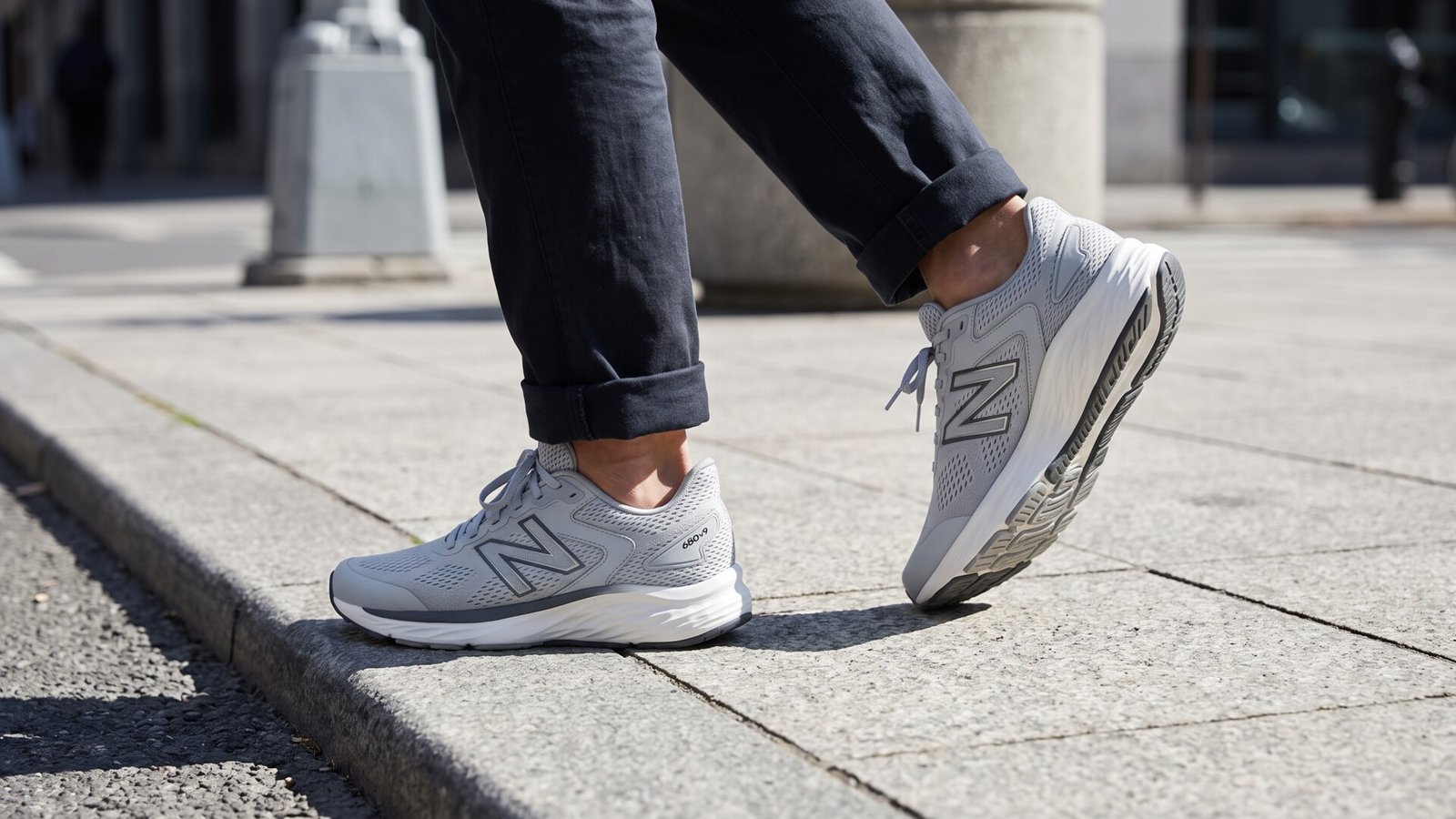
New Balance 680v9 Review
The New Balance 680v9 is a solid buy if you want one affordable athletic shoe that handles walking, commuting, errands, and the occasional jog without asking you to think about it. It is not a performance trainer, and it is not trying to be. That is the whole point.
Here is the tradeoff in one line: you get approachable cushioning, a stable ride, and genuine everyday usefulness, but you give up the refined underfoot feel and long-mileage durability of a shoe like the New Balance 880.
Quick context before the details: the 680v9 is the 2026 version of New Balance’s long-running 680 line, built on a Fresh Foam midsole with an 8 mm drop and a list price of about $85. Versions of this shoe change from year to year, so the specs below apply to the v9 only, not to older 680v7 or 680v8 pairs you may still see on clearance.
See the 680v9 – Men’s →Women’s →
So why do people hesitate? Because the name sounds like a serious running model. The 680 sits in that numerical range that suggests engineering, and buyers assume it competes with proper daily trainers. It does not. It competes with the shoes you wear to the grocery store, the airport, and the gym warmup. Once you accept that, the 680v9 makes a lot of sense.
At a Glance: New Balance 680v9 Review
| Category | Assessment |
|---|---|
| Best for | Walking, daily wear, beginner running, commuting |
| Cushioning | Comfortable for everyday use, not plush or premium |
| Fit | Approachable, but check width options before buying |
| Durability | Good for the price, with expected outsole and upper wear |
| Style | Sporty and easy, less lifestyle-focused than a retro sneaker |
| Value | Strong if you want one affordable multipurpose shoe |
| Main drawback | Feels basic for serious runners or max-cushion seekers |
| Verdict | Recommended for practical daily use and entry-level running |
That table is the short version. The rest of this review is the long version, and it matters most if you are deciding between the 680v9 and something a step up.
New Balance 680v9 Specs
| Spec | New Balance 680v9 |
|---|---|
| Category | Neutral daily running shoe (entry-to-mid tier) |
| Midsole | Fresh Foam (New Balance lists roughly 3% bio-based content) |
| Upper | Lightweight textile upper with molded engineered mesh |
| Outsole | Integrated rubber outsole with heel and forefoot rubber pads |
| Stack height | About 30 mm heel / 22 mm forefoot (brand figures) |
| Heel-to-toe drop | 8 mm |
| Weight | About 9.1–9.7 oz (259–276 g) for a men’s pair, depending on size and source; women’s around 7.3 oz (206 g) |
| Widths | Men’s: standard (D), wide (2E), extra wide (4E). Women’s: narrow, standard and wide |
| List price | About $85; sale colorways often go lower |
| Release | Early 2026 |
Width availability and price vary by colorway and retailer, so check the listing for your exact size. Weight figures differ slightly between New Balance’s own listing and independent lab measurements, which is normal for a shoe weighed in different sizes.
What changed from the 680v8
The v9 keeps the same basic recipe as the 680v8: a Fresh Foam midsole, a mesh upper and a neutral, no-frills platform. Independent lab testing by RunRepeat measured the v9 midsole as noticeably softer than the v8, with slightly less energy return. In practice that means the v9 leans a little more toward comfort than bounce. If you liked the firmer feel of an older 680, try the v9 on before assuming it will feel the same.
Quick recommendation
- Buy it if: you need one reasonably priced shoe for walking, errands, commuting, gym warmups, and occasional running.
- Choose something else if: you run high mileage, need a responsive race-day shoe, or want maximum underfoot softness.
- Editor’s choice: the New Balance 680v9 for buyers who value versatility and price over advanced running performance.
What the New Balance 680v9 Is Designed to Do
The 680v9 is an affordable everyday running shoe. Not a stability shoe. Not a speed shoe. Not a max-cushion recovery trainer. It sits near the entry end of New Balance’s running range, one step above the 520, and that positioning tells you almost everything about who should buy it.
Its job is to be comfortable enough for a short run and durable enough to wear the rest of the day. That sounds like faint praise, but it is exactly what a lot of buyers actually need. Most people shopping in this price bracket are not chasing a personal best. They want one pair of shoes that works for the gym, the walk to the train, and the weekend errands without falling apart.
That is a real use case, and it is underserved. The sneaker market is split between lifestyle shoes with no cushioning and performance shoes that cost twice as much. The 680v9 fills the gap in the middle.
Where it sits against the 880 and the 520
The New Balance Fresh Foam X 880 (currently the 880v15, around $150 at list price) is the more performance-oriented daily trainer. It has a more developed midsole, a smoother transition, and better long-term durability for people who run regularly. If you log real miles, the 880 is the smarter buy.
The New Balance 520 (currently the 520v9, typically around $70) is the lower-cost alternative, and it also uses a Fresh Foam midsole. It is cheaper, simpler, and more basic. If price is the only thing that matters, the 520 gets the job done.
The 680v9 sits between them. It is more capable than the 520 and less refined than the 880. Whether that middle position is worth it depends entirely on how you use the shoe.
See our New Balance sneakers hub for the full lineup, from running shoes like this one to lifestyle models such as the 574 and the 990v6. If you want more model-by-model reviews, the sneaker models section collects them all.
Who this shoe is really for
- Beginner runners who want a comfortable starting point without committing to a premium running shoe.
- Walkers and commuters who prefer running-shoe cushioning and breathable construction over flat casual sneakers.
- Buyers who want a practical second pair for travel, gym use, or everyday rotation.
- Anyone who wants one shoe that does several jobs reasonably well.
And who should be cautious: high-mileage runners, runners who need a specific stability solution, and anyone expecting a highly energetic or plush ride. If that is you, keep reading, but plan to spend more.
Design, Cushioning, and Ride Comfort
Cushioning and underfoot feel
The midsole is where the 680v9 lives or dies, and the honest answer is that it is balanced rather than remarkable. It cushions enough for daily walking and short runs. It does not deliver the deep, sinking softness of a premium max-cushion model, and it is not supposed to.
That moderate cushioning is actually a feature for a lot of buyers. A softer shoe can feel unstable when you are standing for long stretches or walking on uneven pavement. A moderately cushioned platform feels more controlled. You get less sink and more support underfoot, which matters more than plushness if your main activity is walking rather than running.
New Balance itself markets the 680v9 as a plush, lightweight ride, and it is softer than the previous version. Compared with a dedicated max-cushion shoe, though, the stack is modest, so think of it as soft for its price tier rather than soft overall.
Perceived comfort also depends on your body weight, your pace, your foot shape, and what you are used to. A heavier runner may find the cushioning compresses faster. A lighter runner may find it perfectly adequate. The shoe’s intended role is the useful guide here, not a universal feel.
Walking and standing comfort
Walking is one of the strongest use cases for the 680v9. The running-shoe platform gives you more cushioning and a smoother heel-to-toe roll than a flat lifestyle sneaker, and that difference shows up over a long day.
For commuting, travel days, and casual standing, it holds up well. It is not a dedicated walking shoe with a specialized footbed, so if you stand for ten-hour shifts on hard floors, you may want something with more underfoot protection. The New Balance 880 is the natural step up if the price difference is acceptable to you.
But for the person who walks the dog, takes the train, and runs a few errands, the 680v9 covers all of it without complaint.
Breathability and daily wear
The athletic upper breathes. That matters more than people expect. A breathable mesh upper keeps your feet cooler in warm weather, dries faster if you get caught in rain, and handles repeated daily wear better than a leather or synthetic lifestyle shoe.
The tradeoff is style. The 680v9 looks clearly athletic. It works with joggers, jeans, and casual shorts. It does not work with business-casual outfits or anything built around a minimalist leather sneaker. If your wardrobe leans smart, this is not the shoe for that.
Socks matter too. A moisture-wicking running sock will keep the shoe fresher and more comfortable than a cotton everyday sock, especially if you wear the same pair several days a week.
See cushioned running socks on Amazon →
Fit, Sizing, and Width Options
Is the New Balance 680v9 true to size?
Start with your usual New Balance running-shoe size. That is the safest general recommendation, and it works for most people. New Balance fits differ between its running and lifestyle lines, and our New Balance sizing guide explains how sizing compares across popular models. But fit varies by foot shape, and it can vary between versions of the same model, so treat that as a starting point rather than a guarantee.
The important distinction is length versus volume. A shoe can be long enough and still feel tight across the forefoot or over the instep. If the length feels right but the shoe pinches, the problem is volume, not size. Sizing up will not fix that cleanly.
Try the shoe later in the day if you can. Feet swell during normal activity, and a shoe that feels fine in the morning can feel tight by evening.
Who will find the fit most comfortable
Average-width feet are the safest match. If that is you, your normal size should work.
If you have wider feet, look for a wide or extra-wide version before you consider sizing up. New Balance is one of the better brands for width availability: the men’s 680v9 is listed in standard (D), wide (2E) and extra wide (4E), and the women’s version in narrow, standard and wide. Not every colorway comes in every width, so check your size. That is the right first adjustment. Our guide to running shoes for wide feet and the broader wide-feet sneaker roundup cover other options if the 680v9 still feels tight.
Sizing up to solve a width problem usually backfires. You get more room in the toe box, but you also get heel movement, and a slipping heel reduces control and causes its own set of problems. Width selection beats length inflation almost every time.
Check available widths – 680v9 Men’s →Women’s →
Fit checks before keeping the shoe
- Allow roughly a thumb’s width in front of your longest toe, without the heel slipping when you walk.
- Check for pressure at the little-toe area, the arch, the tongue, and the top of your foot.
- Test the shoe with the socks and any insole you actually plan to use.
That last one catches people out. If you swap in a supportive insole, it changes the volume of the shoe, and a fit that worked with the stock insole may not work with the new one. Decide before you commit.
Build Quality, Durability, and Ownership Costs
Materials and construction
The 680v9 is an affordable model, and the value comes from a sensible balance of upper materials, cushioning, and outsole coverage rather than luxury construction. You are not paying for premium foams or exotic uppers. You are paying for a shoe that does its job at a fair price.
When you get the shoe, inspect a few things: the stitching, the shape of the heel counter, the outsole rubber coverage, and whether the upper creases without creating a pressure point. Those are the details that separate a well-made budget shoe from a badly made one.
Durability depends on your body weight, your mileage, the surfaces you walk on, how often you rotate the shoe, and how you clean it. There is no single lifespan number that applies to everyone.
What is likely to wear first
Budget daily trainers tend to wear in predictable places:
- The outsole under the heel and forefoot, where you load the most weight.
- The upper at the flex point, where the shoe creases as you walk.
- The midsole in the most heavily loaded section, where the foam compresses over time.
Here is the thing most buyers get wrong. Visible upper wear is not always the first sign that the shoe needs replacing. Loss of cushioning, uneven wear on the outsole, and new discomfort matter more. A shoe can look fine and still be dead underfoot.
Rotating the 680v9 with another pair helps. It lets the cushioning recover between wears and reduces the daily stress on any single shoe.
Cost per wear
Think about cost per wear rather than sticker price. If you use the 680v9 several times a week and it replaces separate walking, commuting, and gym shoes, the value is strong. One shoe doing three jobs is cheaper than three shoes doing one job each.
But a cheaper shoe is not automatically better value. If it becomes uncomfortable quickly, or if it is wrong for your main activity, you will replace it sooner and spend more overall. Value is about fit and suitability, not just the number on the tag.
That is the real comparison against the New Balance 520 and the New Balance 880. The 520 is the lowest-cost option. The 880 costs more but may make more sense if you run frequently and want a shoe that lasts through real mileage.
Comparing price tiers more broadly? Our roundup of the best budget tech runners under $120 puts shoes in the 680v9’s price range side by side.
Real-World Use: Running, Walking, Travel, and Daily Wear
Running
The 680v9 works for beginner runners, shorter easy runs, treadmill sessions, and occasional jogging. If you are just starting out and you want a comfortable shoe to build a routine, it will not hold you back.
Where it struggles is high weekly mileage, long-distance training, fast workouts, and anything that needs an energetic, refined transition. Those demands belong to a more advanced daily trainer.
The bigger point: comfort and fit matter more than the model’s running label when you are choosing a first pair. A shoe that fits you well and feels good will serve you better than a technically superior shoe that does not.
Walking and commuting
Walking and commuting are the 680v9’s strongest use cases. You get decent traction, everyday cushioning, a breathable upper, and the convenience of one shoe that works across your whole day.
The style tradeoff is real, though. It looks athletic, so it pairs better with casual clothing than business-casual outfits. If your commute ends in an office with a dress code, this is a shoe for the walk, not the meeting.
Travel and everyday errands
For travel, the 680v9 is a genuinely useful pick. It is lighter and more flexible than many casual sneakers, and it can handle airport walking, sightseeing, and a hotel-gym session without complaint.
The packing value is real. One versatile pair can replace separate walking and workout shoes, which frees up space in your bag.
The downside of using one pair for everything: if it gets soaked or heavily worn during a trip, you have no backup. If you travel a lot, consider a second pair or at least a way to dry the shoe overnight.
If walking is your main use and you prefer a leather-upper trainer over a mesh runner, the New Balance 608v5 is the other affordable New Balance worth comparing. For a dedicated slip-on walking shoe from another brand, see our Skechers Go Walk 6 review.
Find the 608v5 – Men’s →Women’s →
What Most Buyers Get Wrong About the New Balance 680v9
The biggest mistake is assuming a running shoe has to feel extremely soft to be comfortable. It does not. Moderate cushioning can give you a more controlled experience for walking and daily wear, and control matters more than plushness when you are on your feet for hours.
The second mistake is assuming the cheapest New Balance running shoe is the best value. It is not always. A modest step up in price can be worth it if the shoe fits you better or lasts longer for how you actually use it.
The third mistake is trying to fix a width problem by sizing up. If the shoe is available in a wide or extra-wide version, that is the correct adjustment. Going up a size trades one problem for another.
The fourth mistake is judging the 680v9 against premium running shoes. It is a daily trainer at a budget price. Compared against its actual peers, it holds up well. Compared against a shoe that costs twice as much, of course it falls short.
New Balance 680v9 vs Alternatives
| Shoe | Typical price (USD) | Best for | Comfort profile | Main advantage | Main limitation |
|---|---|---|---|---|---|
| New Balance 680v9 | About $85 | Everyday running, walking, commuting | Balanced and practical | Strong versatility for the price | Less advanced than premium trainers |
| New Balance 520v9 | About $70 | Lowest-cost casual running and walking | Basic, straightforward | Usually the budget-first choice | Feels less refined for frequent running |
| New Balance 880v15 | About $150 list, often discounted | Frequent running, higher mileage | More developed daily-training comfort | Better long-term running platform | Higher price |
| New Balance 1080v15 | About $170 | Maximum comfort, softer cushioning | Plush and premium | Great for comfort-focused runners | More expensive, less budget-friendly |
| New Balance 574 | About $80–$110 | Lifestyle wear and casual outfits | Firmer, more casual | Better retro styling | Not suited to sustained walking or running |
Prices above are list or typical retail figures checked in November 2026 and change often with sales and colorways.
When the New Balance 680v9 is the better buy
Choose it over the New Balance 520 when you want a more capable everyday shoe and the price gap is reasonable. The 520 is fine, but the 680v9 gives you more shoe for not much more money.
Choose it over the New Balance 574 when walking comfort and athletic function matter more than retro styling. The 574 is a great lifestyle shoe, but it is not built for sustained walking or running.
Check out the 574 – Men’s →Women’s →
Choose it over the New Balance 880 or 1080v15 when you run occasionally and want to keep spending under control. If running is a small part of your week, the extra money is hard to justify.
When to spend more
Move to the New Balance 880 if you run regularly and expect to accumulate substantial mileage. It is the more polished daily trainer and it will hold up better over time.
Consider the New Balance 1080v15 (around $170 at list price) if you prioritize plush cushioning and are comfortable paying a premium for it. It is the comfort-first choice in this lineup.
The key is that spending more should be justified by frequency and need, not by the assumption that every runner needs the most expensive model. Most casual users do not.
Budget alternatives from other brands
The 680v9’s real competition is not only inside New Balance. If you are shopping the same budget daily-trainer tier, these are the shoes most buyers cross-shop:
- Nike Revolution 8: Nike’s entry-level runner, lighter on tech and usually cheaper. Read our Nike Revolution 8 review.
- ASICS Gel-Contend 10: a simple, durable ASICS option that leans toward walking and casual wear. See the Gel-Contend 10 review.
- Adidas Duramo SL 2: a lightweight Adidas budget runner with a sportier look. Our Duramo SL 2 review covers the fit.
- Under Armour Charged Assert 11: another popular entry-level trainer for gym and short runs. See the Charged Assert 11 review.
Check price on Amazon – Gel-Contend 10 Men’s →Women’s →
The 680v9’s main edge over most of these is width choice: few budget runners from other brands come in 2E and 4E as standard options.
For the full spread of New Balance models and how they compare on cushioning, price and style, the New Balance hub is the best place to continue.
How to Style the New Balance 680v9
The 680v9 is a running shoe first, so style it like one rather than forcing it into smart outfits.
- Joggers and tapered sweatpants: the easiest match. A cuffed or tapered hem shows the shoe and keeps the athletic look intentional.
- Straight-leg jeans: works best with darker washes and a hem that sits just at the top of the shoe. Very wide or long denim tends to swallow a slim running silhouette.
- Shorts: pair with low or quarter-length athletic socks in white, grey or black for a clean warm-weather look.
- Colorways: all-black or grey-and-white versions are the most versatile for commuting and travel; brighter colorways read more gym-ready.
If you want a New Balance that looks at home with chinos or casual tailoring, a lifestyle model is the better pick. The 327 and 574 suit retro-casual outfits, the 2002R and 1906R cover the tech-runner look, and the 9060 is the chunkier statement option. For a more premium retro runner, look at the 993 or the New Balance 1000.
Who Should Buy the New Balance 680v9?
- Budget-conscious runners starting a running routine.
- Walkers and commuters who want more support than a flat casual sneaker.
- Travelers looking for one athletic shoe that handles several daily activities.
- Buyers who prefer a stable, uncomplicated ride over aggressive speed or specialized tech.
- Shoppers who can get the correct width and whose main use is walking, casual running, or everyday wear.
If you see yourself in that list, the 680v9 is a straightforward recommendation.
Who Should Skip It?
- Runners training frequently or preparing for long-distance events.
- Buyers seeking maximum softness, bounce, or a premium underfoot experience.
- People who need a formal-looking shoe for office wear.
- Shoppers with a pronounced fit issue that the available widths cannot solve.
- Anyone expecting one shoe to replace a dedicated running shoe, walking shoe, and performance trainer indefinitely.
No single shoe does everything. The 680v9 does a lot of things well for the price, but it is not a specialist, and pretending otherwise sets you up for disappointment.
Final Verdict: Is the New Balance 680v9 Worth It?
For practical daily use, walking, commuting, beginner running, and occasional workouts, yes. The New Balance 680v9 is worth buying. It balances price, comfort, versatility, and approachable fit better than many overly specialized or purely lifestyle alternatives, and it does it without asking you to overthink the purchase.
The qualification is simple: it is a value-oriented daily trainer, not the best choice for serious mileage or buyers who want premium cushioning. Judge it by that role and it delivers.
The decision framework:
- Buy the New Balance 680v9 for one affordable, versatile athletic shoe.
- Buy the New Balance 520v9 if the lowest reasonable price matters most.
- Buy the New Balance 880v15 if running is a regular, high-mileage activity.
- Buy the New Balance 1080v15 if maximum cushioning matters more than budget.
Check the current price and available widths before you buy. Width availability is the one thing that most often decides whether this shoe works for you.
The 680v9 is a good shoe, and the caveat is this: it is only a good shoe for you if your life actually looks like the use cases above. If you run four times a week, or you need a shoe that looks at home in an office, or you have a foot issue that needs real support rather than a wider toe box, this is the wrong purchase and the extra money for an 880 or a dedicated walking shoe is money well spent. But if you want one affordable pair that handles the walk, the commute, the errands, and the occasional jog without drama, stop researching and buy it. Just get the width right first.
Check the 680v9 on Amazon – Men’s →Women’s →
Frequently Asked Questions About New Balance 680v9
Is the New Balance 680v9 good for walking?
Yes, for most everyday walking. The running-shoe construction handles extended movement better than a flat casual sneaker, and the Fresh Foam midsole adds cushioning for long days on your feet. If you have ongoing foot pain or a specific foot condition, check with a podiatrist before choosing a shoe.
Is the New Balance 680v9 good for running?
It is best for beginner running, shorter easy runs, treadmill sessions, and occasional jogging. It does not offer the refinement, cushioning, or durability that frequent high-mileage runners expect from a more advanced daily trainer. For a first running shoe, it is a sensible starting point.
Does the New Balance 680v9 run true to size?
Start with your usual New Balance running-shoe size. Width and foot shape can change the fit, so check the retailer’s current size chart and return policy before committing. If you can, try the shoe later in the day when your feet are at their largest.
Is the New Balance 680v9 good for wide feet?
Look for an available wide or extra-wide version rather than automatically sizing up. Check forefoot pressure and heel security before keeping the shoe. If the heel slips, the shoe is too long, and going wider is the better fix than going longer. The men’s 680v9 is listed in D, 2E and 4E widths, and the women’s in narrow, standard and wide.
How does the New Balance 680v9 compare with the New Balance 520?
The 680v9 is the more versatile step-up option. The 520v9 (typically around $70) is mainly attractive when minimizing cost is the priority, and it also uses Fresh Foam. The best choice depends on how often you run, how the shoe fits, and what the current sale pricing looks like.
How does the New Balance 680v9 compare with the New Balance 880?
The 880 (currently the 880v15, around $150 at list price) is the stronger option for regular runners and higher mileage. The 680v9 is the better value for occasional running, walking, commuting, and general daily wear. If running is a small part of your week, the 680v9 makes more sense.
How much does the New Balance 680v9 cost?
The list price is about $85 in the US. Sale colorways are often cheaper, and prices vary by retailer, size and width.
What is the difference between the 680v8 and the 680v9?
Both use a Fresh Foam midsole and a mesh upper. Independent lab testing found the v9 midsole softer than the v8, with slightly less energy return, so the v9 feels a bit more comfort-oriented. Specs such as weight and stack can differ between versions, so check the version when buying on clearance.
Is the New Balance 680v9 a stability shoe?
No. It is a neutral running shoe without dedicated stability features. If you want a stability option from New Balance, the 860 line is the brand’s stability daily trainer.
Can the New Balance 680v9 be worn all day?
It can work for many all-day situations, especially walking and commuting. Comfort depends on fit, foot shape, activity level, and your personal cushioning preference. If you stand for long shifts, compare it with a more specialized cushioned walking option before you commit.